Alexander Grothendieck
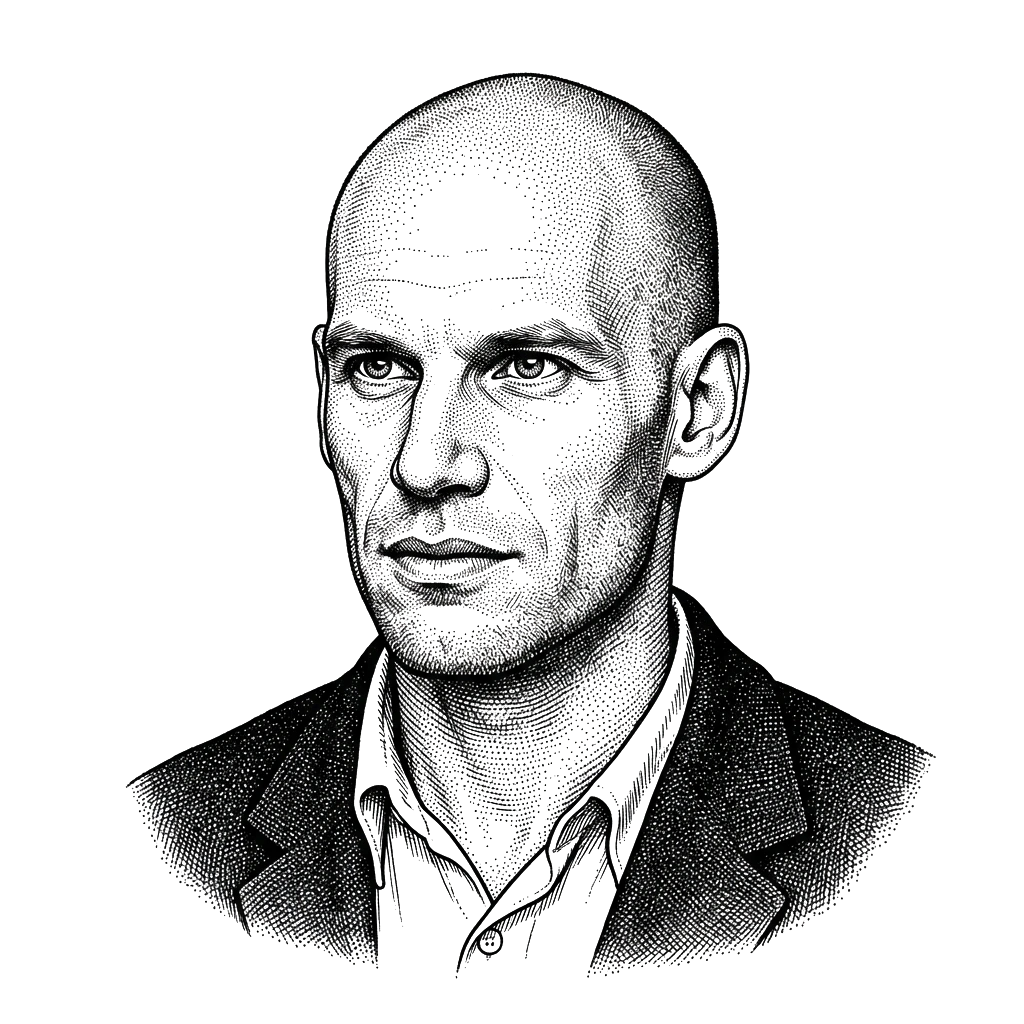
In the forested solitude of the Ariège Pyrenees, in the hamlet of Lasserre, an old man with a shaved head and coarse sandals lived for over two decades as a ghost. He cultivated a garden of organic vegetables, baked whole-wheat bread, refused visits from former colleagues and journalists, and burned hundreds of pages of mathematical calculations in the hearth. When the Royal Swedish Academy of Sciences awarded him the Crafoord Prize in 1988, along with a purse of several hundred thousand dollars, he returned the citation with a scathing public letter: his pension was more than enough, and accepting honors from an academic establishment corrupted by military-industrial funding and hollow careerism would violate his conscience. Alexander Grothendieck had walked away from the mathematical world he had conquered, but the intellectual universe he left behind had been rebuilt down to its bedrock.
Born in Berlin in 1928 to anarchist revolutionary parents—his father, Sascha Schapiro, was a Hasidic-born Russian anarchist murdered in Auschwitz; his mother, Hanka Grothendieck, a German writer—Alexander endured a childhood fractured by Nazism, French internment camps, and stateless exile. In the camp of Rieucros and the refugee haven of Le Chambon-sur-Lignon, the boy taught himself mathematics, discovering on his own how to calculate the circumference of a circle without formal textbooks. When he arrived at the University of Nancy in 1949, the grand masters of French functional analysis, Laurent Schwartz and Jean Dieudonné, handed the unknown youth a list of fourteen unsolved problems in the theory of topological vector spaces, expecting him to choose one for his doctorate. Within eighteen months, Grothendieck returned with complete, brilliant solutions to all fourteen.
Yet functional analysis was merely a prelude. In the late 1950s, at the newly founded Institut des Hautes Études Scientifiques (IHÉS) in Bures-sur-Yvette, Grothendieck unleashed the greatest revolution in algebraic geometry since René Descartes. Before Grothendieck, algebraic geometry studied the geometric zero-sets of polynomial equations over specific fields like the real or complex numbers. Grothendieck recognized that this framework was too narrow, constrained by classical geometric prejudices. He demolished the classical definition of a variety and replaced it with the concept of a scheme.
A scheme allowed geometric tools—tangent spaces, dimension, fibrations—to be applied not merely to smooth continuous spaces, but to the discrete, arithmetic world of prime numbers and arbitrary commutative rings. For Grothendieck, there was no longer any ontological wall between geometry and number theory; they were two dialects of a single, deeper reality. To formalize this vision, he and Dieudonné produced the Éléments de Géométrie Algébrique (ÉGA) and the Séminaire de Géométrie Algébrique (SGA)—tens of thousands of pages of foundational mathematics that became the architectural code of late-twentieth-century mathematics.
Grothendieck’s method was legendary: the philosophy of the "Rising Sea." Where other mathematical geniuses—the "hammer-and-chisel" problem solvers—approached a difficult mathematical conjecture like a hard nut to be cracked with ingenious, specialized blows, Grothendieck preferred to submerge the nut in a rising sea of general concepts. In his lyrical memoir, Récoltes et Semailles (Reaping and Sowing), he described it: "The sea advances insensibly and without a sound, nothing seems to happen, nothing moves, the water is so far off you hardly hear it.. yet after a time it surrounds the stubborn object, which becomes a tiny peninsula, then an island, and finally is submerged and dissolves." By the time Grothendieck addressed a famous conjecture, the conceptual framework had become so expansive, natural, and fertile that the proof was not a violent tour de force, but an inevitable, quiet consequence.
His conceptual inventions proliferated like a new taxonomy of reality. He replaced the topological concept of an open set with the revolutionary idea of a Grothendieck topology and a topos—a generalized space that can exist without points, functioning as a "world" in which mathematical objects live. He introduced motives, the elusive, luminous "heart of the matter" that was meant to explain the profound, mysterious commonalities between all the disparate cohomology theories of algebraic varieties. It was the dream of a universal cohomology, an ontological symphony uniting the continuous and the discrete.
Then, at the height of his creative powers in 1970, the catastrophe of moral conscience struck. Discovering that the IHÉS received a minute fraction of its funding from the French Ministry of Defense, Grothendieck demanded that the director immediately refuse military money. When the board refused, Grothendieck resigned on the spot, abandoning the institute he had made the mathematical capital of the world. He was forty-two years old.
He founded an ecology and anti-militarism movement called Survivre et Vivre, crisscrossed university campuses lecturing not on algebraic geometry, but on the environmental suicide of industrial capitalism and the moral culpability of scientists participating in the nuclear arms race. In the lecture halls of Paris, students who had worshiped him as a mathematical god derided him as a fanatic or a mystic. Slowly, bitterly, Grothendieck withdrew from the academic fraternity, moving from the University of Montpellier into deeper provincial isolation, until in 1991 he disappeared entirely into Lasserre, instructing his children that his surviving manuscripts should never be published.
On November 13, 2014, Alexander Grothendieck died in the hospital of Saint-Girons at the age of eighty-six. In the wooden trunks he left behind in his isolated stone cottage lay over seventy thousand pages of unpublished mathematical, mystical, and meditative writings.
Grothendieck remains the quintessential prophet of modern mathematics. He did not merely solve isolated problems; he altered the visual field of the human intellect. The proof of Fermat’s Last Theorem by Andrew Wiles, the proof of the Weil Conjectures by Pierre Deligne, and the entire modern edifice of arithmetic geometry, string theory, and category theory are built within the conceptual cathedrals Grothendieck raised. He taught humanity that mathematics is not a cold technical calculator, but an act of profound contemplation—an ongoing search for the invisible, harmonious structures that whisper beneath the surface of being.
“The sea advances insensibly and without a sound, nothing seems to happen... yet after a time it surrounds the stubborn object.”
“Fertility is measured by the number of new questions that germinate, not by the answers that bring an end to inquiry.”
“It is honor enough for me to have participated in the adventure of understanding.”
“To me, mathematics is a form of contemplation, a search for the deep harmony that links disparate forms.”
“Discovery is the privilege of the child: the child who has no fear of being once again wrong.”
- Éléments de Géométrie Algébrique (ÉGA) 1960–1967
- Séminaire de Géométrie Algébrique (SGA 1–7) 1960–1969
- Produits Tensoriels Topologiques et Espaces Nucléaires 1955
- Récoltes et Semailles 1986 (pub. 2022)
- Esquisse d'un Programme 1984