Aristotle
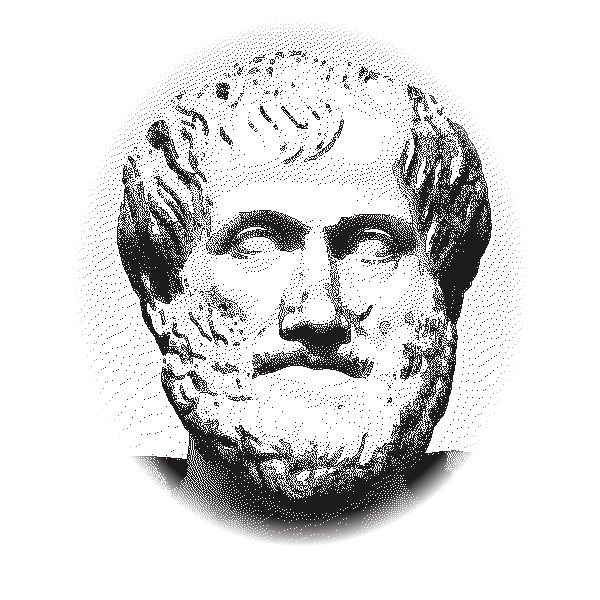
To walk the perimeter of the Lyceum in the autumn of 335 BC was to witness the invention of systematic partition. Where Plato had looked upward toward the luminous, unreachable ceiling of ideal Forms—dismissing the sensory world as an unstable cavern of flickering shadows—his greatest pupil looked relentlessly at the dirt, the barnacle, the gestation of the dogfish, and the anatomy of the civic assembly. Aristotle understood that truth was not an ethereal resident of an inaccessible heaven, but an internal principle woven directly into the fabric of concrete, individual things. A bronze sphere was not an imperfect imitation of sphericity; it was bronze brought into the actualization of roundness. The primary reality of the cosmos did not reside in detached abstractions, but in substance—ousia—the singular, stubborn thing that stands on its own and possesses attributes without being an attribute of anything else.
To grasp this was to demand an entirely new engine for human thought. Before Aristotle, discourse was rhetorical, mythic, or dialectically open-ended; arguments drifted upon the charisma of the speaker or the poetic resonance of a metaphor. Aristotle severed assertion from persuasion by constructing the organon, an analytical toolkit of formal syllogism that rendered reasoning mechanical and inspectable. If all men are mortal, and Socrates is a man, the mortality of Socrates is not a matter of rhetorical flair or political consensus; it is an inescapable formal consequence necessitated by the structural intersection of classes. By mapping premise to conclusion with axiomatic precision, he created the world's first formal logic, converting language from an instrument of enchantment into an instrument of demonstration.
Yet demonstration alone could not explain the teeming, restless dynamism of the natural world. Why did an acorn never produce an olive tree? Why did water fall while flame leaped toward the celestial sphere? To answer the problem of change—which had paralyzed Greek philosophy between Parmenides' denial of motion and Heraclitus' chaotic flux—Aristotle engineered the fourfold architecture of causality. Every phenomenon, whether a sculptor carving marble or a heart beating inside an embryo, required four distinct explanatory inquiries: What is it made of (the material cause)? What is its defining structure or pattern (the formal cause)? What agent or impetus set it in motion (the efficient cause)? And toward what ultimate realization or end does it tend (the final cause, or telos)?
This teleological lens transformed observation into a vast, unified field of empirical inquiry. In the lagoon of Lesbos, Aristotle dissected mollusks, mapped the reproductive chambers of rays, and recorded the embryological development of chicks by cracking open a fertilized egg on each successive day of incubation. Where modern observers would later see blind mechanics, Aristotle saw an inherent striving toward mature form: entelecheia, the having-of-one's-end-within. Living matter was not passive mud; it was potency (dynamis) straining toward full actuality (energeia). The living organism was defined by its soul, not as an ethereal ghost, but as the animating formal principle of an organized physical body capable of nutrition, perception, and contemplation.
In the human sphere, this structural drive toward actualization yielded the Nicomachean Ethics and the Politics. Just as an eye achieves excellence (arete) when it sees clearly, and an oak tree achieves excellence when it attains towering canopy, the human animal achieves eudaimonia—a flourishing life lived in accordance with reasoned virtue. Virtue was not a set of ascetic prohibitions, but a finely tuned equilibrium between excess and deficiency: courage poised between cowardice and rashness, temperance between gluttony and insensibility. Society, in turn, was not an artificial social contract, but the natural vessel of human development. Because man is by nature a political animal (zoon politikon), the polis exists prior to the individual in purpose, serving as the crucible where moral character is practiced and enacted.
In the higher strata of being, this hierarchy of form and matter demanded a cosmological anchor. Because every movement in the cosmos is prompted by another, an infinite regress of physical movers would render the origin of motion unintelligible. Aristotle posited the Unmoved Mover: pure actuality without potentiality, eternal, immutable, drawing the concentric crystalline celestial spheres not through physical collision, but through desire—as the beloved moves the lover. The universe was a closed, continuous, teleological organism, perfectly ordered from the heaviest terrestrial elements resting at the center to the unblemished quintessence circling in the outer heavens.
The supreme vulnerability of this monumental architecture lay precisely in its sublime self-consistency. By binding mechanics, logic, biology, and cosmology into an interlocking, authoritative whole, Aristotle created a mental system so comprehensive that it cast a two-thousand-year shadow across Western and Islamic thought. For medieval scholasticism, he became simply The Philosopher. When late Renaissance astronomers and natural philosophers discovered that celestial bodies bore blemishes, that falling weights accelerated uniformly regardless of mass, and that projectile motion followed inertial parabolic arcs rather than impetus, the collapse of Aristotle's physics threatened to drag down his logic and ethics with it.
His system suffered from the very teleology that gave it explanatory power: by projecting goal-directed purpose onto inanimate matter, he anthropomorphized physical mechanics, mistaking natural regularities for intentional striving. His geocentric cosmology and denial of the void (horror vacui) ossified into dogmas that delayed the birth of quantitative mechanics. Yet the foundational distinction between substance and accident, potentiality and actuality, genus and species, remained the scaffolding upon which European classification and modern biology were constructed.
Today, Aristotle stands not as an obsolete dogmatist whose errors Galileo and Newton overturned, but as the supreme architect of systematic categorization. In contemporary systems biology, epigenetics, and developmental biology, the concept of morphogenetic fields and genetic regulatory networks has subtly rehabilitated his insight that living forms cannot be comprehended purely as disordered material particles without an overarching formal constraint. In modern computer science, type systems, relational ontologies, and object-oriented inheritance mirror the hierarchical taxonomy of the Categories.
To study Aristotle is to encounter the mind that first taught humanity how to define a term, construct a valid deduction, classify a living genus, and demand that metaphysics answer to the palpable evidence of the senses. He was the prime cartographer of intellect, who demonstrated that behind the confusing multiplicity of phenomena lies an intelligible architecture waiting to be named, ordered, and understood.
“Knowing yourself is the beginning of all wisdom.”
“It is the mark of an educated mind to be able to entertain a thought without accepting it.”
“We are what we repeatedly do. Excellence, then, is not an act, but a habit.”
“The whole is more than the sum of its parts.”
“Nature does nothing in vain.”
- Organon (Categories, Prior Analytics, Posterior Analytics) c. 350 BC
- Physics (Physica) c. 340 BC
- Metaphysics (Metaphysica) c. 335 BC
- Nicomachean Ethics c. 330 BC
- De Anima (On the Soul) c. 330 BC
- Politics (Politica) c. 325 BC
- Poetics c. 335 BC