Carl Friedrich Gauss
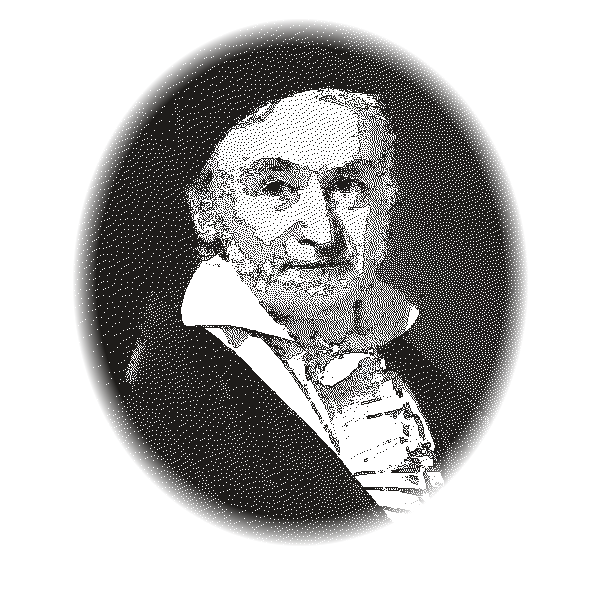
On a spring morning in 1796, an eighteen-year-old student at Göttingen stood before a sheet of rough paper and resolved a question that had remained stationary since Euclid walked Alexandria. For two thousand years, geometers had known how to construct an equilateral triangle and a regular pentagon using only an unmarked straightedge and a compass, yet the circle had stubbornly refused division into seventeen equal arcs. Mathematicians assumed the failure belonged to human imagination; Gauss understood that it belonged to the algebra of cyclotomic equations. By proving that the roots of unity could be decomposed into nested square roots whenever the number of sides was a Fermat prime, he transformed geometric construction from an exercise in spatial intuition into the algebraic factorization of polynomials. He did not draw lines until the algebra demanded them. This was the inaugural signature of Carl Friedrich Gauss: an absolute refusal to operate on the surface of appearances, preferring to unearth the structural substrate where geometry, number, and reality dissolve into identical symmetry.
His childhood in Brunswick had already signaled an uncanny, computational intimacy with number. Legend recounts the three-year-old child correcting his father’s payroll calculations for bricklaying, and the ten-year-old schoolboy astonishing Master Büttner by instantly summing the integers from one to one hundred through pairwise addition of extremes. Yet arithmetic, in the eighteenth century, was largely regarded as an empirical playground—an archipelago of clever tricks, unproven conjectures, and computational accidents. Gauss saw in it an architectural cathedral. Where Euler wandered with exuberant, reckless intuition, Gauss demanded immutable foundations. Numbers were not merely markers for tallies or measurements; they formed closed, resonant structures governed by exact symmetries.
In 1801, at the age of twenty-four, Gauss published the Disquisitiones Arithmeticae, a treatise that effectively created modern number theory out of raw arithmetic. The central conceptual weapon of the work was modular arithmetic. By defining two integers as congruent modulo a given base when their difference was divisible by that base, Gauss swept away the clutter of boundless magnitudes. Infinite lines of numbers collapsed into finite, cyclic rings. Computations that had choked earlier analysts suddenly possessed the crystalline symmetry of clocks. Through this single notation, he tamed the law of quadratic reciprocity—a theorem so profound, and so resistant to rigorous demonstration by Euler and Legendre, that Gauss called it the theorema aureum, the golden theorem, returning to produce eight distinct proofs of its truth over his lifetime.
The Disquisitiones was written in an austere, lapidary Latin that offered no concessions to pedagogical softness. Gauss deliberately erased all traces of his intellectual scaffoldings. Like an architect who removes the scaffolding once the cathedral dome is keyed into place, he presented finished theorems with seamless, unassailable deductions. He had no interest in showing how he arrived at a truth; he cared only that the truth, once stated, admitted no fracture. His personal motto, engraved upon his seal beside a tree bearing few fruits, was Pauca sed matura—few, but ripe. To his contemporaries, this reticence often bordered on arrogance, but to Gauss, it was an aesthetic and moral necessity. Truth was sacred; to publish half-formed intuitions or messy approximations was an insult to the discipline.
The dawn of the nineteenth century brought a crisis that dragged the young prince of mathematics from abstract integers into celestial space. On New Year’s Day, 1801, the Italian astronomer Giuseppe Piazzi observed a faint, moving point of light in the constellation Taurus. He tracked it across nine degrees of the sky before illness and the glare of the Sun swallowed it into celestial invisibility. Astronomers were in despair; forty-one days of erratic observations along a tiny arc were vastly insufficient for the established methods of Lagrange and Laplace to calculate an orbit. Without predictive coordinates, the object—christened Ceres—would be lost forever among the millions of unmapped stars.
Gauss took up the challenge not as an astronomer, but as an analyst of errors. Recognizing that every observational measurement was corrupted by human and atmospheric noise, he developed the method of least squares: minimizing the sum of the squared deviations between predicted trajectories and observed points. Underlying this was his derivation of the normal distribution, the bell-shaped curve where random errors symmetrically cancel around the underlying physical truth. Blending this statistical engine with Keplerian dynamics and novel non-linear vector equations, Gauss computed the orbit of Ceres in a fever of weeks. When Baron Franz Xaver von Zach pointed his telescope into the night sky at the end of December 1801, exactly where Gauss’s numbers pointed, Ceres reappeared. The twenty-four-year-old had restored a missing planet to mankind using nothing more than a scrap of observations and the calculus of probability.
The precision that tracked Ceres in the heavens was soon applied directly to the mud and hills of Lower Saxony. Commissioned by King George IV to direct the geodetic survey of the Kingdom of Hanover, Gauss spent a decade in the field, traversing dense forests, scaling mountains, and enduring the miserable logistics of nineteenth-century cartography. He did not delegate the tedious field observations; he mounted triangles with his own hands and invented the heliotrope, an instrument using mirrors to reflect sunlight across sixty miles, enabling observers to take exact angular measurements between distant mountain peaks.
Out of this grinding manual labor emerged one of the deepest revolutions in the history of thought. Confronted with the problem of mapping the curved surface of the Earth onto flat paper without distortion, Gauss was forced to reconsider the fundamental nature of space. In his 1827 memoir, Disquisitiones generales circa superficies curvas, he introduced intrinsic differential geometry. He proved what he termed the Theorema Egregium—the Remarkable Theorem: the Gaussian curvature of a surface does not depend on how that surface is embedded in three-dimensional space, but can be determined entirely by measurements of distances and angles made by a two-dimensional creature living purely within the surface itself. A sheet of paper can be rolled into a cylinder without stretching because its intrinsic curvature remains zero; an orange peel cannot be flattened onto a table without tearing because its intrinsic curvature is positive. By decoupling curvature from ambient space, Gauss planted the seed that his student Bernhard Riemann would cultivate into the tensor geometry of curved manifolds, and which Albert Einstein, nearly a century later, would recognize as the physical fabric of gravity.
Yet the vastest terrain of Gauss’s mind remained entirely hidden from the world. When Wolfgang Bolyai wrote to his lifelong friend in 1831, proudly enclosing a treatise by his son János claiming to have discovered a revolutionary, self-consistent geometry in which Euclid’s parallel postulate did not hold, Gauss replied with a crushing, dispassionate honesty: to praise the boy’s work would be to praise himself, for he had held the entire framework in his private notebooks for more than three decades. He had withheld it, he admitted, out of fear of the "clamor of the Boeotians"—the dogmatic Kantian philosophers who insisted that Euclidean geometry was an innate, inescapable synthetic a priori intuition.
He died in Göttingen in 1855, having served as director of the astronomical observatory for nearly half a century. In his desk lay locked journals containing discoveries that would occupy subsequent generations: the foundations of complex analysis, the theory of elliptic and modular functions, the fast Fourier transform, the principles of non-Euclidean geometry, and the vector formulations of electromagnetism. He was the last universal mathematician, the princeps mathematicorum who saw the universe not as an assemblage of isolated problems, but as a single, coherent continuum of order. He moved through reality like an ancient surveyor, silent and exacting, measuring the curve of the Earth and the drift of the stars, confident that long after empires and philosophies dissolved, the arithmetic of the cosmos would endure unchanged.
“Pauca sed matura (Few, but ripe).”
“Mathematics is the queen of the sciences and number theory is the queen of mathematics.”
“It is not knowledge, but the act of learning, not possession but the act of getting there, which grants the greatest enjoyment.”
“I have had my results for a long time: but I do not yet know how I am to arrive at them.”
“God does arithmetic.”
- Disquisitiones Arithmeticae 1801
- Theoria motus corporum coelestium 1809
- Theoria combinationis observationum erroribus minimis obnoxiae 1823
- Disquisitiones generales circa superficies curvas 1827
- Intensitas vis magneticae terrestris ad mensuram absolutam revocata 1832
- Allgemeine Theorie des Erdmagnetismus 1839