Charles Babbage
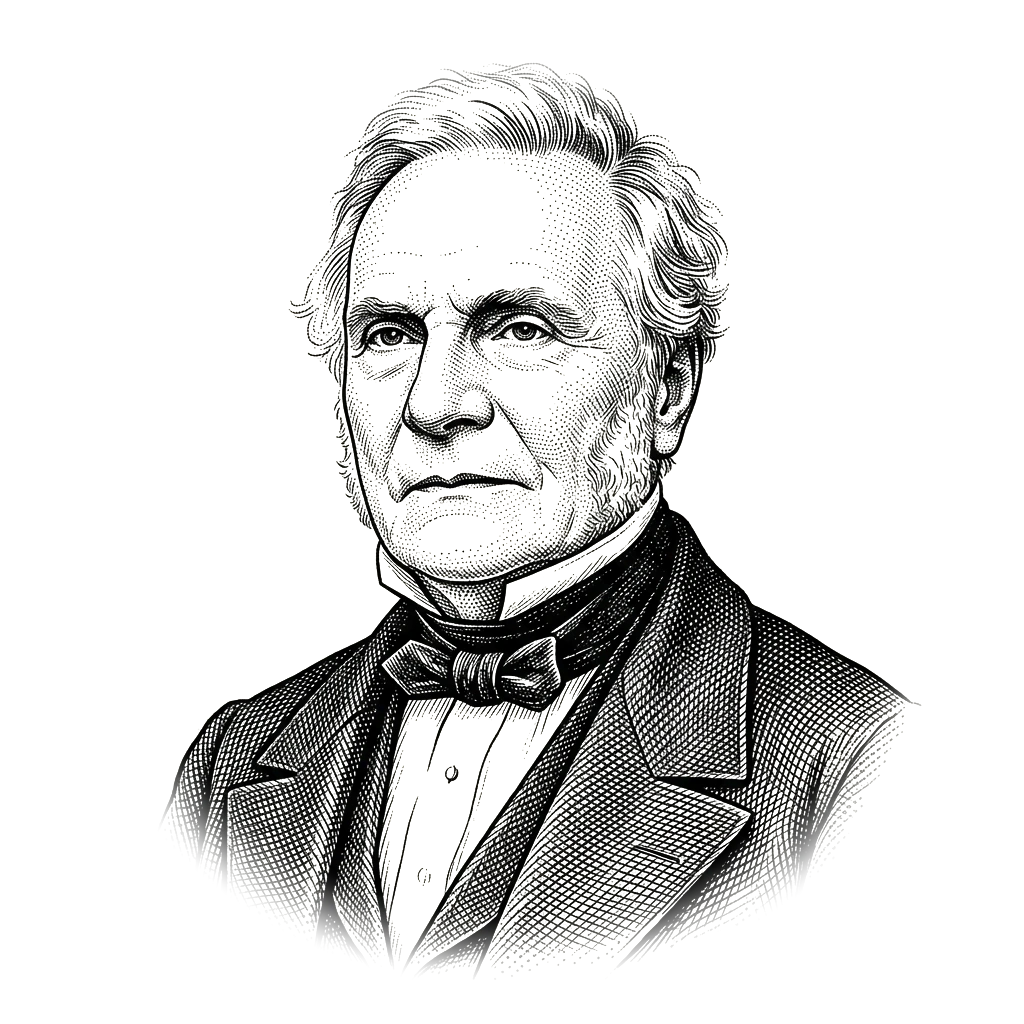
In the drawing room of 1 Dorset Street, London, on a summer evening in 1833, a distinguished assembly of Victorian philosophers, politicians, and socialites gathered around a gleaming two-and-a-half-foot brass apparatus. Standing beside the machine was a forty-one-year-old Lucasian Professor of Mathematics, Charles Babbage, cranking a polished handle. As the gears whirred, columns of brass toothed wheels rotated, carrying tens, evaluating differences, and ringing a mechanical bell whenever a mathematical result was reached. Among the onlookers was a seventeen-year-old girl, Augusta Ada Byron, daughter of the poet Lord Byron. While others marveled at the device as an exquisite mechanical curiosity, Ada recognized its profound metaphysical significance: Babbage had begun the embodiment of human reason into brass and iron.
Born in London in 1791 to a prosperous banking family, Babbage had displayed an intense passion for machinery and mathematics from childhood, dissecting his clockwork toys to discover what made them tick. At Trinity College, Cambridge, finding the mathematics faculty stagnant and obsessed with Newton’s clumsy dot-notation for calculus, Babbage co-founded the Analytical Society with John Herschel and George Peacock to translate the modern Lagrangian differential calculus of Europe into English. In 1821, while sitting with Herschel in the rooms of the Astronomical Society checking printed logarithmic navigation tables riddled with fatal human typographical and calculation errors, Babbage exclaimed in exasperation: "I wish to God these calculations had been executed by steam!"
That exasperated exclamation gave birth to the Difference Engine. Mathematical tables—logarithms, trigonometric functions, astronomical ephemerides—are computed by evaluating polynomials. Babbage realized that by applying the mathematical method of finite differences, polynomial evaluation could be reduced entirely to the primitive operation of repeated addition, eliminating multiplication and division altogether. Over ten years, backed by substantial British government grants, Babbage constructed the Difference Engine No. 1: an intricate clockwork colossus designed to contain twenty-five thousand brass and steel parts, weighing several tons, capable of computing polynomials to sixteen digits and automatically stamping the results into copper stereotype plates to eliminate human typesetting errors.
Yet the construction was an agonizing, protracted struggle against the metallurgical boundaries of his century. Standardized machine parts did not exist; every gear, axle, cam, and pinion had to be drafted by hand, filed from raw castings, and fitted with painstaking manual labor by master toolmaker Joseph Clement. Babbage invented an entire standardized system of mechanical notation—a symbolic architectural grammar using arrows, letters, and dots that mapped the instantaneous motion, velocity, and timing of hundreds of interacting mechanical gears simultaneously. Through this symbolic notation, Babbage could debug a massive mechanical machine on paper before a single piece of brass was turned on a lathe, anticipating modern hardware description languages by more than a century.
Then, before the Difference Engine could be completed, Babbage had a vastly more daring, revolutionary vision: the Analytical Engine (1834). Where the Difference Engine was a specialized calculator hardwired for polynomial subtraction and addition, the Analytical Engine was a general-purpose, programmable computer. Babbage conceived the fundamental architectural separation that still defines modern computer architecture: the "Store" (memory, where numbers are held on vertical columns of geared wheels) and the "Mill" (the central processing unit, where arithmetic operations are executed). Numbers were transferred from the Store to the Mill, operated upon through addition, subtraction, multiplication, or division, and then returned to memory.
To program the Analytical Engine, Babbage borrowed the punched card system invented by Joseph-Marie Jacquard for weaving intricate silk tapestries: "The Analytical Engine weaves algebraic patterns just as the Jacquard loom weaves flowers and leaves." Two sets of punched cards fed into the machine: Operation Cards, which dictated which arithmetic operation to perform, and Variable Cards, which directed which columns in the Store should supply the numbers and receive the results. Most remarkably, Babbage invented conditional branching and looping: the machine could inspect the sign of a number in the Mill and, based on that sign, jump forward or backward in the sequence of punched cards, establishing mechanical Turing-completeness.
Yet Babbage was an intellectual tragic figure. He was an uncompromising perfectionist with a prickly, abrasive temperament who fought bitter public wars with the British government, the Royal Society, and the street musicians of London who rattled his sensitive nerves. When the Chancellor of the Exchequer, Robert Peel, finally terminated funding for the Difference Engine in 1842 after spending over seventeen thousand pounds without receiving a finished working machine, Babbage was devastated. He spent his remaining years designing and refining the Analytical Engine on thousands of meticulous mechanical engineering drawings, but lacked the funding and precision tools to build it in physical metal.
In his 1832 economic treatise, On the Economy of Machinery and Manufactures, Babbage demonstrated that his computational insights extended into industrial organization. He formulated the "Babbage Principle": dividing human labor so that workers are paid high wages only for the specific tasks that demand high skill, reserving routine arithmetic or manual operations for cheaper labor. He analyzed the postal system, calculating that the cost of collecting and auditing postage based on travel distance vastly exceeded the actual transport cost, proposing the uniform flat-rate penny post that transformed worldwide mail systems. Everything Babbage touched, from factories to post offices, he analyzed as an interconnected information system.
He died in London on October 18, 1871, largely dismissed by his contemporaries as an eccentric visionary who had wasted public money chasing impossible mechanical chimeras. Half of his brain was preserved at the Royal College of Surgeons, and the other half at the Science Museum in London. In 1991, to celebrate the bicentenary of his birth, the Science Museum in London constructed Babbage’s Difference Engine No. 2 from his original 1847 drawings, using only the materials and tolerances available in Victorian England. The machine worked flawlessly, printing out calculation tables to thirty-one digits without a single mechanical jam.
Charles Babbage was not an impractical dreamer; he was a giant born into an era whose metallurgical tooling had not yet caught up to the velocity of his mind. A century before Alan Turing proved the mathematical limits of computation and John von Neumann built the electronic stored-program computer, Babbage had drafted their mechanical blueprint in iron, brass, and punched cards. He proved that the operation of human reason could be liberated from biological frailty and entrusted to the infallible mechanics of universal logic.
“I wish to God these calculations had been executed by steam!”
“The Analytical Engine weaves algebraic patterns just as the Jacquard loom weaves flowers and leaves.”
“Errors using inadequate data are much less than those using no data at all.”
“As soon as an Analytical Engine exists, it will necessarily guide the future course of science.”
“Propose to an Englishman any principle, or any instrument, however admirable, and you will observe that the whole effort of the English mind is directed to find a difficulty, a defect, or an impossibility in it.”
- On the Economy of Machinery and Manufactures 1832
- Passages from the Life of a Philosopher 1864
- Note on the Application of Machinery to the Computation of Tables 1822
- Reflections on the Decline of Science in England 1830
- The Ninth Bridgewater Treatise: A Fragment 1837