Claude Shannon
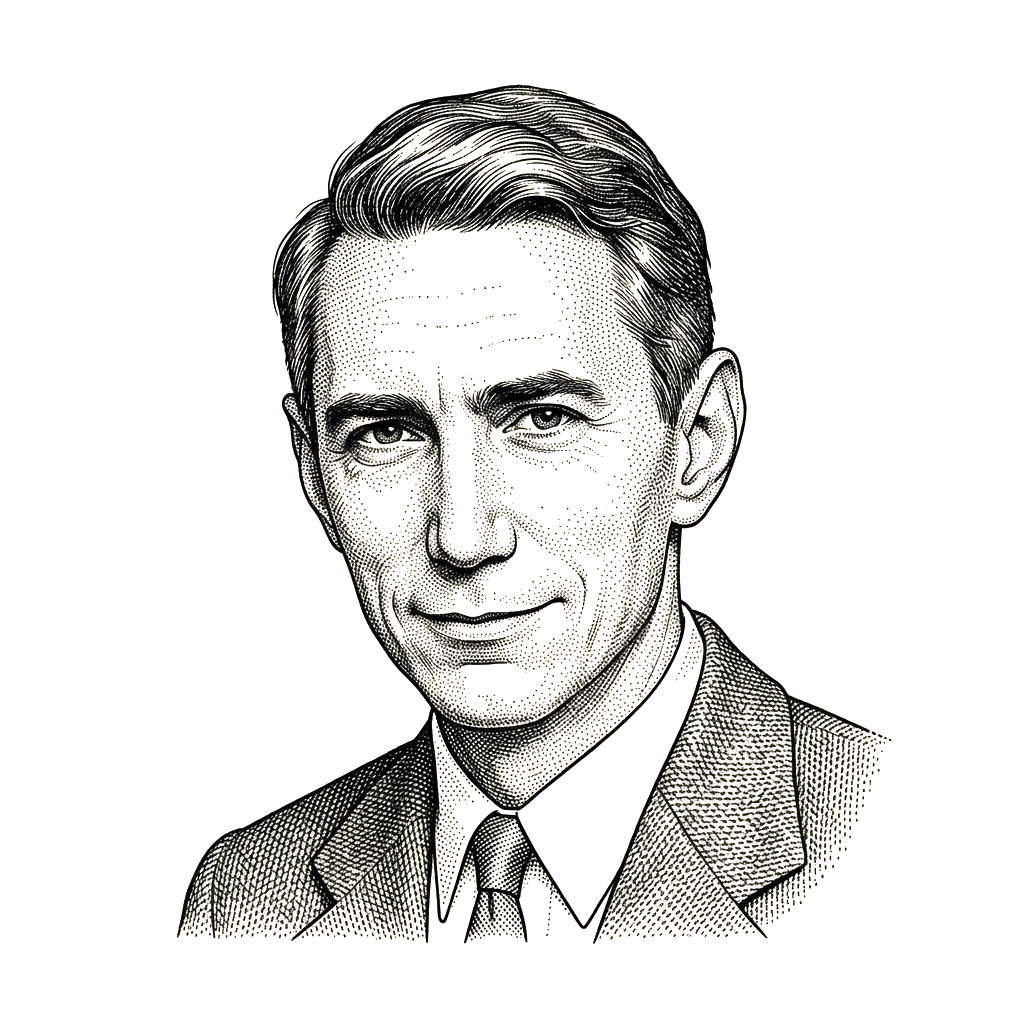
In 1936, an electromagnetic relay was understood as a piece of plumbing. Inside automatic telephone exchanges, banks of thousands of these electromechanical switches opened and closed to route calls across copper networks. When an electric current energized an iron coil, a magnetic field pulled an armature down, pressing two electrical contacts together. The design of these switching networks was an intuitive, messy craft. Engineers accumulated personal notebooks of wiring patterns, troubleshooting by trial and error when currents found unintended "sneak paths" through the maze of copper.
Claude Shannon, a twenty-one-year-old graduate student working on Vannevar Bush’s mechanical differential analyzer at MIT, was assigned to maintain the machine’s relay racks. At the same time, to satisfy an academic requirement, he enrolled in a mathematics course that introduced George Boole’s 1854 algebra of logic. Boole had attempted to formalize human thought by treating propositions as algebraic terms that could evaluate to only two conditions: true (1) or false (0).
Shannon noticed what switchboard engineers had missed: an open switch and a closed switch are not merely conduits for electrical current. They are physical manifestations of truth values.
A closed circuit conducts current; an open circuit halts it. If two switches are placed in series along a wire, electricity flows only if the first switch is closed and the second switch is closed. If they are wired in parallel, electricity flows if either the first or the second switch is closed. A switch held shut by a spring and pulled open by a magnetic coil performs logical negation: current flows only when the control coil is not energized.
In his 1937 master’s thesis, Shannon proved that electrical switching circuits were structurally identical to the calculus of propositions. This meant circuit design was no longer a matter of physical intuition. An engineer could write down the required behavior of an exchange as a logical equation, apply formal algebra to eliminate redundant terms, and read the simplified equation directly back into an optimal wiring diagram. Logic could manipulate electricity; electricity could execute logic.
A decade later, working at Bell Telephone Laboratories, Shannon turned his attention from the switches that directed calls to the signals traveling across the wires.
Telecommunications was then dominated by the physical constraints of analog media. A telephone transmitter converted voice vibrations into an undulating electrical wave. As that wave traveled down hundreds of miles of wire, it weakened. Thermal vibrations in the copper atoms injected static—what engineers called noise. Amplifiers boosted the signal, but every amplifier added noise of its own. The reigning engineering axiom was that noise was an irreducible physical barrier: to transmit more clearly, one had to burn more power, widen the cable's frequency spectrum, or accept that long-distance signals would degrade into static.
Shannon broke the impasse by stepping outside the physics of transmission and ignoring the content of the message.
In his 1948 monograph, A Mathematical Theory of Communication, Shannon insisted that the meaning of a communication was irrelevant to the engineering task. Whether a transmission carried a commercial transaction, a musical score, or meaningless gibberish, its technical reality was identical: it was a specific sequence selected from an ensemble of possible sequences.
Information, Shannon proposed, is not substance or meaning; it is the reduction of uncertainty. If you are told the outcome of a fair coin toss, your uncertainty is halved: you have received one binary digit, or bit, of information. If an event is certain, its occurrence conveys zero information. Because the letters in human language do not appear with equal frequency—in English, e appears far more often than z, and a u almost invariably follows a q—natural messages are riddled with statistical redundancy.
Shannon showed that the information content of a source is measured by its statistical entropy: $$H = -\sum p_i \log_2 p_i$$
This entropy set an absolute mathematical limit on data compression. A message can be compressed without loss down to its entropy rate, but any attempt to compress it further guarantees the destruction of data.
He then addressed the central dread of the communications engineer: could a message ever be sent through noise without error?
The conventional method for catching errors was repetition: sending a bit three times (000 for 0) and taking a majority vote at the receiver. But repetition throttled speed. As noise mounted, ensuring accuracy seemed to require infinitely slow transmission.
Shannon proved the opposite. Every communication channel has a fixed, calculable limit, which he termed the channel capacity ($C$), determined entirely by its frequency bandwidth and its ratio of signal power to noise power: $$C = B \log_2\left(1 + \frac{S}{N}\right) \quad \text{bits per second}$$
Shannon’s Second Theorem delivered the central revelation of modern communications: so long as the rate of transmission ($R$) is less than the channel capacity ($C$), there exists an encoding system that allows data to be transmitted across the noisy channel with an error rate arbitrarily close to zero.
One did not need to slow the transmission rate to zero. One did not need infinite power. Static could be rendered completely harmless without sacrificing throughput.
Shannon’s proof was geometric. Rather than transmitting bits one by one, he proposed gathering bits into long blocks of length $N$. A block of $N$ bits can be represented as a single point in an $N$-dimensional space. Noise acts as a random displacement, jostling the transmitted point into an $N$-dimensional sphere centered on its original location.
If an engineer attempts to use all possible points in that space, the noise-spheres overlap, creating confusion. But if the engineer uses only a sparse collection of points—spacing them through the high-dimensional space so their surrounding noise-spheres never intersect—the receiver can effortlessly identify which point was sent. The receiver simply measures which valid code-point is closest to the corrupted signal and snaps it back to truth.
The paradox of Shannon’s triumph was that his proof was non-constructive. He proved that optimal error-correcting codes must exist by calculating the statistical behavior of codebooks chosen completely at random. He did not construct a single working code. He mapped the coastline of the continent, proving that safe passage existed, but left generations of mathematicians and engineers to spend fifty years designing the actual mathematical vessels capable of navigating it.
Shannon did not invent the physical transistors or fiber-optic strands that make up the digital world. His contribution was more durable: he demonstrated that logic, information, and communication are mathematical structures that exist independently of the copper, glass, or silicon through which they happen to move.
“Frequently the messages have meaning; that is they refer to or are correlated according to some system with certain physical or conceptual entities. These semantic aspects of communication are irrelevant to the engineering problem.”
“Information is the resolution of uncertainty.”
“I just wondered how things work, or how you can make a mathematical model of something.”
- A Symbolic Analysis of Relay and Switching Circuits 1938
- A Mathematical Theory of Communication 1948
- Communication Theory of Secrecy Systems 1949
- Programming a Computer for Playing Chess 1950
- The Bandwagon 1956