Gottfried Wilhelm Leibniz
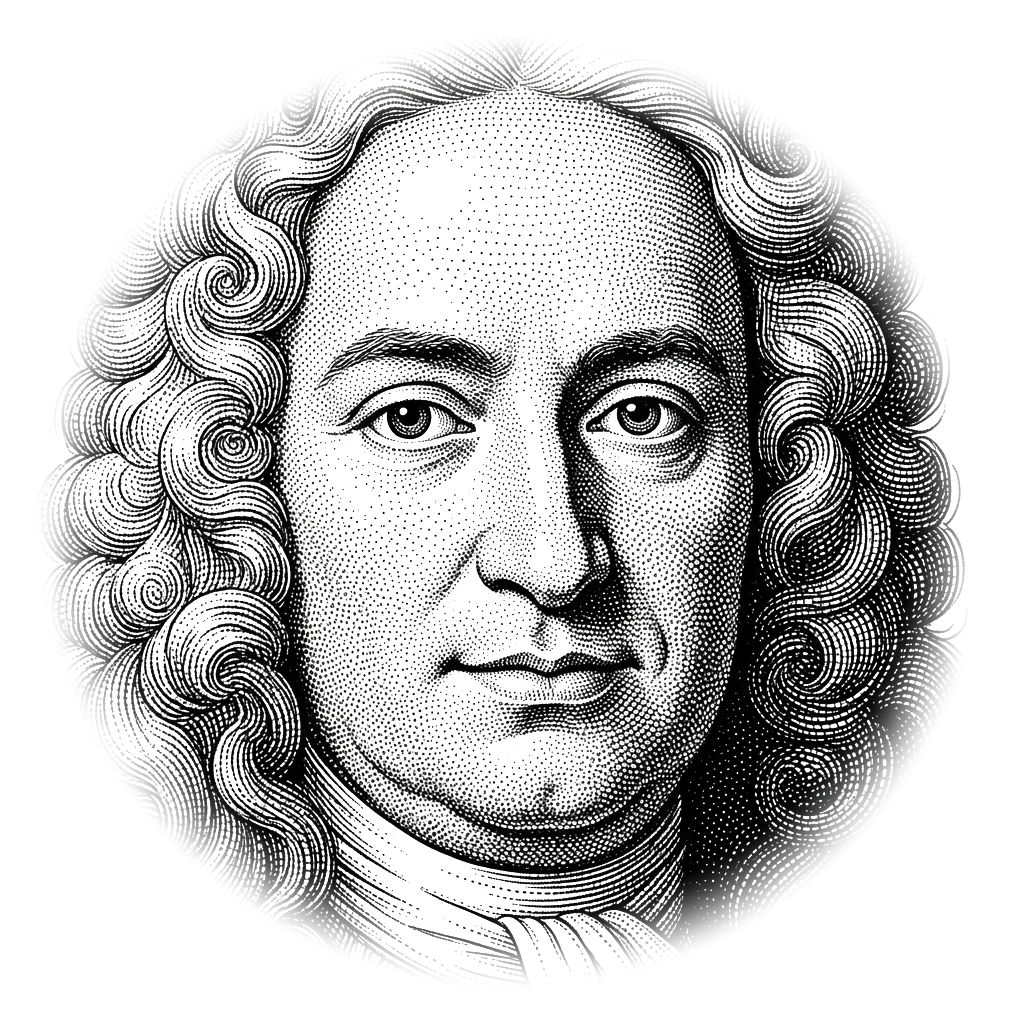
In the rain-slicked autumn of 1675 in Paris, a young Saxon diplomat and polymath dipped his quill into an inkwell and drafted a pair of elongated symbols that would permanently alter the computational capability of human civilization. Gottfried Wilhelm Leibniz was not content to merely solve individual geometric puzzles by clumsy synthetic exhaustion. He sought an algebraic instrument—an operational calculus—that would mechanize the manipulation of the infinite. Where Isaac Newton conceived of fluxions as physical velocities of flowing quantities across time, wrapping his methods in protective geometric obscurity, Leibniz saw calculus as a formal linguistic problem. He introduced the integral sign $\int$ as an elongated S for summa, and $d$ for differentia, designing an operational notation so intuitive, modular, and resilient that the symbols themselves seemed to think on behalf of the mathematician.
This linguistic genius was not an isolated triumph; it was the manifestation of a lifelong obsession: the Characteristica Universalis. Leibniz envisioned an alphabet of human thought, a universal formal language wherein every concept would be assigned a numerical character, and all valid reasoning would reduce to algebraic computation. If two philosophers disagreed, they would not need to shout, posture, or mobilize armies. They would take up pens, sit down at a table, and say to one another: Calculemus—let us calculate. Long before the advent of silicon microprocessors, Leibniz realized that human reasoning could be completely disembodied from biological psychology and executed by formal, symbolic manipulation.
To embody this vision in brass and iron, Leibniz turned from ink to physical mechanics. Dismayed by the hours spent by astronomers and merchants in mind-numbing manual arithmetic, he designed the Stepped Reckoner (Staffelwalze), a mechanical computing machine capable of performing not merely addition and subtraction, but automated multiplication, division, and the extraction of roots. At its core lay a stepped drum—a cylinder with nine gear teeth of progressively increasing length along its circumference. By shifting a counting pinion along the axis of this drum, the machine translated positional shifts into repeated mechanical additions. It was a masterpiece of early precision engineering, establishing the stepped gear mechanism that would power mechanical calculators until the mid-twentieth century.
Yet his mechanical ambitions reached even deeper into the bedrock of arithmetic. In 1703, meditating on the hexagrams of the ancient Chinese I Ching and seeking a method of arithmetic that would make the mysteries of creation transparent, Leibniz formulated binary arithmetic (Arithmétique Binaire). He recognized that all numbers, all logical relationships, and all operations of thought could be represented using only two characters: $0$ and $1$. For Leibniz, $0$ represented the void of non-being, and $1$ represented the divine unity of God creating the universe ex nihilo. In this visionary synthesis of theological mysticism and algebraic reduction, he laid down the operational substrate upon which the entire digital universe of modern computer architecture would eventually be constructed.
In the realm of metaphysics, Leibniz confronted the radical dualism of Descartes and the terrifying pantheism of Spinoza with a system of astonishing originality: the Monadology. If the material world is infinitely divisible, he argued, matter itself cannot be the ultimate foundation of reality, for whatever is composite must ultimately be composed of simple, indivisible units. These irreducible metaphysical atoms he named monads. Monads are immaterial, unextended, windowless centers of perception and appetite. They have no windows through which anything could enter or depart; they do not interact through physical collision. How, then, does the physical universe present itself as a coordinated, causal clockwork?
Leibniz introduced the doctrine of Pre-Established Harmony. At the moment of creation, God synchronized every monad with every other monad, like an infinite choir singing from different sheets of music in perfect, unblemished counterpoint, or two master clocks wound to tick in perpetual synchrony. Every monad reflects the entire universe from its own unique, internal perspective. Space and time are not absolute physical containers, as Newton dogmatically asserted, but relational orders: space is the order of coexistence, time the order of successive states. Reality is not a dead, inert machine of colliding billiard balls; it is an infinitely dense, living, interconnected organism pulsing with internal force (vis viva).
This sublime metaphysical architecture was anchored by two sovereign logical pillars: the Principle of Contradiction (which governs all necessary truths) and the Principle of Sufficient Reason (which governs all contingent truths). Nothing occurs without a reason why it is thus and not otherwise. Because God is omniscient, omnipotent, and perfectly benevolent, He surveyed an infinite spectrum of possible worlds before creation and chose to actualize the one that maximized richness and variety while minimizing complexity of fundamental laws. This was Leibniz's famous claim that ours is 'the best of all possible worlds'—a profound theological proposition that Voltaire would brutally satirize in Candide as naïve optimism.
Yet Leibniz's concept of the best possible world was neither complacent nor blind to suffering. It was an optimization problem. Just as a geometer must accept acute angles to construct a multifaceted polyhedron, the actualization of a cosmos capable of moral freedom and structural complexity necessarily involves disharmony as a local dissonance within a global, harmonic resolution. His late life was marred by bitter intellectual isolation: he was embroiled in a poisonous priority dispute with Isaac Newton and the Royal Society over the invention of calculus, and he died neglected in Hanover, his funeral attended only by his personal secretary.
Today, the vindication of Gottfried Wilhelm Leibniz is total. History swept past Newton's geometric calculus to embrace Leibniz's elegant differential notation across every engineering and physical discipline on Earth. In modern theoretical physics, the Einsteinian concept of spacetime as a relational metric field rather than a rigid Newtonian stage is a direct fulfillment of Leibniz's relational critique. In computer science, his binary arithmetic, stepped gear logic, and dream of the universal characteristic gave birth to Boolean algebra, Turing machines, automated theorem proving, and contemporary artificial intelligence.
To study Leibniz is to encounter an intellect that stood simultaneously at the apex of the Baroque era and at the threshold of the computational age. He walked through libraries, royal courts, and mining shafts, seeing beneath the surface chaos of European politics a hidden, supreme order. He gave humanity the tools to differentiate the infinitesimal, integrate the continuum, and calculate the structure of thought itself.
“When there are disputes among persons, we can simply say: Let us calculate (Calculemus), without further ado, to see who is right.”
“Music is the pleasure the human mind experiences from counting without being aware that it is counting.”
“Nothing takes place without a sufficient reason; that is, why it is thus rather than otherwise.”
“The present is great with the future, the future might be read in the past, the distant is expressed in the near.”
“To love is to find in the happiness of another one's own happiness.”
- De Arte Combinatoria (On the Combinatorial Art) 1666
- Nova Methodus pro Maximis et Minimis (New Method for Maxima and Minima) 1684
- Discours de métaphysique (Discourse on Metaphysics) 1686
- Explication de l'Arithmétique Binaire (Explanation of Binary Arithmetic) 1703
- Nouveaux essais sur l'entendement humain (New Essays on Human Understanding) 1704
- Théodicée (Theodicy) 1710
- La Monadologie (The Monadology) 1714