Jorge Luis Borges
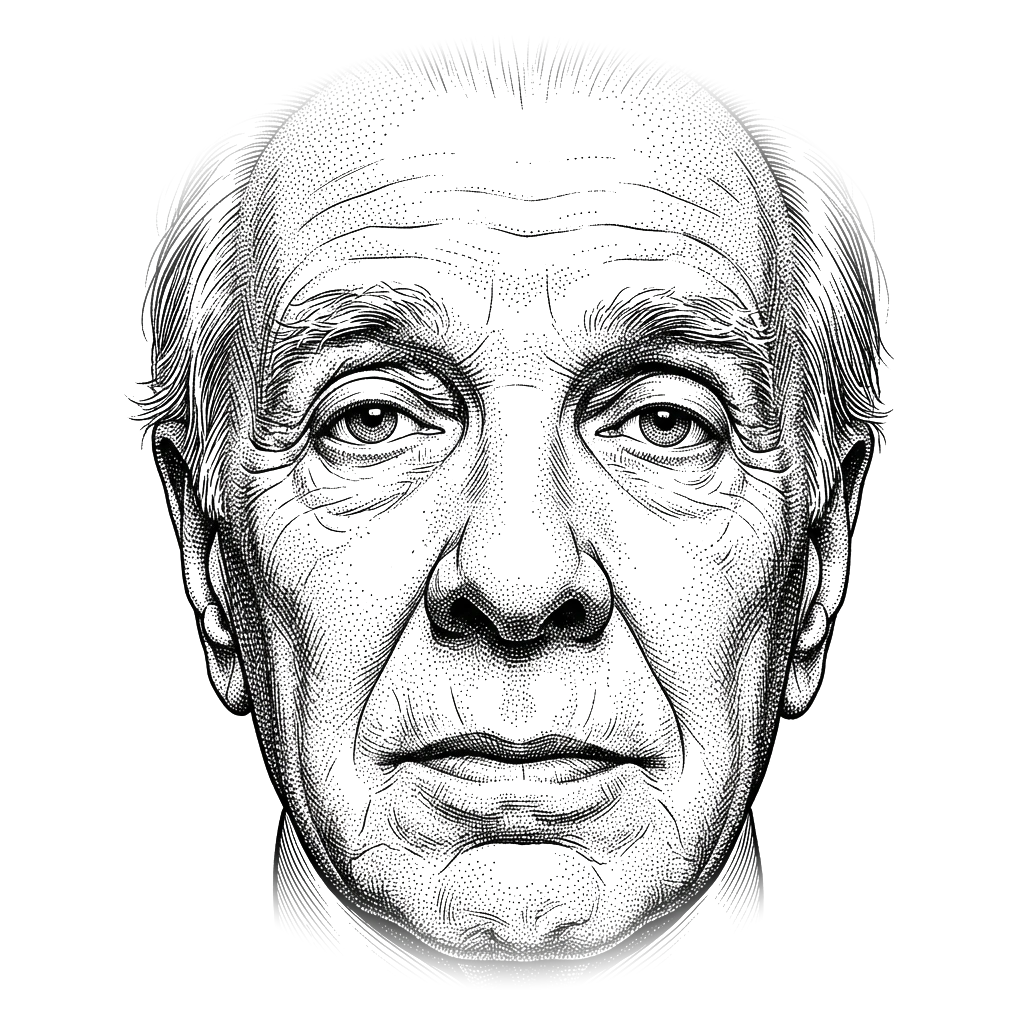
In 1955, following the overthrow of the Perón dictatorship, a fifty-six-year-old municipal librarian was appointed Director of the National Public Library of Argentina. For decades, Jorge Luis Borges had worked in humiliating obscurity, cataloging books in the dreary basement of the Miguel Cané branch in a working-class suburb of Buenos Aires, passing his afternoons translating Kafka in secret on the service stairs. Now, he was handed the custodianship of nearly a million volumes housed in an ornate neoclassical palace on Calle México. Yet by a stroke of exquisite, tragic irony, the hereditary blindness that had stalked his family for six generations chose that exact moment to draw its final veil over his eyes. His sight dissolved into a luminous, golden fog through which print could no longer be deciphered. In his famous "Poem of the Gifts," he recorded the moment with serene, dry astonishment: "No one should read self-pity or reproach into this declaration of the mastery of God, who with magnificent irony granted me at once eight hundred thousand books and darkness."
He had been born in Buenos Aires in 1899, but he was born into an English library. Before he could speak Spanish on the street, he was reading Stevenson, Poe, and the Arabian Nights in his father’s vast collection of Victorian calfskin volumes. When he finally read Don Quixote in its original Spanish years later, it felt to him like a clumsy translation. Literature was never, for Borges, an imitation of life; life was an imperfect, ephemeral commentary on literature. Reality was not an irreducible bedrock of granite, but a fragile, fluctuating text written, erased, and rewritten by human consciousness.
In the late 1930s, recovering from a near-fatal head injury and septic fever that he feared had destroyed his mental faculties, Borges tested his sanity by attempting a literary form he had never previously dared: the philosophical narrative. The result was a sequence of brief, crystalline fictions collected in Ficciones and El Aleph that permanently altered the conceptual landscape of world literature.
Borges held a profound, aristocratic disdain for the sprawling psychological novel. He considered it a tedious, redundant vanity to spend five hundred pages detailing the furniture of a drawing room or the petty matrimonial quarrels of bourgeois adulterers when an author could summarize the entire metaphysical architecture of an idea in ten flawless pages. To achieve this supreme density, he invented the pseudo-bibliographical essay: writing scholarly reviews of imaginary books by nonexistent authors, or meticulously attributing historical masterpieces to modern figures. In "Pierre Menard, Author of the Quixote," a twentieth-century French symbolist attempts not to copy Cervantes, but to compose afresh, line for line and word for word, the exact text of Don Quixote. Borges demonstrates with deadpan academic precision that while Cervantes's seventeenth-century prose was a lively, colloquial romance, Menard's identical twentieth-century text is a staggering work of historicist irony, philosophical subversion, and psychological ambiguity. Meaning does not reside inside the ink of the text; meaning is an emergent property generated in the consciousness of the reader across historical time.
Yet his most dizzying architectural constructions were informational cosmologies. In "The Library of Babel," written while he was still stamping dates at the municipal library, Borges conceived the universe as an endless, periodic labyrinth of hexagonal galleries. In each hexagon sit twenty shelves; on each shelf stand thirty-two volumes; each volume comprises four hundred and ten pages; each page contains forty lines; each line contains eighty characters drawn from an alphabet of twenty-five orthographic symbols.
Because the library contains every possible permutation of those twenty-five symbols across four hundred and ten pages, the Library is complete. It contains everything: the detailed history of the future, the archangels' autobiographies, the faithful catalog of the Library, thousands of false catalogs, the proof of the falsity of those catalogs, and the translation of every book into all languages. Yet the immediate consequence of total informational completeness is absolute epistemic despair. For every single line of profound truth, there are leagues of senseless, cacophonous gibberish ("dhcmrlchtdj"). Sects of librarians wander the endless stairs, driven mad by false searches, while others murder their fellows in theological purges. Borges demonstrated, decades before the advent of the World Wide Web and algorithmic generative models, that uncurated infinite information is mathematically and functionally indistinguishable from absolute silence.
In "The Garden of Forking Paths," written in 1941, Borges anticipated the profoundest ontological questions of theoretical physics. The protagonist, a Chinese professor spying for imperial Germany in England during the First World War, discovers the lost labyrinth of his ancestor Ts'ui Pên. The labyrinth is not a physical maze of hedges, but an infinite, chaotic novel in which all possible outcomes occur simultaneously. In traditional fiction, when an author presents a protagonist with an agonizing choice—to kill a rival or forgive him, to take the left path or the right—the narrative chooses one branch and deletes the other. In the work of Ts'ui Pên, the author chooses both. Time is not a linear, uniform conveyor belt moving from past to future; it is an infinitely proliferating web of diverging, converging, and parallel branches.
Sixteen years before the physicist Hugh Everett III formulated the Many-Worlds interpretation of quantum mechanics, and decades before Theodor Nelson coined the term "hypertext," Borges had mapped the formal topology of non-linear multiverses. He saw that reality is a continuous bifurcation of probabilities, where in one universe two men are enemies, in another they are lovers, and in a third neither exists.
In his masterwork "The Aleph," Borges confronted the ultimate aesthetic impossibility: how can sequential, linear language represent the simultaneous totality of the cosmos? In the dark basement of a house on Calle Garay in Buenos Aires, beneath the cellar stairs, he discovers the Aleph—a tiny iridescent sphere, barely an inch in diameter, within which sits every point in the universe, seen from every angle simultaneously without distortion, overlapping, or confusion. He sees the populous sea, dawn and dusk, the delicate bone-structure of a hand, horses with swirling manes in the Caspian, convex deserts, the circulation of his own dark blood, and his own face reading the Aleph in the cellar. In that terrifying, ecstatic instant, the linear grammar of speech breaks down; the intellect is swallowed by the infinite simultaneity of being.
In his final years, completely blind, Borges traveled the universities of the world accompanied by his devoted companion and widow, María Kodama. He looked like an ancient Homeric rhapsodist, leaning on a polished walking stick, reciting Old English alliterations and Norse sagas in a frail, whispery voice. He had transformed literature from a photographic record of external appearances into a laboratory of the metaphysical imagination. He died in Geneva in 1986, having proved that reality is an infinite labyrinth of words, mirrors, and dreams, and that we are all characters wandering through a library whose shelves have no beginning and no end.
“I have always imagined that Paradise will be a kind of library.”
“Time forks perpetually towards innumerable futures. In one of them I am your enemy.”
“To think is to forget differences, to generalize, to abstract. In the overly replete world of Funes, there were nothing but details.”
“The original is unfaithful to the translation.”
“No one should read self-pity or reproach into this declaration of the mastery of God, who with magnificent irony granted me at once eight hundred thousand books and darkness.”
- Historia universal de la infamia (A Universal History of Infamy) 1935
- El jardín de senderos que se bifurcan (The Garden of Forking Paths) 1941
- Ficciones 1944
- El Aleph 1949
- Otras inquisiciones (Other Inquisitions) 1952
- El hacedor (The Maker / Dreamtigers) 1960