Laozi
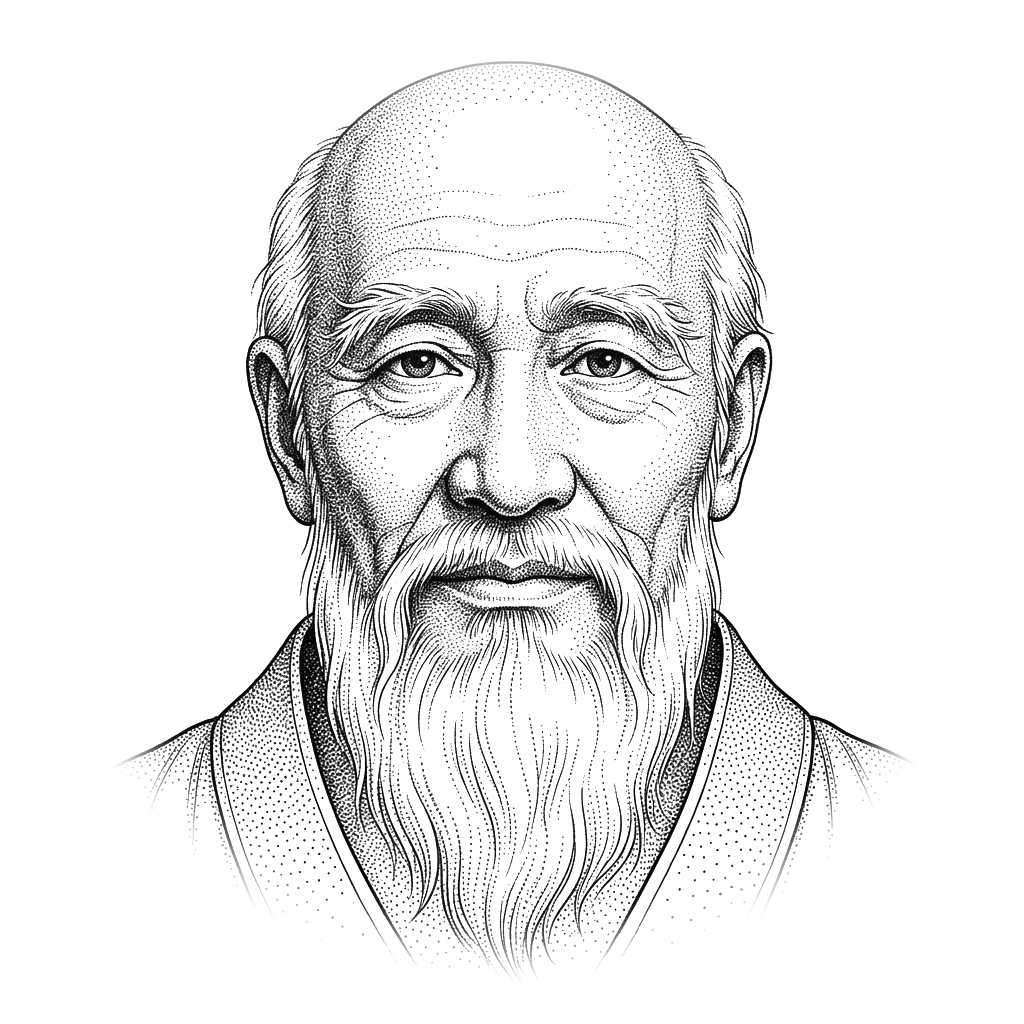
At the western frontier pass of Xiangu, where the fertile plains of the central Chinese kingdoms dissolved into the wild, desolate gorges of the western mountains, an elderly archivist from the imperial court of Zhou arrived riding a blue-black water ox. The royal house of Zhou was decaying into the chaotic, bloody treachery of the Warring States period, with petty feudal lords weaponizing Confucian moralisms and Legalist brutality to wage ceaseless war for territorial conquest. Disgusted by the vain pageantry, hypocritical ceremonials, and violent ambition of the imperial capital at Luoyang, Laozi—the "Old Master"—had quietly resigned his post as keeper of the imperial archives and turned his mount toward the western desert, intending to vanish into anonymity without leaving a trace of his passage.
Recognizing the venerable scholar by the quiet aura of authority that preceded him, Yin Xi, the warden of the mountain pass, barred the gateway. The guard made a solemn, historic plea: "Master, since you are about to withdraw into complete seclusion, I beg of you to write down a book for us, that your wisdom may not be lost to the world." Laozi lingered at the border post for several days, dipping a wolf-hair brush into pine-soot ink to write out five thousand Chinese characters on bamboo slips before rolling them up and handing them to the border guard. He then passed through the wooden gates and rode westward into the shifting sands, disappearing forever from human sight. The slender collection of aphorisms and paradoxical poems he left behind—the Dao De Jing (Tao Te Ching)—became the foundation of Taoist thought and one of the most translated and influential texts in world literature.
The foundational concept of Laozi's thought was the Dao—the nameless, uncarved Way that precedes Heaven, Earth, and the pantheon of gods. In the opening lines of the text, Laozi issued his famous epistemological warning: Dao ke dao, fei chang Dao; ming ke ming, fei chang ming—"The Way that can be spoken of is not the eternal Way; the name that can be named is not the eternal name." The Dao is not a personal creator deity who issues moral commandments from a celestial throne, nor is it an abstract mathematical theorem. It is the unforced, self-generating mother of ten thousand things (wanwu), operating without effort, possessing without claiming ownership, accomplishing all things while seeking no glory.
To align with this primordial current, Laozi formulated the paradoxical discipline of Wu Wei—effortless action, or non-contrived doing. Wu Wei is not lethargic passivity, fatalistic resignation, or sheer laziness; it is the art of acting in such complete harmony with the natural grain of reality that action produces maximum effect with minimum friction. Just as a master swimmer rides the swirling currents of a river rather than thrashing violently against the rapids, so the Taoist sage operates without aggressive ego-assertion, vanity, or coercive manipulation. Where the Confucian scholars of his era sought to reform society through an ever-expanding apparatus of rigid etiquette, elaborate rituals, and legal codes, Laozi warned that moral codes only proliferate when the spontaneous goodness of the Dao has been lost: "When the great Dao declined, humaneness and righteousness appeared; when cleverness and knowledge emerged, great hypocrisy was born."
Laozi's primary metaphor for the highest virtue was water (shui). In Chapter Eight, he wrote: "The highest good is like water. Water benefits all things and does not compete with them. It settles in places that everyone despises; therefore, it is close to the Dao." Water is soft, fluid, and completely yielding, seeking always the lowest ground; yet nothing in the world can surpass water in wearing away jagged rocks, carving grand canyons, and eroding impenetrable granite cliffs. By adopting the posture of water—humility, flexibility, and non-contention—the sage becomes indestructible, because one who does not compete can never be defeated.
This logic inverted classical patriarchal values of martial dominance, unyielding rigidity, and aggressive masculine expansion. Laozi celebrated the receptive, dark, yielding feminine principle (yin), urging leaders to know the male, yet preserve the female (zhi qi xiong, shou qi ci), and to know the white while preserving the black. A living human body is soft and supple, while a corpse is stiff and rigid; living trees and grasses are tender and pliant, while dead wood is dry and brittle. Rigidity, stiffness, and unyielding dogmatism are the companions of death, while softness, flexibility, and humility are the companions of life.
In political philosophy, Laozi proposed a radical critique of imperial statecraft that anticipated philosophical anarchism and libertarian minimalism. The ruler who governs best, he argued, governs least. He compared the administration of a great empire to the delicate culinary art of frying a small fish (zhi da guo, ruo peng xiao xian): if you poke and prod it constantly with spatulas, it falls apart into messy shreds; if you leave it alone over a gentle fire, it cooks to perfection. When governments impose heavy taxes, intrusive regulations, and harsh penal codes, society descends into crime, famine, and rebellion: "The more taboos and prohibitions there are in the world, the poorer the people become; the more sharp weapons the people possess, the more chaos reigns in the state; the more laws and decrees are promulgated, the more thieves and bandits multiply."
The ideal Taoist community was small, self-contained, and deeply integrated into the local ecology. Laozi envisioned villages where people lived in simple contentment, eating wholesome food, wearing simple homespun clothing, enjoying the rhythms of agriculture, and living in such harmony with their surroundings that although the crowing of roosters and the barking of dogs in neighboring villages could be heard across the valley, people grew old and died without ever feeling the anxious urge to travel there in search of commercial conquest or vain spectacles.
Laozi's historical existence remains wrapped in poetic legend. Sima Qian, the grand historian of the Han dynasty, recorded conflicting biographical traditions, identifying him variously as Lao Dan, an archivist from the state of Chu, and Li Er, while candidly admitting that Laozi was an elusive recluse whose true legacy was the deliberate concealment of his own ego. Yet whether the Dao De Jing was the work of a single sage riding westward on a water ox or the distilled collective wisdom of ancient Chinese oral traditions, its philosophical impact remains profound.
Taoism became the vital counter-weight and corrective to Confucian rigidity throughout two and a half millennia of East Asian history. It inspired the spontaneous ink washes of Song dynasty landscape painters, the martial dynamics of Tai Chi, the restorative diagnostics of traditional Chinese medicine, and the radical naturalism of Zen Buddhism. Laozi's serene voice continues to whisper across civilizational boundaries, reminding an exhausted, hyper-accelerated modern world that true power lies in yielding, true wealth lies in knowing when one has enough, and the greatest victories are achieved when nothing is forced.
“The Dao that can be told is not the eternal Dao; the name that can be named is not the eternal name.”
“Water is fluid, soft, and yielding. But water will wear away rock, which is rigid and cannot yield. What is soft is strong.”
“Nature does not hurry, yet everything is accomplished.”
“When you are content to be simply yourself and don't compare or compete, everyone will respect you.”
“Knowing others is intelligence; knowing yourself is true wisdom. Mastering others is strength; mastering yourself is true power.”
- Dao De Jing (Tao Te Ching) c. 5th–4th Century BC
- Guodian Bamboo Slips (Oldest Extant Laozi) c. 300 BC
- Mawangdui Silk Texts (Laozi A & B) c. 168 BC
- Heshang Gong Commentary c. 2nd Century BC
- Wang Bi Commentary on the Laozi c. 240 AD