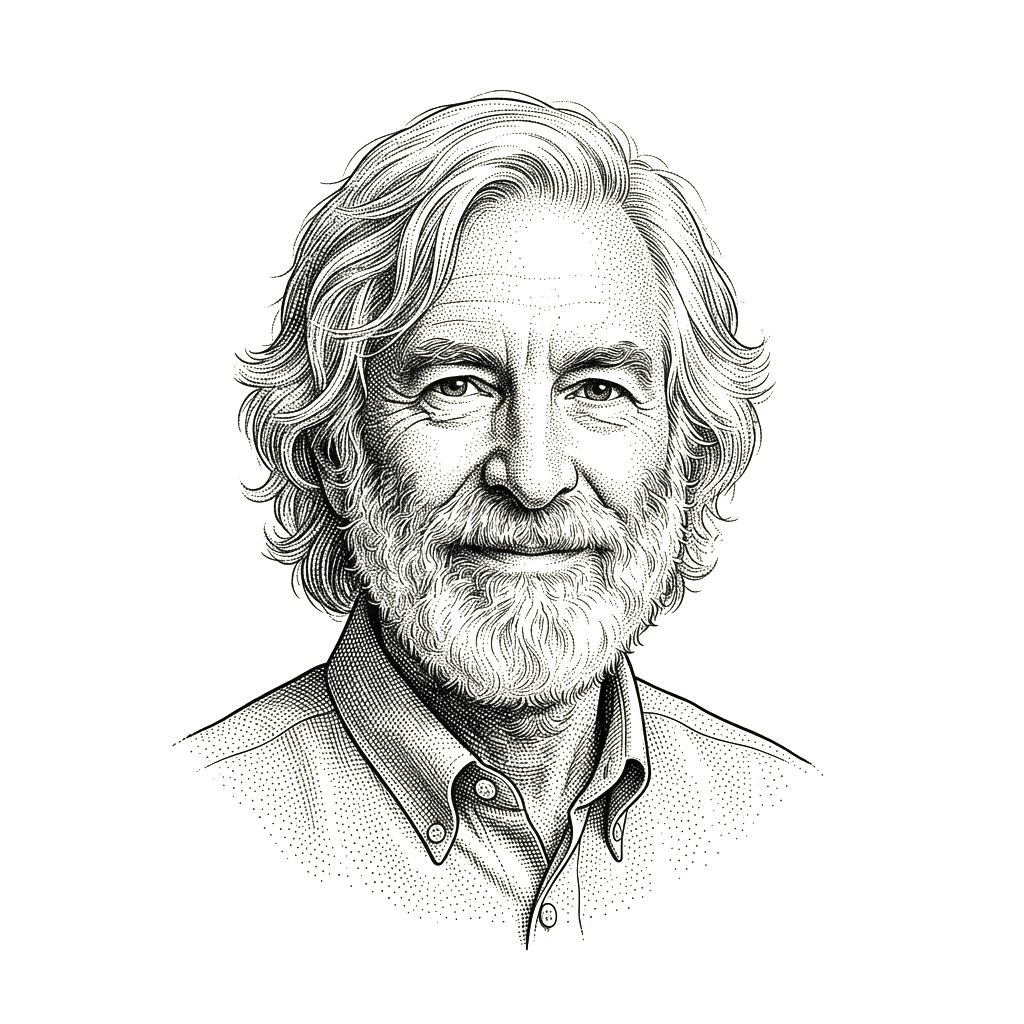
Leslie Lamport
In 1978, computer science was quietly captive to a seventeenth-century illusion. As computers were first wired together across telephone lines and satellite links into networks, engineers assumed that time was an absolute, universal backdrop. A mainframe in Boston and a terminal in California were assumed to share a single, invisible river of time. If a database record was updated on the East Coast and read on the West Coast, engineers believed one could simply consult a physical clock to decide which event came first.
Leslie Lamport, a mathematician working at Massachusetts Computer Associates, read a draft paper on distributed databases and recognized a profound conceptual mistake. The authors were attempting to synchronize distributed machines using physical timestamps, oblivious to the fact that physical clocks drift, jitter, and can never be perfectly synchronized across space.
Computer scientists were thinking like Isaac Newton. Lamport had studied physics, and he knew they needed to think like Albert Einstein.
In his 1905 theory of special relativity, Einstein demonstrated that because the speed of light is finite, there is no universal "now." Simultaneity is relative to the observer. If two stars explode in opposite corners of the galaxy, asking which star exploded first is physically meaningless unless a beam of light can travel from one explosion to the other. Without a physical signal connecting two events, no absolute temporal sequence exists between them.
Lamport recognized that a computer network is a microcosm of relativistic spacetime. Electronic messages traveling along wires, optical fibers, or radio waves are the system’s equivalent of light.
Between two independent processors separated by physical distance, physical time does not exist. There is no master clock in the sky. If node $A$ computes locally and node $B$ computes locally without communicating, it is mathematically meaningless to ask which event happened first. They inhabit separate causal light cones.
The only objective reality in a distributed system is causality: did event $A$ cause event $B$?
In his 1978 paper—"Time, Clocks, and the Ordering of Events in a Distributed System"—Lamport shattered the illusion of physical time and replaced it with a causal partial ordering: the happens-before relation ($\to$).
- If events $a$ and $b$ occur within the same process, and $a$ precedes $b$, then $a \to b$.
- If $a$ is the sending of a message and $b$ is its receipt by another process, then $a \to b$.
- If $a \to b$ and $b \to c$, then $a \to c$.
If neither $a \to b$ nor $b \to a$ holds, the events are concurrent. Neither can influence the other.
To operationalize this causal framework, Lamport discarded physical clocks and invented the logical clock: a simple integer counter on each processor. A processor increments its counter on each local event, stamps the value on every outgoing message, and upon receiving a message, advances its clock past the sender's timestamp. By breaking ties with unique process identifiers, Lamport transformed this partial causal order into an unambiguous global total order.
From this simple arithmetic emerged the foundation of modern distributed infrastructure: State Machine Replication. If independent computers agree on a totally ordered sequence of commands, and execute them deterministically from the same initial state, they will arrive at the exact same output. A system can be replicated across continents, survive hardware crashes, and maintain an identical, unflinching truth.
Having tamed time, Lamport confronted betrayal.
In the late 1970s, consulting for SRI International on NASA’s SIFT aircraft flight-control project, Lamport realized that computing hardware did not merely crash silently. A failing sensor or corrupted processor could transmit contradictory information: instructing one flight computer to pitch up while telling another to pitch down.
With Robert Shostak and Marshall Pease, Lamport formalized this hazard as The Byzantine Generals Problem. A council of generals surrounds an enemy fortress, needing unanimous agreement to attack or retreat. Traitors among them send conflicting messages to sow division.
Lamport proved a fundamental mathematical boundary: with unauthenticated (oral) messages, no consensus is possible unless more than two-thirds of the generals are loyal ($n \ge 3m + 1$, where $m$ is the number of traitors). With three generals, a single traitor can make consensus mathematically impossible. Yet if generals employ unforgeable cryptographic signatures, consensus becomes achievable for any number of traitors so long as loyal generals can communicate. Decades later, this threshold became the cryptographic bedrock of blockchains and fault-tolerant avionics.
Yet the most common frontier remained benign, asynchronous chaos. In a real-world network, hardware rarely lies, but messages are delayed, dropped, or duplicated, and nodes crash without warning. In 1985, Fischer, Lynch, and Paterson (FLP) proved that in an asynchronous network, no deterministic protocol can guarantee both safety (never agreeing on conflicting values) and liveness (always reaching a decision) if even a single computer can fail.
Lamport answered with Paxos.
Rather than pursuing impossible guarantees, Paxos sacrifices liveness during network partitions while maintaining an absolute guarantee of safety. Named after a fictional parliamentary system on a Greek island, Paxos achieves agreement across overlapping quorums—simple majorities of machines. Because any two majorities must intersect at least one common node, any new proposal is mathematically forced to learn and respect earlier decisions before establishing a new one.
Initially rejected by reviewers who mistook its allegorical style for frivolity, Paxos was republished years later and became the consensus engine underpinning Google's Chubby and Spanner, Amazon's DynamoDB, and the modern cloud.
In his later career, Lamport targeted what he considered software engineering's most dangerous habit: writing code before thinking.
"Architects don't build a skyscraper by pouring concrete on day one; they draw blueprints," Lamport observed. A program burdened by syntax and implementation details obscures algorithmic logic. Because the possible interleavings in a concurrent system vastly exceed the number of atoms in the universe, conventional testing can never prove a distributed system free of race conditions.
To solve this, Lamport created TLA+ (Temporal Logic of Actions). TLA+ is not a programming language; it is an applied mathematical notation grounded in first-order logic and set theory. It requires engineers to specify what a system is mathematically permitted to do across time before writing code. At Amazon Web Services and Microsoft Azure, TLA+ uncovered subtle, catastrophic concurrency bugs in core storage architectures that had eluded years of production testing.
Leslie Lamport’s life work is an unyielding defense of mathematical rigor over mechanical craft. He proved that distributed systems are synchronized not by the ticking of clocks, but by causal logic; that consensus amidst chaos is governed by immutable quorum geometries; and that the only reliable shield against catastrophic failure is the discipline to write down what you mean before you build it.
“A distributed system is one in which the failure of a computer you didn't even know existed can render your own computer unusable.”
“If you're not writing a program, you're just writing code.”
“Thinking doesn't guarantee you won't make mistakes. But not thinking guarantees you will.”
“The concept of time is fundamental to our way of thinking. Yet, in distributed systems, physical time is an illusion.”
- Time, Clocks, and the Ordering of Events in a Distributed System 1978
- The Byzantine Generals Problem (with Shostak & Pease) 1982
- The Part-Time Parliament / Paxos Made Simple 1998 / 2001
- Specifying Systems: The TLA+ Language and Tools 2002