Werner Heisenberg
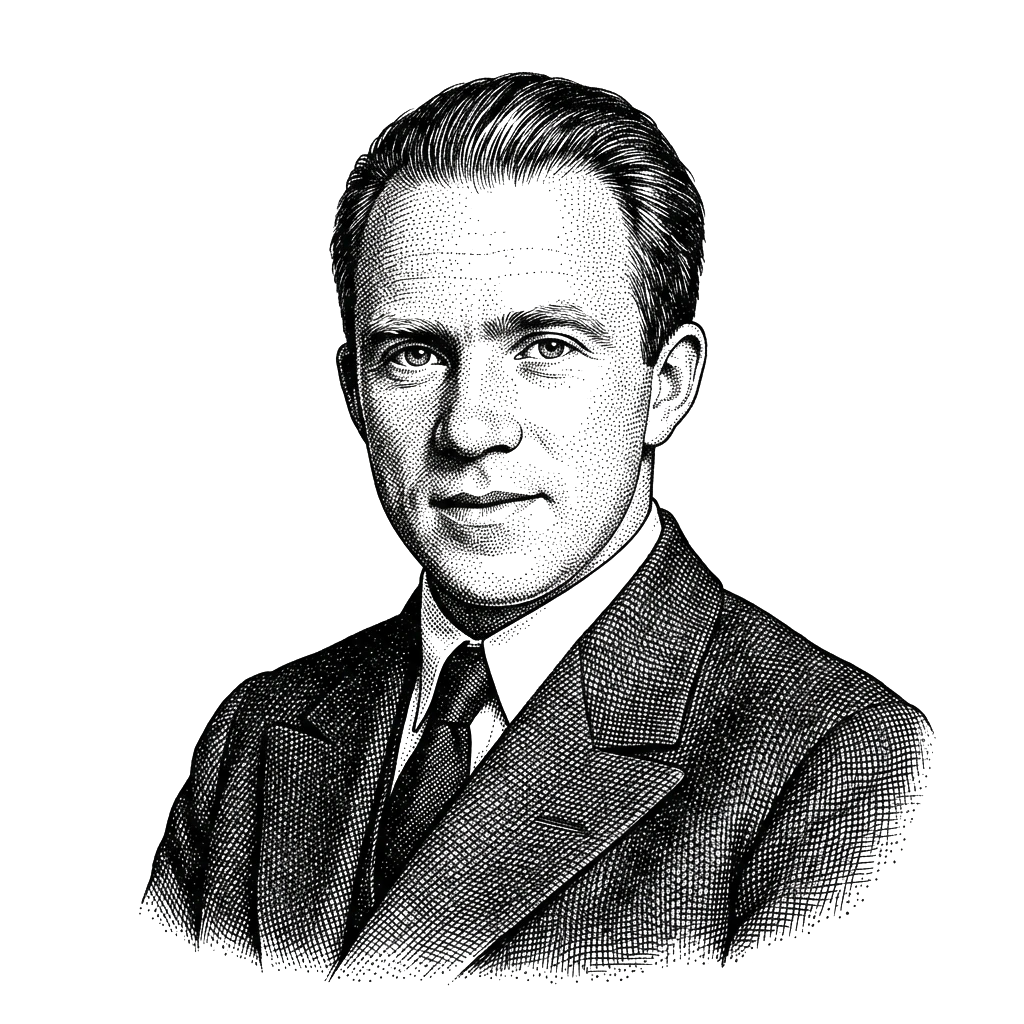
In the early summer of 1925, suffering from an acute and agonizing attack of hay fever that swollen his eyes and choked his throat, a twenty-three-year-old German physicist fled the pollen-choked mainland for the barren, windswept rock of Helgoland in the North Sea. There, in an island landscape stripped bare of trees, accompanied only by the ceaseless crash of the gray Atlantic against black sea cliffs, Werner Heisenberg performed the decisive conceptual demolition that opened the quantum age. For twelve years, physicists had attempted to rescue Niels Bohr's planetary model of the atom—imagining tiny electrons orbiting the nucleus like miniature planets, leaping unpredictably between discrete orbits. Heisenberg realized that the model was contaminated by classical prejudice: no human instrument had ever seen an electron orbit, nor could an orbit ever be measured.
Pacing the cliffs of Helgoland until three o'clock in the morning, Heisenberg made a radical epistemological vow: physics must abandon all unobservable classical mental pictures and build its mathematical framework exclusively upon quantities that can actually be observed in the laboratory—specifically, the frequencies and intensities of spectral radiation emitted by atoms. Through feverish, sleepless nights, calculating the energy conservation of non-commuting tabular arrays of transitions, he arrived at a bizarre mathematical result where multiplying transition $A$ by transition $B$ did not equal multiplying $B$ by $A$. When the calculation finally balanced, confirming the principle of energy conservation, he was terrified: "I was deeply shaken. I had the feeling that I was looking through the surface of atomic phenomena into a strangely beautiful interior, and I felt almost dizzy at the thought that I was now to examine this wealth of mathematical structures that nature had so generously spread before me."
Returning to Göttingen, Heisenberg presented his cryptic tables to his mentor Max Born. Born recognized that Heisenberg had independently stumbled upon matrix algebra—a branch of higher mathematics completely unknown to contemporary quantum physicists. Joined by Pascual Jordan, Born and Heisenberg published the legendary Dreimännerarbeit (Three-Man Paper), establishing Matrix Mechanics: the first complete, rigorous, and self-consistent mathematical formulation of quantum mechanics. Particles were no longer billiard balls traveling along classical trajectories in three-dimensional space; they were described by infinite-dimensional Hermitian matrices acting upon state vectors.
When Erwin Schrödinger proposed an alternative wave mechanics in 1926—claiming that atomic reality consisted of continuous, visualizable matter waves governed by a differential equation—Heisenberg was fiercely critical. He understood that Schrödinger's wave visualizability (Anschaulichkeit) was a comforting delusion, an attempt to smuggle classical continuum mechanics back into a reality that was fundamentally discrete and discontinuous. To settle the debate, Heisenberg spent months in Copenhagen with Niels Bohr, arguing late into the night until both men were on the verge of physical and nervous exhaustion.
Out of that intense Copenhagen crucible came Heisenberg's crowning breakthrough: the Uncertainty Principle (Unschärferelation), formulated in 1927. Through his famous thought experiment with the gamma-ray microscope, Heisenberg demonstrated that the act of observing an atomic particle unavoidably alters its state. To pinpoint the exact position of an electron, one must bounce a photon of light off it; but a photon with a wavelength short enough to resolve high position accuracy carries high momentum, which inevitably delivers a violent, uncontrollable kick to the electron, scrambling its momentum.
Heisenberg proved that this was not a practical defect of human engineering, but an intrinsic, fundamental property of physical reality. The product of the uncertainty in position and the uncertainty in momentum can never be less than half of the reduced Planck constant: $\Delta x \cdot \Delta p \ge \hbar / 2$. A particle does not possess a simultaneously sharp position and sharp momentum that we are merely too clumsy to detect; prior to measurement, those properties do not exist in a definite classical state. The classical dream of Laplacian determinism—where knowledge of the exact position and velocity of every particle in the universe at one instant allows the total prediction of all past and future time—was smashed forever.
In 1932, at the age of thirty-one, Heisenberg was awarded the Nobel Prize in Physics for the creation of quantum mechanics. Yet the triumphant ascent of his science was shadowed by the dark political tragedy of his homeland. When the National Socialists seized power in 1933, driving Einstein, Born, Bethe, and Wigner into exile, Heisenberg chose to remain in Germany, enduring vicious assaults from the Nazi "German Physics" (Deutsche Physik) movement, which denounced him as a "White Jew" for teaching relativity and quantum theory. During the Second World War, Heisenberg served as the scientific head of the German uranium project (Uranverein).
His wartime role remains one of the most agonizing, intensely debated moral enigmas in the history of science. Did Heisenberg deliberately drag his feet, subtly exaggerating the technical difficulties and critical mass of plutonium to prevent Hitler from acquiring an atomic bomb, or did the German project simply fail because of bureaucratic fragmentation, Allied bombings, and theoretical miscalculations regarding graphite moderators? His ambiguous September 1941 meeting in occupied Copenhagen with his beloved mentor Niels Bohr permanently severed their deep friendship, leaving behind an insoluble cloud of suspicion that haunted Heisenberg for the rest of his life.
Following the war, interned with fellow German physicists at Farm Hall in England where they heard the radio broadcasts of the atomic bombing of Hiroshima with stunned horror, Heisenberg returned to Germany to rebuild German science, serving as director of the Max Planck Institute for Physics. In his elder years, he turned increasingly to philosophical reflections on quantum epistemology, defending the Copenhagen interpretation in Physics and Philosophy and seeking an elusive unified non-linear field theory of elementary particles—the "world formula."
He died in Munich on February 1, 1976. On his gravestone, friends inscribed an epitaph echoing his revolutionary insight into the boundaries of knowledge: "He lies here somewhere." Werner Heisenberg permanently dismantled the naive classical assumption that human beings can observe the universe from an objective, detached Olympian vantage point. He proved that what we observe is not nature itself, but nature exposed to our method of questioning, forever weaving the observer into the fabric of the cosmos.
“What we observe is not nature itself, but nature exposed to our method of questioning.”
“An expert is someone who knows some of the worst mistakes that can be made in his subject, and how to avoid them.”
“The first gulp from the glass of natural sciences will turn you into an atheist, but at the bottom of the glass God is waiting for you.”
“Not only is the universe stranger than we think, it is stranger than we can think.”
“In the history of science, every step is a step into the unknown.”
- On Quantum-Theoretical Reinterpretation of Kinematics (Helgoland Paper) 1925
- On the Perceptual Content of Quantum Kinematics (Uncertainty Paper) 1927
- The Physical Principles of the Quantum Theory 1930
- On the Structure of Atomic Nuclei (Isospin Paper) 1932
- Physics and Philosophy 1958