William Shakespeare
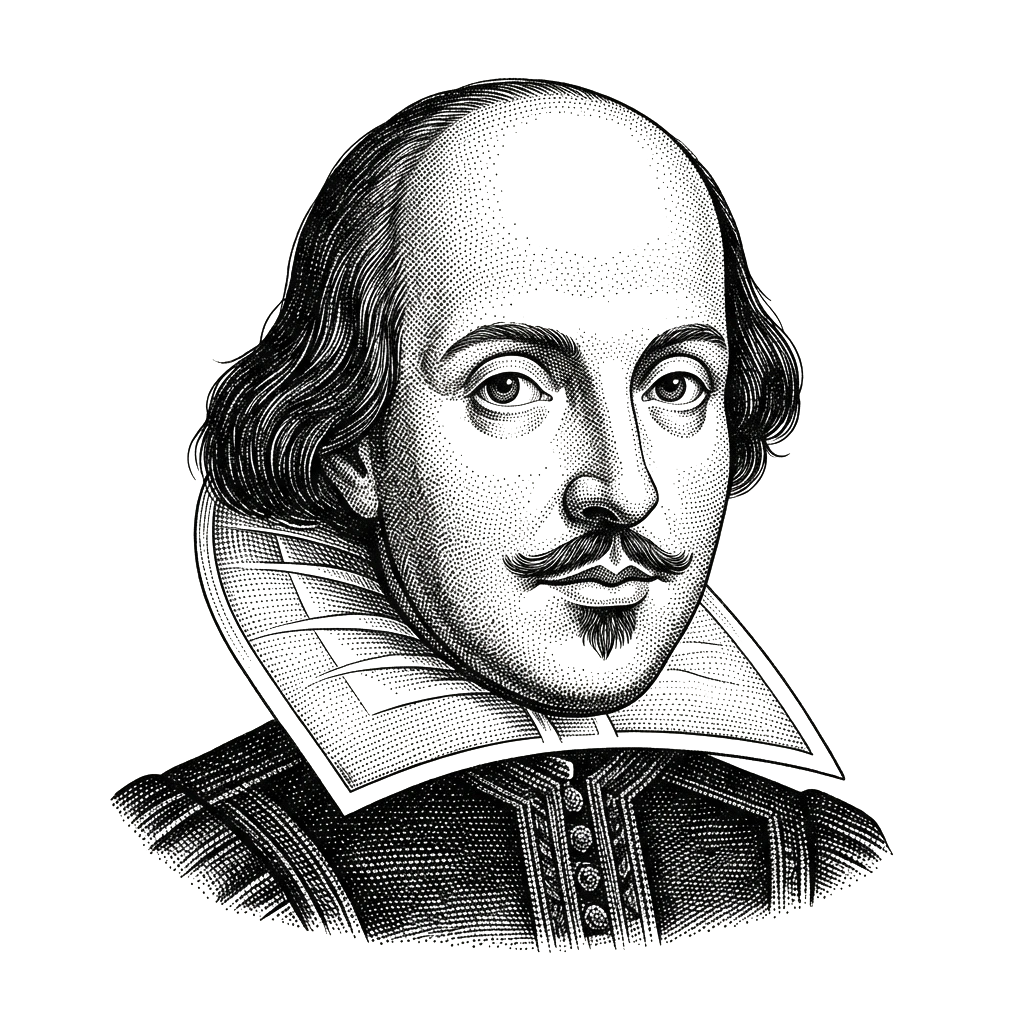
In the bitter winter of 1598, on the north bank of the frozen Thames, a small band of actors and carpenters committed a brazen act of architectural theft. Barred by an intractable landlord from entering The Theatre in Shoreditch—the timber playhouse where their repertory had been forged—the Lord Chamberlain's Men, armed with daggers, broadswords, and crowbars, dismantled the entire wooden structure beam by beam in the middle of the night. Hauling the heavy oak timbers across the icy river to the unruly liberty of Southwark, they raised the Globe, christening it under a banner displaying Hercules bearing the globe on his back: Totus mundus agit histrionem—the whole world plays the actor. In that circular wooden O, open to the volatile London rain and sky, William Shakespeare constructed the theatrical crucible of modern selfhood.
Born in 1564 in the market town of Stratford-upon-Avon, the son of a glover and alderman who fell into debt, Shakespeare had no university pedigree, unlike the "University Wits" Marlowe and Greene who sneered at the "upstart crow" beautified with their feathers. His schooling was the King's New School: eight-hour daily grinds in Latin syntax, Ovid's Metamorphoses, rhetoric, and the classical dialectic of arguing in utramque partem—from both sides of any human dilemma. When he arrived in London in the late 1580s, the English language was a turbulent, expanding ocean, absorbing loanwords, vernacular slang, legal jargon, and theological controversy. Shakespeare seized this linguistic chaos, expanding the English lexicon by over seventeen hundred words and turning syntax into a seismograph of human psychology.
Before Shakespeare, dramatic characters were largely moral emblems, morality play virtues, or monolithic statues of classical fury. In the tragedies and problem plays, Shakespeare invented the phenomenon of human interiority: characters who overhear themselves speaking, who surprise themselves in soliloquy, and whose tragic destruction stems not from an external wheel of fortune, but from the fatal friction within their own divided consciousness. When Hamlet stands over the praying Claudius and stays his sword, his hesitation is not cowardice, but an unprecedented excess of awareness—an intellect that paralyzes will by perceiving every metaphysical reverberation of action.
In Macbeth, the vaulting ambition that murders Duncan does not bring triumph, but an existential vertigo where memory becomes a torment and time itself disintegrates into the monotonous stutter of "tomorrow, and tomorrow, and tomorrow." In King Lear, Shakespeare strips royalty, family, language, and sanity down to the unaccommodated bare forked animal on the storm-swept heath. Lear's agony is not that the heavens are hostile, but that they are utterly indifferent, forcing humanity to discover compassion only when everything earthly has been smashed to dust. Shakespeare refused the comforting resolutions of didactic morality; he stared directly into the abyss of human vulnerability and recorded what he saw without blinking.
Yet the tragic abyss was only one hemisphere of his cosmos. In the comedies and late romances, Shakespeare mapped the transformative power of forgiveness, festivity, and pastoral renewal. In A Midsummer Night's Dream and As You Like It, characters flee the claustrophobic courts of rigid law into green worlds—the forest of Athens, the Forest of Arden—where gender, class, and rationality dissolve into creative play. The lunatic, the lover, and the poet, Theseus observes, are of imagination all compact; yet out of airy nothing, the poet gives to airy nothing a local habitation and a name.
His verbal architecture operated on multiple simultaneous registers: the high rhetorical cadence of blank verse for kings and statesmen, and the earthy, prose rhythms of drunkards, gravediggers, and fools. His clowns and fools—Feste, the Fool in Lear, Touchstone—are never peripheral comic relief; they are the sovereign truth-tellers of the drama, the only voices permitted to puncture the delusions of monarchs with riddles and paradoxical clarity. By weaving the sublime and the grotesque, the royal and the base, into a single uninterrupted tapestry, Shakespeare mirrored the irreducible polyphony of human existence.
By 1613, having composed thirty-eight plays and a hundred and fifty-four sonnets that laid bare the agonizing paradoxes of erotic devotion and mortal decay, Shakespeare did what few artistic titans have ever done: he laid down his instruments and walked away. In his final solo masterpiece, The Tempest, the magician Prospero, stranded on an enchanted island, orchestrates a reconciliation with the enemies who usurped him. Yet instead of extracting vengeance, Prospero realizes that "the rarer action is in virtue than in vengeance." Standing on the brink of return to the mortal world, he abjures his rough magic, breaks his staff, and buries his book deeper than did ever plummet sound.
Retiring to New Place, the grandest house in Stratford, Shakespeare lived out his remaining years not as a self-conscious literary icon, but as a quiet country gentleman, investing in tithes, malt, and local property. He died on April 23, 1616, at the age of fifty-two, leaving his wife his "second best bed" and having never bothered to collect or print a definitive edition of his works. Had two fellow actors from the King's Men, John Heminges and Henry Condell, not lovingly assembled his foul papers, promptbooks, and memorial transcriptions into the First Folio of 1623, half of his masterpieces—including Macbeth, Twelfth Night, The Tempest, and Julius Caesar—would have been lost to human memory forever.
In the preface to that First Folio, his fierce rival and friend Ben Jonson delivered the timeless judgment: "He was not of an age, but for all time!" Shakespeare’s genius was not the invention of novel philosophical doctrines, but the creation of an imaginative mirror large enough to reflect the entire spectrum of human reality. He possessed what John Keats later named "Negative Capability"—the capacity to exist in uncertainties, mysteries, and doubts, without any irritable reaching after fact and reason.
Four centuries after his death, his language remains the bedrock of world culture. Whenever a judge weighs mercy against justice, whenever a lover feels the ache of time's sickle, whenever a leader recognizes the theatrical pageantry of political power, or whenever an ordinary person grapples with the phantom voices of their own divided heart, they speak the grammar Shakespeare articulated. He took the transient, volatile medium of popular English theater and elevated it into a universal secular liturgy, proving that to study the human condition in all its beauty, absurdity, and terror is to stand upon his stage.
“All the world's a stage, and all the men and women merely players.”
“There are more things in heaven and earth, Horatio, than are dreamt of in your philosophy.”
“We are such stuff as dreams are made on, and our little life is rounded with a sleep.”
“The quality of mercy is not strained; it droppeth as the gentle rain from heaven upon the place beneath.”
“Give sorrow words; the grief that does not speak knits up the o'erwrought heart and bids it break.”
- Hamlet, Prince of Denmark c. 1600–1601
- King Lear c. 1605–1606
- Macbeth c. 1606
- The Tempest 1611
- Sonnets 1609