Ada Lovelace
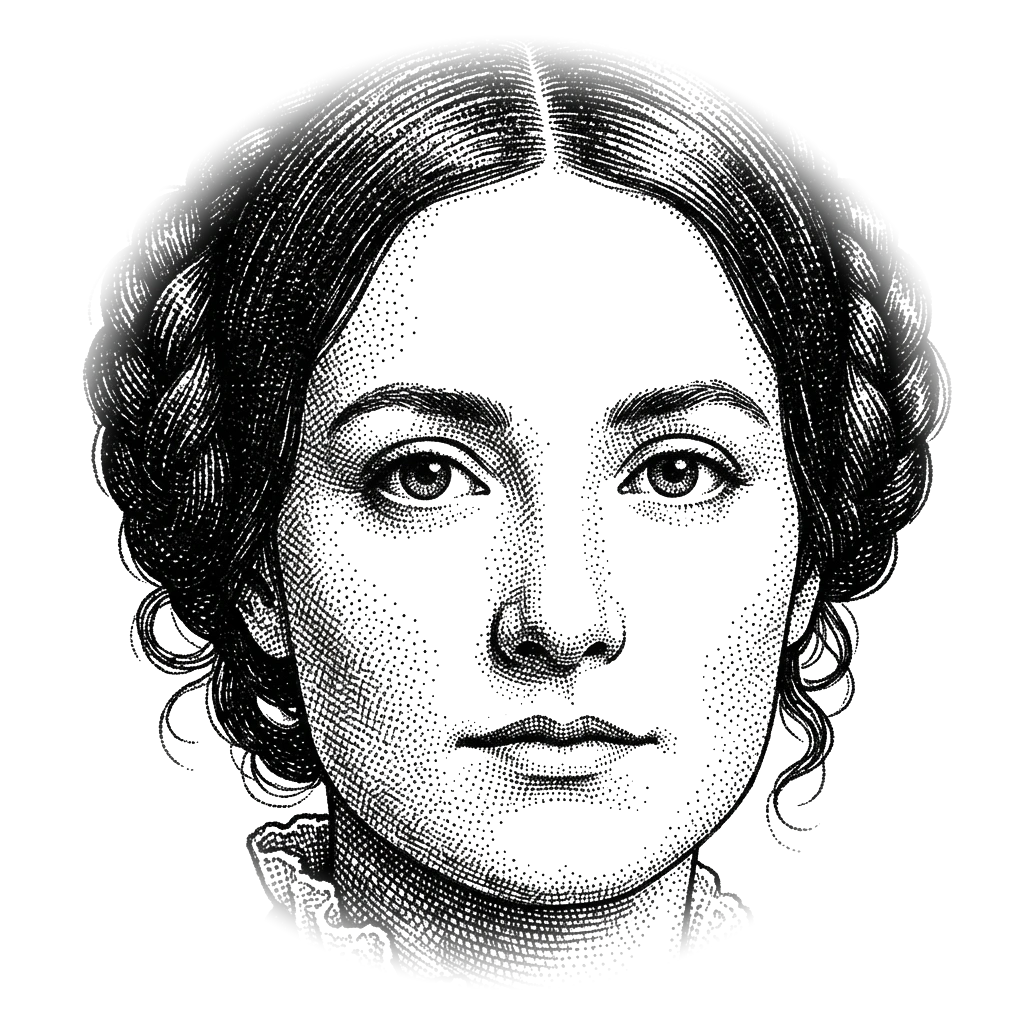
In the damp London drawing rooms of the 1840s, surrounded by the ticking brass clocks and heavy velvet drapes of Victorian high society, an aristocratic woman in her late twenties looked upon a towering apparatus of interlocking gears and perceived a universe that its own inventor could not fully comprehend. Charles Babbage called his Analytical Engine a machine for calculating tables—a mechanical leviathan of columns, wheels, and levers designed to eliminate the human errors that riddled nautical almanacs and astronomical ephemerides. Babbage saw arithmetic: sums, differences, products, and quotients carved into brass teeth. Augusta Ada King, Countess of Lovelace, saw something infinitely more radical. She saw that numbers were merely arbitrary symbols. If an engine could manipulate numerical quantities according to axiomatic rules, it could manipulate any physical or conceptual entity that could be mapped into symbolic relations.
This was the intellectual leap she termed 'poetical science'—not a retreat into romantic mysticism, despite her heritage as the sole legitimate daughter of Lord Byron, but a disciplined, imaginative synthesis of mathematical rigor and metaphysical intuition. Her mother, Lady Byron, terrified that the girl might inherit her father's mercurial madness, had immersed Ada from childhood in a relentless curriculum of geometry, logic, and astronomy. The result was not the suppression of imagination, but its channeling into structural precision. When Lovelace translated Luigi Menabrea's French paper on Babbage's engine in 1842, she did not merely provide an English rendering; she appended seven extensive annotations, lettered A through G, that tripled the length of the original text and established the foundational philosophy of computer science.
In Note A, Lovelace drew the immortal distinction between Babbage's earlier Difference Engine and the Analytical Engine. The Difference Engine was a specialized calculating machine, limited to tabulating polynomials via the method of finite differences; it was a mechanical clock that could only strike one kind of hour. The Analytical Engine, by contrast, introduced the Jacquard loom's punched cards into mechanical calculation. Just as the Jacquard loom used holes in pasteboard cards to guide silk threads into intricate floral brocades without altering the loom itself, the Analytical Engine used operational cards to dictate the sequence of mechanical operations and variable cards to dictate the memory columns to be operated upon. Lovelace wrote the definitive sentence of the computational age: the Analytical Engine weaves algebraical patterns just as the Jacquard loom weaves flowers and leaves.
This separation of the operational mechanism from the data upon which it acts marks the birth of software. Lovelace understood what modern engineering calls the separation of code and state, control flow and storage. The Engine was partitioned into the 'Store'—where numbers were held in passive vertical columns of geared wheels, corresponding to modern random-access memory—and the 'Mill'—where active arithmetical operations were executed, corresponding to the central processing unit. By choreographing how cards could command the Mill to read from columns, execute operations, store results back into empty registers, and repeat loops conditionally based on internal states, she invented the core concepts of the subprogram, algorithmic iteration, and conditional branching.
To demonstrate the reality of this abstract science, Lovelace authored Note G: the complete, step-by-step trace of an algorithm to calculate the Bernoulli numbers. This was not a vague speculative sketch; it was a fully realized execution trace, complete with variable addresses, intermediate registers, operational cycles, and parallel column updates. Bernoulli numbers—fundamental coefficients appearing in the Taylor series expansions of trigonometric functions and number theory—presented a formidable computational challenge because each successive number requires a nested summation over previously derived values. Lovelace mapped this recursive labyrinth onto twenty-five distinct mechanical cycles, producing the world's first published, functioning computer program.
More profound than the algorithm itself was her realization of algorithmic limits. In what Alan Turing would later designate 'Lady Lovelace's Objection,' she wrote that the Analytical Engine has no pretensions whatever to originate anything; it can do whatever we know how to order it to perform. A machine does not possess intentionality, consciousness, or spontaneous creative will. Its majesty lies in its ability to execute logical dependencies with infallible, tireless velocity, relieving the human intellect of mechanical drudgery so that it may ascend to higher planes of synthesis. Yet she simultaneously anticipated algorithmic composition, suggesting that if the fundamental relations of pitched sounds and the laws of harmony were susceptible of operational expression, the Engine might compose elaborate and scientific pieces of music of any degree of complexity.
Her life, like that of her father, was brief and intense, shadowed by chronic illness, painful gastrointestinal ailments, and the social constraints of an era that denied women university admission and scientific publication under their own names (her notes were signed only with the modest initials 'A.A.L.'). She died of uterine cancer in 1852 at the age of thirty-six, the exact age at which Byron had perished. Babbage's Analytical Engine was never completed in their lifetimes; the Victorian machine tool industry lacked the micrometer precision required to manufacture thousands of identical interlocking gears without friction seizing the assembly. For nearly a century, Lovelace's notes were treated as a quaint Victorian curiosity, the eccentric hobby of an aristocratic dilettante.
Yet when the crisis of wartime cryptanalysis and ballistics forced John von Neumann, Alan Turing, and the builders of ENIAC and EDSAC to design electronic computing architectures in the 1940s, Lovelace's concepts reappeared with shocking immediacy. Turing studied Note G intensely while formulating the Turing Test and the concept of universal computing machines. What Babbage had conceived as a cathedral of brass and steam, Lovelace had understood as a universal medium for logical operations.
Today, Ada Lovelace stands as the prophet of the digital epoch. The programming language Ada, created by the United States Department of Defense for mission-critical aerospace and defense systems, honors her memory. But her true monument is the universal computer itself. Every smartphone streaming synthesized audio, every compiler translating high-level logic into machine instructions, and every algorithm orchestrating operations across memory registers fulfills the vision she articulated in her quiet study in 1843.
She demonstrated that the highest exercise of intellect occurs when mathematical rigor is joined to creative vision. She saw through the heavy metal of the industrial revolution to glimpse the weightless kingdom of information. In an age of coal, steam, and soot, Ada Lovelace understood that the most powerful engine humanity would ever construct was an engine made of pure, executable logic.
“The Analytical Engine weaves algebraical patterns just as the Jacquard-loom weaves flowers and leaves.”
“In considering any new subject, there is frequently a tendency, first, to overrate what we find to be already interesting or remarkable; and, secondly, by a sort of natural reaction, to undervalue the true state of the case.”
“The science of operations, as derived from mathematics more especially, is a science of itself, and has its own abstract truth and value.”
“I believe myself to possess a most singular combination of qualities exactly fitted to make me pre-eminently a discoverer of the hidden realities of nature.”
“The Analytical Engine has no pretensions whatever to originate anything. It can do whatever we know how to order it to perform.”
- Sketch of the Analytical Engine (Translation and Notes A-G) 1843
- Notes on the Bernoulli Number Algorithm (Note G) 1843
- Letters on Poetical Science and Mathematical Philosophy 1840-1852