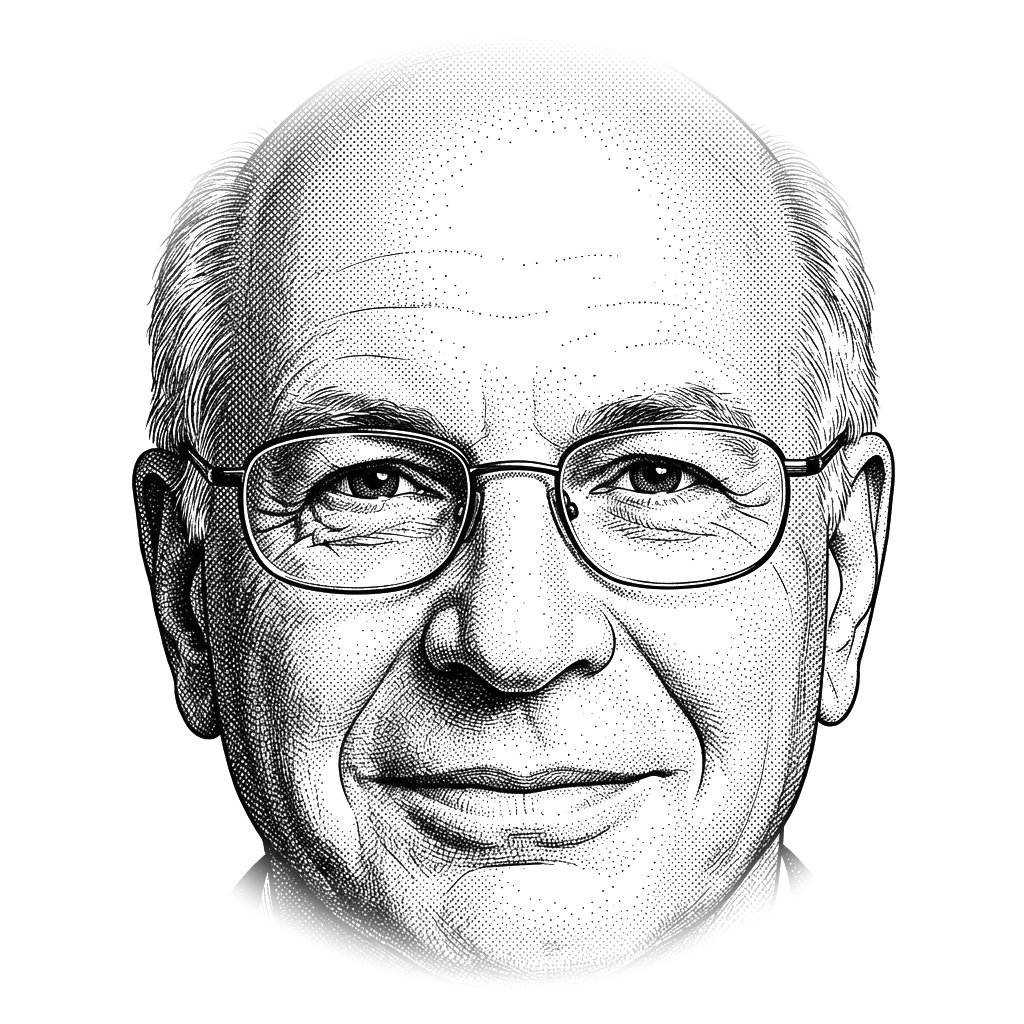
Daniel Kahneman
For decades, modern economics rested upon an intoxicating theoretical fiction: Homo economicus, the rational actor. Formalized by John von Neumann, Oskar Morgenstern, and Leonard Savage, this axiomatic agent was a frictionless calculating machine. Faced with an uncertain world, the rational agent surveyed all possible outcomes, assessed their objective probabilities through Bayesian integration, weighted each payoff by its utility across lifetime wealth, and chose the mathematically optimal path. Any human deviations were dismissed as unsystematic noise that competitive markets would swiftly wash away.
Daniel Kahneman looked at this pristine edifice and saw that it described a creature that does not exist.
Trained in visual psychophysics and attention, Kahneman approached the mind not as a broken calculator, but as a sensory instrument. The human eye does not measure illumination in absolute lumens; it registers contrast relative to ambient light. The skin does not gauge temperature in kelvins; it registers whether water feels warm or cold relative to its prior state of adaptation. Perceptual systems are differential engines designed to register change and contrast.
When Kahneman formed his partnership with Amos Tversky at the Hebrew University of Jerusalem in 1969, they posed a foundational question: What if human judgment under uncertainty is governed not by probability calculus, but by the comparative mechanics of perception?
Over three decades, Kahneman and Tversky proved that when people confront statistical problems, they do not integrate probability distributions. Instead, the mind executes an unconscious attribute substitution: it replaces an intractable statistical question with an easy associative one.
They mapped the three canonical heuristics through which this substitution operates:
First, Representativeness. The mind evaluates the likelihood of an outcome by how closely it resembles a prototype, routinely ignoring statistical base rates and sample sizes. In their 1983 Linda problem, participants met Linda—thirty-one, single, outspoken, and deeply committed to social justice. When asked whether Linda was more likely to be a bank teller, or a bank teller active in the feminist movement, more than eighty-five percent of respondents chose the latter. In doing so, they violated the conjunction rule of probability ($P(A \land B) \le P(A)$) because the narrative portrait felt more representative.
Second, Availability. The probability of an event is judged by the cognitive ease with which instances come to mind. Because plane crashes, terrorism, and homicides receive vivid coverage, they are retrieved with effortless fluency, causing people to drastically overestimate their frequency while underestimating quiet killers—stroke, asthma, diabetes—whose occurrences leave no vivid trace.
Third, Anchoring and Adjustment. When estimating an unknown quantity, any numerical value introduced into the environment—even a random number spun on a rigged wheel—acts as a psychological anchor. The mind adjusts away from it, but the adjustment halts prematurely, pulling the estimate toward the initial suggestion.
These heuristics were not random blunders. They were systematic cognitive illusions—as repeatable and structural as optical illusions.
In 1979, Kahneman and Tversky published "Prospect Theory: An Analysis of Decision under Risk," the paper that dismantled Expected Utility Theory and eventually earned Kahneman the 2002 Nobel Prize in Economic Sciences.
The core insight of Prospect Theory was the rejection of the Bernoullian assumption that choices are evaluated in terms of absolute wealth states ($W$). Human beings do not evaluate final assets; they evaluate gains and losses relative to a plastic reference point ($x = W - W_0$).
This yielded the asymmetric, S-shaped value function: $$v(x) = \begin{cases} x^\alpha & \text{for } x \ge 0 \\ -\lambda (-x)^\beta & \text{for } x < 0 \end{cases}$$
The function embodies three core principles: 1. Reference Dependence: Payoffs are coded as gains or losses purely relative to a neutral reference state, which can be manipulated by framing. 2. Diminishing Sensitivity: The curve is concave for gains and convex for losses ($\alpha, \beta \approx 0.88$). Consequently, human risk preferences invert across zero: people are risk-averse when securing gains, but become risk-seeking gamblers when trying to avert losses. 3. Loss Aversion: The negative curve is far steeper than the positive curve ($\lambda \approx 2.25$). Losses loom roughly twice as large as equivalent gains; the pain of losing \$10,000 dwarfs the pleasure of gaining \$10,000.
Compounding this was a non-linear decision weighting function, $\pi(p)$, showing that people do not weight probabilities linearly. Humans overweight rare tail events—simultaneously buying lottery tickets and catastrophic insurance—while underweighting moderate and high probabilities.
Through framing effects, Kahneman showed that identical statistical realities yield contradictory decisions. In the Asian disease problem, identical outcomes produced risk aversion when framed as "lives saved" and risk-seeking when framed as "lives lost." Rationality, under neoclassical axioms, was an empirical phantom.
Kahneman synthesized these mechanics in Thinking, Fast and Slow (2011) through the dual-process cognitive architecture: * System 1: Fast, automatic, associative, and effortless. It continuously constructs causal stories governed by WYSIATI ("What You See Is All There Is"). * System 2: Slow, deliberate, rule-governed, and effortful. It handles complex calculation and impulse control. But System 2 is computationally constrained and metabolically lazy. Pupillometry proved that the pupil dilates in exact synchrony with the mental effort expended by System 2 during challenging tasks.
Crucially, System 2 is rarely the sovereign master of thought; it routinely functions as a retrospective defense attorney, inventing coherent justifications for intuitive choices already made by System 1.
Even the conscious self is divided. In his work on hedonic psychology, Kahneman distinguished between the experiencing self—which lives each moment in continuous time—and the remembering self, which constructs retrospective narratives. In clinical trials of painful procedures such as colonoscopies, Kahneman discovered the peak-end rule and duration neglect: retrospective evaluations ignore total elapsed duration, reflecting only the average of the worst moment and the final moment. The remembering self will willingly impose greater total pain on the experiencing self so long as the ordeal ends on a milder note.
Kahneman never argued that the human mind was irrational in the colloquial sense. He proved that human reason possesses a decipherable anatomy. We are not calculating machines, nor are we erratic animals. We are associative creatures navigating uncertainty with an evolved perceptual apparatus—deeply biased, remarkably coherent, and fundamentally human.
“A reliable way to make people believe in falsehoods is frequent repetition, because familiarity is not easily distinguished from truth.”
“The confidence that individuals have in their beliefs depends mostly on the quality of the story they can tell about what they see, even if they see little.”
“Losses loom larger than gains.”
“Nothing in life is as important as you think it is, while you are thinking about it.”
“We can be blind to the obvious, and we are also blind to our blindness.”
- Belief in the Law of Small Numbers (with Amos Tversky) 1971
- Judgment under Uncertainty: Heuristics and Biases (with Amos Tversky) 1974
- Prospect Theory: An Analysis of Decision under Risk (with Amos Tversky) 1979
- Choices, Values, and Frames 2000
- Thinking, Fast and Slow 2011
- Noise: A Flaw in Human Judgment (with Sibony & Sunstein) 2021