Albert Einstein
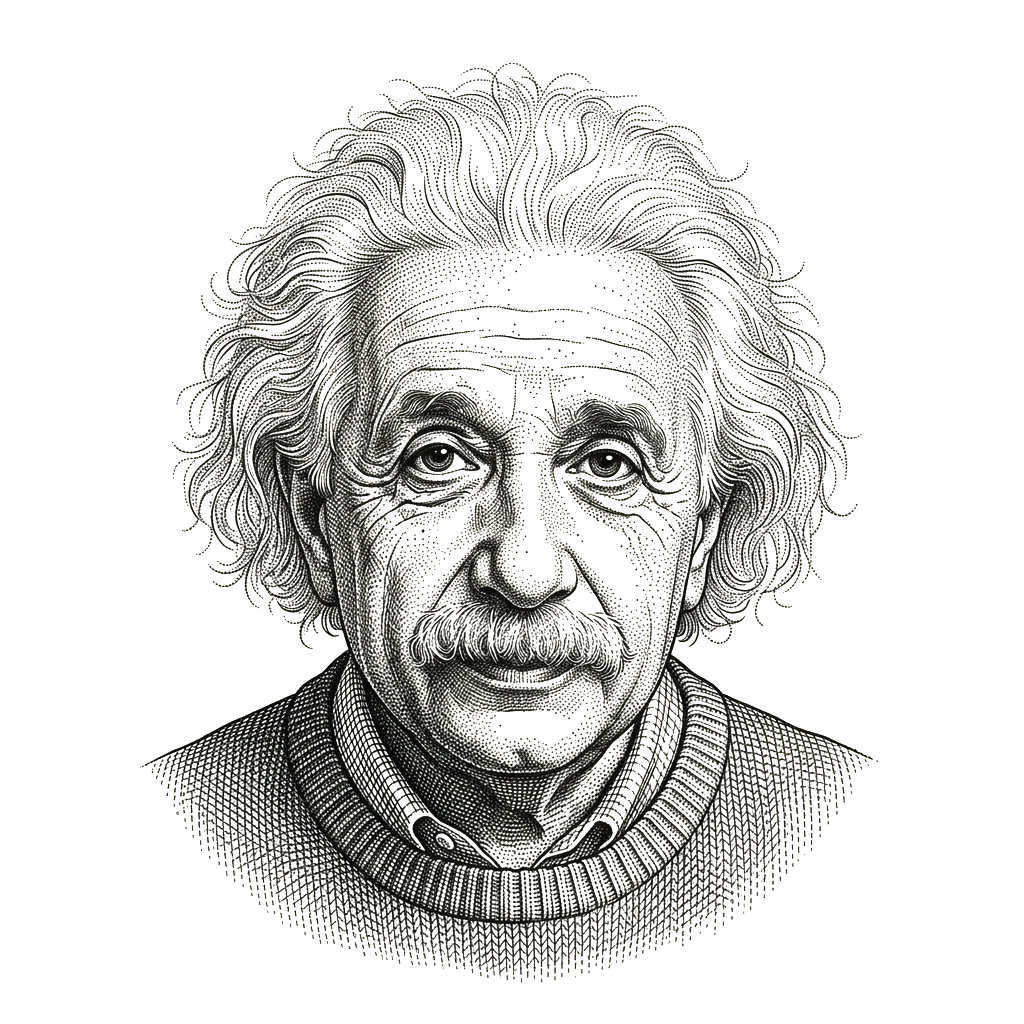
In 1905, inside the Swiss Patent Office in Bern, a twenty-six-year-old technical clerk sat examining patent applications for electromechanical clock synchronizers. Central Europe was coordinating its rail network. Municipalities still ran on idiosyncratic local times, and engineers were stringing telegraph lines along tracks to force station clocks into agreement. At the same moment, theoretical physics was fracturing along a fault line between its two greatest monuments.
Newtonian mechanics rested on the premise that space was an inert Euclidean stage and that time flowed uniformly across the universe without relation to anything external. Maxwellian electrodynamics, codified four decades later, showed that light was an electromagnetic wave whose vacuum speed, $c$, was an unyielding constant of roughly 300,000 kilometers per second.
These architectures were mathematically irreconcilable. Under Newtonian kinematics, velocities added directly: light from a speeding train should travel faster than light from a stationary lantern. Yet Maxwell’s equations contained no term for emitter speed; light propagated at $c$ regardless. To preserve Newton, physicists posited the luminiferous aether, an invisible fluid serving as the absolute rest frame. When Albert Michelson and Edward Morley’s 1887 interferometer failed to detect Earth's drift through this sea, theorists devised ad hoc fixes, positing that motion contracted measuring rods and produced an artificial distortion termed "local time."
Albert Einstein saw what the masters had missed: the aether was an unnecessary ghost. The flaw lay not in Maxwell’s electrodynamics, but in humanity's unexamined intuition regarding time.
Einstein grounded his revolution in an operational question: what does it mean to declare that two events happen "at the same time"?
Simultaneity, he realized, is not a cosmic verdict handed down by a universal master clock. It is an operational comparison mediated by physical signals. Because information cannot travel faster than light, any determination that two distant events occur concurrently depends on light signals reaching an observer positioned between them.
Consider a railway carriage struck at both ends by lightning. For an observer standing midway on the embankment, the flashes travel equal distances at speed $c$ and arrive simultaneously. But for a passenger inside the carriage hurtling toward the forward flash and away from the rear one, the forward beam arrives first. Because the speed of light is strictly invariant for all observers regardless of uniform motion—Einstein’s founding postulate—neither perspective is privileged. There is no master frame to declare who is "really" correct.
Simultaneity is relative. If simultaneity is relative, time itself cannot be absolute.
Every moving frame carries its own operational clock. As an object moves relative to an observer, its time dilates, its length contracts along the line of motion, and space and time dissolve as independent containers. As Hermann Minkowski recognized in 1908, space by itself and time by itself fade into shadows; only a unified four-dimensional continuum—spacetime—remains invariant.
From this kinematic foundation flowed an inevitable physical consequence. If a body emits or absorbs energy $L$, its inertial mass must shift by $L/c^2$. Mass is not an immutable substance, but concentrated energy bound in cohesive stasis: $$E = mc^2$$
Special relativity resolved the conflict between mechanics and electrodynamics, but it applied only to unaccelerated inertial frames and directly contradicted Newton’s gravitation, which presumed instantaneous action-at-a-distance.
In November 1907, still at his Bern desk, Einstein experienced what he termed "the happiest thought of my life": if an observer falls freely from the roof of a house, they will not feel their own weight.
In free fall, the observer drops at the identical acceleration of everything around them. If they release a set of keys, the keys hover beside them in midair. Inside a falling chamber, gravity vanishes. Conversely, an observer enclosed in a windowless capsule accelerated through deep space at $9.8\,\text{m/s}^2$ feels their boots pressed firmly to the floor; dropped objects accelerate downward exactly as they do on Earth.
This was the Equivalence Principle: inertial mass (resistance to acceleration) and gravitational mass (response to gravity) are not coincidentally equal; they are physically identical.
Gravitation, Einstein realized, is not an attractive mechanical force. If a beam of light traverses an accelerating rocket cabin, the rising floor causes the beam's trajectory to appear curved. By the Equivalence Principle, a light beam skimming past a massive body must likewise bend. Yet light possesses no mass to be hauled by a Newtonian pull. If light bends across empty space, it is simply traversing the straightest path through an underlying fabric that has itself been warped.
Space and time were not a rigid backdrop. They were elastic, dynamic, and curved.
To cast this vision into mathematical law required eight years of struggle. Einstein abandoned Euclidean geometry for the non-Euclidean tensor calculus of Bernhard Riemann, Gregorio Ricci-Curbastro, and Tullio Levi-Civita. Guided by his friend Marcel Grossmann, Einstein navigated coordinate blind alleys, physical paradoxes, and the "hole argument" before arriving, in November 1915, at the definitive field equations: $$G_{\mu\nu} = \frac{8\pi G}{c^4} T_{\mu\nu}$$
On the left sits $G_{\mu\nu}$, the Einstein tensor, encoding the metric curvature of four-dimensional spacetime. On the right sits $T_{\mu\nu}$, the stress-energy tensor, encoding the distribution and flux of matter and energy. Spacetime tells matter how to move; matter tells spacetime how to curve.
Planets do not orbit the Sun because an invisible tether tugs them inward; they follow straight lines—geodesics—through a spacetime manifold curved by solar mass. When Mercury swings past perihelion, the anomalous forty-three arcseconds of orbital precession that had defied Newtonian astronomy for decades emerged directly from the metric without an adjustable parameter.
Cultural myth would later degrade Einstein’s discovery into an intellectual slogan: "everything is relative."
The truth was its precise inversion. Einstein’s quest was not the defense of subjectivity, but the unyielding pursuit of absolute invariants. He dissolved parochial frames of reference precisely to isolate what remains unalterable: the invariant speed of light, the spacetime interval $ds^2$, and the tensorial laws of nature that hold identically for every observer in the cosmos.
Albert Einstein did not invent the universe; he stripped away the provincial illusions that obscured it. By transforming Newton’s rigid clockwork into a living geometry, he proved that reality is an indivisible tapestry wherein space, time, matter, and energy exist in perpetual, self-consistent conversation.
“Time and space are modes by which we think and not conditions in which we live.”
“Matter tells spacetime how to curve, and spacetime tells matter how to move.”
“The most incomprehensible thing about the universe is that it is comprehensible.”
“Subtle is the Lord, but malicious He is not.”
- On the Electrodynamics of Moving Bodies (Zur Elektrodynamik bewegter Körper) 1905
- Does the Inertia of a Body Depend Upon Its Energy-Content? 1905
- The Field Equations of Gravitation (Die Feldgleichungen der Gravitation) 1915
- The Foundation of the General Theory of Relativity 1916
- Can Quantum-Mechanical Description of Physical Reality be Considered Complete? (EPR) 1935