Ludwig Boltzmann
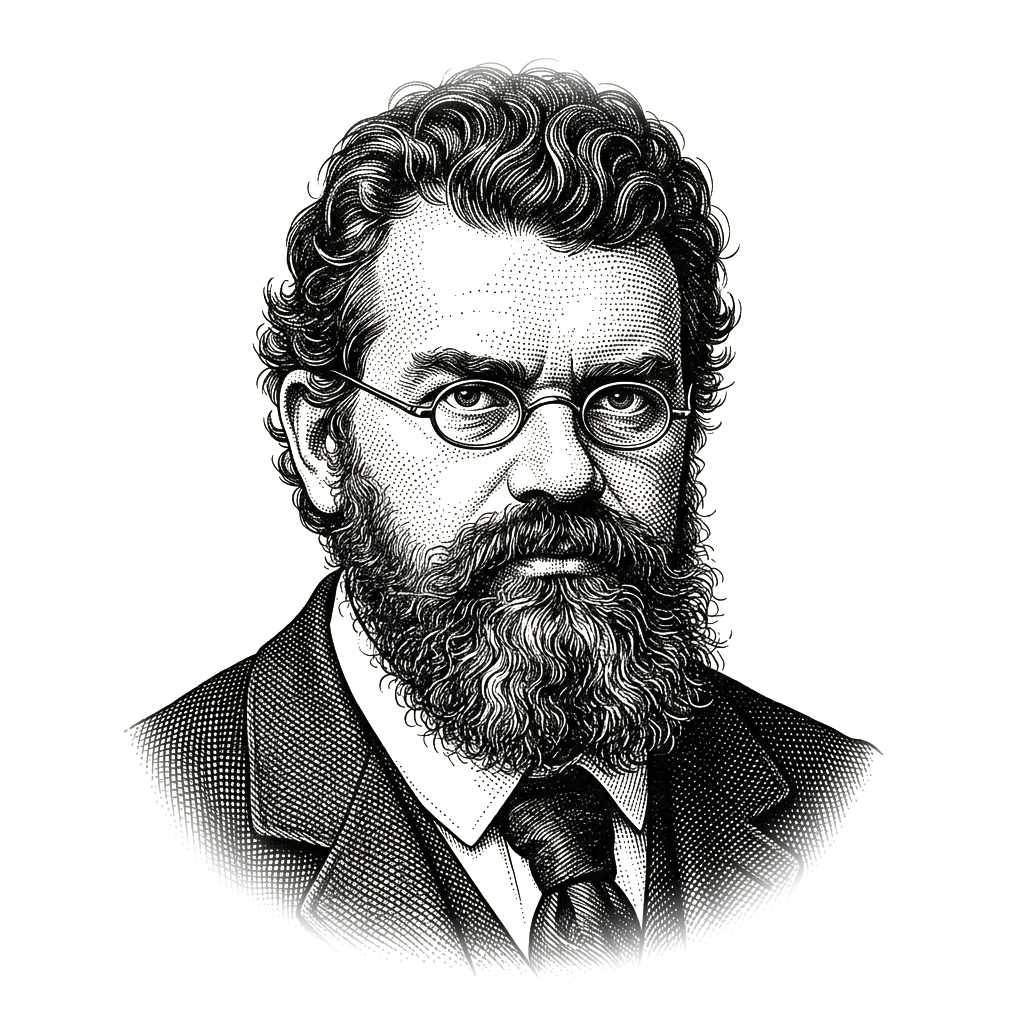
In the closing decades of the nineteenth century, European physics believed it was completing an immaculate continuum. Spearheaded by Ernst Mach, Wilhelm Ostwald, and Georg Helm, a formidable orthodoxy arose under the banners of Energetik and radical positivism. This doctrine decreed that physical science must restrict itself strictly to measurable macroscopic quantities: energy, volume, pressure, and temperature. The hypothesis of invisible atoms was dismissed as an unprovable metaphysical relic. When atomists spoke at the Imperial Academy of Sciences in Vienna, Mach cut them short with an icy challenge: "Have you ever seen one?"
Thermodynamics appeared to sanction this continuum. In 1865, Rudolf Clausius codified the Second Law: $$dS = \frac{dQ_{\text{rev}}}{T}$$ Clausius declared that the energy of the universe was constant, while its entropy perpetually climbed toward a maximum. Yet entropy remained an opaque shadow—an unexplained tax levied upon every transformation of heat into work, driving the cosmos toward a silent "heat death" (Wärmetod). Classical thermodynamics could calculate the toll, but could not explain why nature extracted it.
Ludwig Boltzmann saw through the smooth illusion. Where Mach and Ostwald saw an indivisible fluid, Boltzmann saw an unfathomable multiplicity: sixty sextillion discrete particles in every liter of gas, colliding and exchanging momentum under Newtonian mechanics.
Heat was not an ethereal fluid; it was the kinetic energy of moving masses. But Boltzmann’s singular leap went far beyond reviving atomism. His core act of seeing was the discovery that the macroscopic certainty of thermodynamics is an illusion produced by the statistical combinatorics of microscopic permutations.
In 1877, Boltzmann published the paper that re-anchored physics upon probability: "On the Relation Between the Second Law of the Mechanical Theory of Heat and Probability Calculations." He introduced a distinction that transformed science: the macrostate versus the microstate.
A macroscopic observer measures only bulk properties: pressure, temperature, and volume. This is the macrostate. Beneath that surface lies the microstate: the exact coordinates and momenta of every individual atom in phase space. Boltzmann asked the foundational question: How many distinct microscopic arrangements produce the exact same macroscopic state?
He designated this multiplicity with the letter $W$, for Wahrscheinlichkeit (probability).
Consider a vessel divided by a partition, with gas confined to one half. When the barrier is removed, the gas rushes into the void until it fills the chamber uniformly. Energeticists claimed an irreversible force compelled this expansion. Boltzmann proved otherwise.
Each particle obeys reversible laws of collision. A gas expands not because particles are driven by an expansive force, but because the microstates where particles are distributed throughout the vessel outnumber the microstates where they remain clustered in one half by an astronomical factor. Equilibrium is not a mechanical law; it is an overwhelming combinatorial inevitability.
From this emerged the central equation of statistical physics: $$S = k \log W$$ Entropy is the logarithmic measure of microstate multiplicity. The logarithm is structurally essential. When two independent systems unite, their microscopic possibilities multiply ($W = W_1 \times W_2$), but their macroscopic entropies add ($S = S_1 + S_2$). The logarithm is the unique bridge that translates the multiplicative geometry of microstates into the additive scale of human measurement.
This probabilistic insight forced Boltzmann to confront classical mechanics' deepest crisis: the Arrow of Time.
Newtonian mechanics is time-symmetric. If one films the collision of two elastic spheres and plays the footage backward, the reverse sequence obeys the laws of physics with identical fidelity. Replacing $t$ with $-t$ leaves Hamilton’s equations invariant. How, then, can an ensemble of reversible collisions produce an irreversible world? Why does a shattered glass never spontaneously reassemble and leap back onto the table?
This was the Umkehreinwand (Reversibility Paradox), raised by Josef Loschmidt: if every collision is reversible, reversing every particle velocity ($\mathbf{v} \to -\mathbf{v}$) must cause entropy to decrease.
Boltzmann’s answer was devastating: "Go on, then, reverse them!"
The reverse trajectory is not dynamically forbidden; it is merely astronomically improbable. If every molecular velocity in a room were reversed with absolute precision, dispersed smoke would contract back into the candle wick. But the set of microstates yielding such behavior is an infinitesimal sliver within phase space.
The Second Law is not an absolute mechanical rule; it is a statistical law of typicality. The arrow of time does not originate in the equations of motion. It emerges because our universe began in a state of staggeringly low entropy. We do not experience time’s forward march because dynamical laws demand it, but because the cosmos is sliding down an astronomical gradient of increasing probability.
The cost of this defense was catastrophic. For three decades, Boltzmann stood in bitter isolation against the Continental establishment. At the 1895 Lübeck conference, when Ostwald and Helm proclaimed the death of atomism, Boltzmann fought back with ferocious precision. Arnold Sommerfeld recalled a duel between a bull and a skillful matador, with Boltzmann's mathematics carrying the day.
Yet the establishment remained unmoved. In Vienna, Mach stayed obstinate. In Berlin, Ernst Zermelo leveled the Wiederkehreinwand (Recurrence Paradox), arguing that Poincaré’s recurrence theorem forbade irreversible decay. Boltzmann demonstrated that the recurrence time for a cubic centimeter of gas exceeded the age of the universe by hundreds of orders of magnitude. His opponents heard the mathematics, but clung to the continuum.
Plagued by severe neurasthenia, cyclical depression, and failing eyesight, Boltzmann felt his life’s work slipping away. In the 1898 preface to his Lectures on Gas Theory, he wrote with tragic prescience:
"I am conscious of being only an individual struggling weakly against the stream of time. But it still remains in my power to contribute in such a way that, when the theory of gases is again revived, not too much will have to be rediscovered."
On September 5, 1906, in the coastal resort of Duino near Trieste, while his wife and daughter swam in the Adriatic, Ludwig Boltzmann took his own life. He was sixty-two.
Vindication came with agonizing swiftness. In 1905, Albert Einstein showed that the jitter of Brownian pollen was the direct consequence of molecular impacts. In 1908, Jean Perrin’s experiments confirmed Einstein’s equations, forcing Ostwald to recant and concede that atoms were real. Max Planck had already salvaged quantum radiation in 1900 by adopting Boltzmann’s combinatorial counting.
Today, in the Zentralfriedhof in Vienna, Boltzmann rests beneath a monument of dark stone. Above his carved marble bust, there are no academic titles or dates—only the immortal formula that bridges the microscopic swarm to the macroscopic world: $$S = k \cdot \log W$$
“Bring forward what is true, write it so that it is clear, and defend it to your last breath.”
“Available energy is the main object at stake in the struggle for existence and the evolution of the world.”
“If you are out to describe the truth, leave elegance to the tailor.”
“The second law of thermodynamics can be proved from the mechanical theory if one assumes that the present state of the universe... started from a very improbable state.”
- Studien über das Gleichgewicht der lebendigen Kraft zwischen bewegten materiellen Punkten 1868
- Weitere Studien über das Wärmegleichgewicht unter Gasmolekülen (H-Theorem) 1872
- Über die Beziehung zwischen dem zweiten Hauptsatze der mechanischen Wärmetheorie und der Wahrscheinlichkeitsrechnung (S = k log W) 1877
- Vorlesungen über Gastheorie (Lectures on Gas Theory) 1896–1898