Dmitri Mendeleev
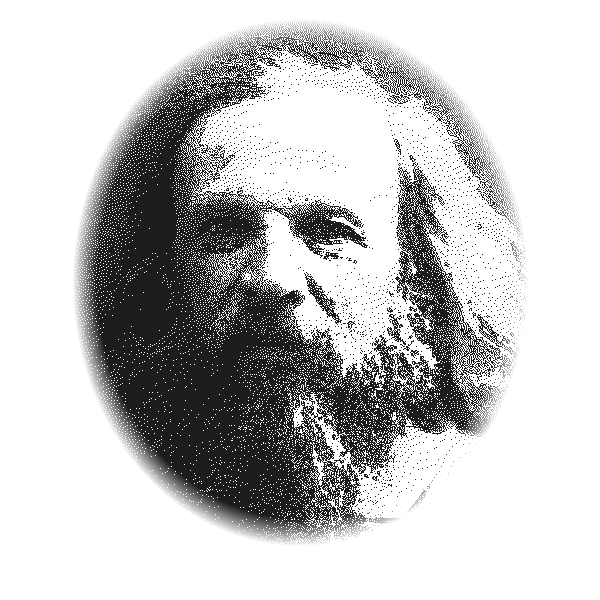
In the winter of 1849, a Siberian mother named Maria Dmitrievna Mendeleeva rode thousands of miles west across the snow-choked Ural Mountains in a horse-drawn sleigh, accompanied by her youngest, seventeenth child. Behind them lay Tobolsk, where their family glass factory had burned to ash; before them lay the imperial academies of Moscow and Saint Petersburg. Maria was dying of tuberculosis, but she was consumed by a single fierce determination: that her brilliant son Dmitri would receive a university education. Denied entry in Moscow because he was a provincial Siberian, she pushed onward to the Main Pedagogical Institute in Saint Petersburg, secured his admission, and died weeks later. Her final benediction remained burned into his conscience for the rest of his life: "Refrain from illusions, insist on work and not on words, patiently search divine and scientific truth."
Two decades later, that Siberian boy had become the professor of general chemistry at the University of Saint Petersburg. Chemistry in the 1860s was not yet a unified discipline; it was an incoherent, sprawling warehouse of empirical recipes. Sixty-three elements had been isolated, but they floated like disconnected islands in a chaotic sea of qualitative descriptions. One learned that copper reacted with nitric acid, that sulfur formed pungent yellow crystals, and that iron rusted in moist air, but there was no governing architectural law connecting their weights, their combining affinities, or their physical densities. Writing a textbook for his Russian students—The Principles of Chemistry—Mendeleev found himself paralyzed by the lack of an overarching classification scheme. He could not teach an architecture that did not yet exist.
The catalytic intellectual event had occurred in September 1860 at the First International Chemical Congress in Karlsruhe, Germany. There, the Italian chemist Stanislao Cannizzaro had distributed a pamphlet resurrecting the forgotten hypothesis of Amedeo Avogadro, demonstrating how to distinguish cleanly between atomic weights and molecular weights. For the first time, chemists possessed a reliable, standardized set of relative atomic weights for the known elements.
On February 17, 1869, scheduled to depart on an inspection tour of cheese-making dairies in Tver, Mendeleev canceled his trip and locked himself inside his study. He took sixty-three blank index cards, writing on each the chemical symbol of an element, its atomic weight, and its principal chemical properties. He began to play a peculiar form of solitaire—what he called "chemical patience"—arranging and rearranging the cards on his desk according to ascending atomic weight. Other chemists had noticed dim patterns: Johann Wolfgang Döbereiner had discovered chemical "triads" like chlorine-bromine-iodine, and John Newlands had proposed an eccentric "law of octaves" that was laughed off by the Chemical Society of London. But their schemes had always broken down after the first few elements.
Mendeleev saw deeper. As the cards shifted across his blotter, he realized that chemical properties did not simply repeat at fixed numerical intervals; they pulsed in periodic waves of varying length. The alkali metals—lithium, sodium, potassium—anchored the beginnings of cycles, each binding fiercely to oxygen in a one-to-two ratio; the halogens—fluorine, chlorine, bromine—anchored the ends, binding to hydrogen one-to-one. When the elements were arranged by increasing atomic weight, their chemical valence and physical attributes recurred as a periodic function of their mass.
Yet the true leap of Mendeleev’s genius was not what he accommodated, but what he refused to force. Where other systematizers tortured their data to fit neat rows, twisting dissimilar elements together to maintain unbroken continuity, Mendeleev recognized that nature was incomplete. Whenever an element’s properties refused to align with its assigned column, he did not abandon the pattern; he assumed that the error belonged to humanity’s incomplete catalog. He left empty spaces in the table.
Even more audacious, he treated those blank spaces not as admissions of ignorance, but as exact blueprints for discovery. Predicting that three elements were missing between known neighbors, he named them eka-boron, eka-aluminium, and eka-silicon (using the Sanskrit prefix eka, meaning "one", honoring the ancient Sanskrit grammarians whose phonological grid had inspired his matrix). For each missing element, Mendeleev sat at his desk and computed its precise physical and chemical specifications: its atomic weight, its density, its melting point, the formulas of its oxides and chlorides, even the specific gravity of its salts.
He went further still, daring to contradict established laboratory measurements. When the accepted atomic weights of uranium, beryllium, indium, and tellurium failed to match his periodic progression, he declared that the experimental chemists had miscalculated their equivalent weights. He reordered tellurium and iodine, placing heavier tellurium before lighter iodine because its chemical affinity aligned it with the sulfur family rather than the halogens. It was an act of astonishing scientific impudence: a provincial Russian professor telling the great analytical laboratories of Western Europe that their balances were wrong.
The vindication arrived with the force of an avalanche. In 1875, the French chemist Paul-Émile Lecoq de Boisbaudran discovered a new element in zinc blende from the Pyrenees, naming it gallium. When its properties were published, Mendeleev recognized his eka-aluminium. He wrote immediately to Lecoq in Paris, pointing out that while the Frenchman had described the element brilliantly, his measured specific gravity of 4.7 was incorrect; according to the periodic law, it had to be approximately 5.9. Astonished and irritated, Lecoq re-purified the metal, re-measured it with exquisite care, and obtained 5.94. Mendeleev had determined the physical density of an unseen metal better from his desk in Saint Petersburg than the discoverer had with the substance in his hand.
In 1879, Lars Fredrik Nilson in Uppsala discovered scandium—Mendeleev’s eka-boron. In 1886, Clemens Winkler in Freiberg isolated germanium—Mendeleev’s eka-silicon. In every instance, the discovered properties aligned with Mendeleev’s predictions with uncanny, chilling precision. The periodic table was no longer an ingenious filing system; it was the fundamental law of terrestrial matter.
In his later years, Mendeleev cut a mythic, terrifying figure across Saint Petersburg. With a vast, cascading white beard and shaggy hair that he refused to cut more than once a year—even when granted an audience with Tsar Alexander III—he looked like a prophet who had walked out of the taiga. He applied his immense analytical intellect to the modern industrialization of Russia: surveying the oil fields of Baku, designing smokeless gunpowder (pyrocollodion) for the imperial navy, and advocating for high-latitude Arctic navigation in the icebreaker Yermak.
When the noble gases were discovered in the 1890s by William Ramsay—inert elements that possessed zero chemical valence and had no obvious place in the original framework—Mendeleev’s table did not break. It welcomed them seamlessly as an entirely new column, "Group 0", closing the periodic cycle between halogens and alkali metals with perfect symmetry.
Dmitri Mendeleev died in 1907, six years before Henry Moseley proved that the fundamental ordering principle of the table was not atomic weight, but the positive charge of the atomic nucleus—the atomic number $Z$. Mendeleev had built upon atomic weight because it was the only measurable proxy available to the nineteenth century, yet his matrix was so profound that it anticipated the subatomic architecture of the electron shells. His periodic table remains hanging on the wall of every laboratory on Earth: an elemental alphabet carved into the bedrock of reality, showing that beneath the dizzying variety of matter lies a single, repeating song of number and symmetry.
“I saw in a dream a table where all the elements fell into place as required. Awakening, I immediately wrote it down on a piece of paper.”
“Knowing how contented, free, and joyous is life in the world of science, one privately wishes that many would enter its portals.”
“Refrain from illusions, insist on work and not on words, patiently search divine and scientific truth.”
“The elements, if arranged according to their atomic weights, exhibit an apparent periodicity of properties.”
“Work, look for peace and calm in work: you will find it nowhere else.”
- On the Compounds of Alcohol with Water (Doctoral Dissertation) 1865
- The Relation of Properties to Atomic Weights of the Elements 1869
- The Principles of Chemistry (Osnovy khimii) 1869
- The Periodic Law of the Chemical Elements (Faraday Lecture) 1889
- An Attempt Towards A Chemical Conception of the Ether 1904