Francis of Assisi
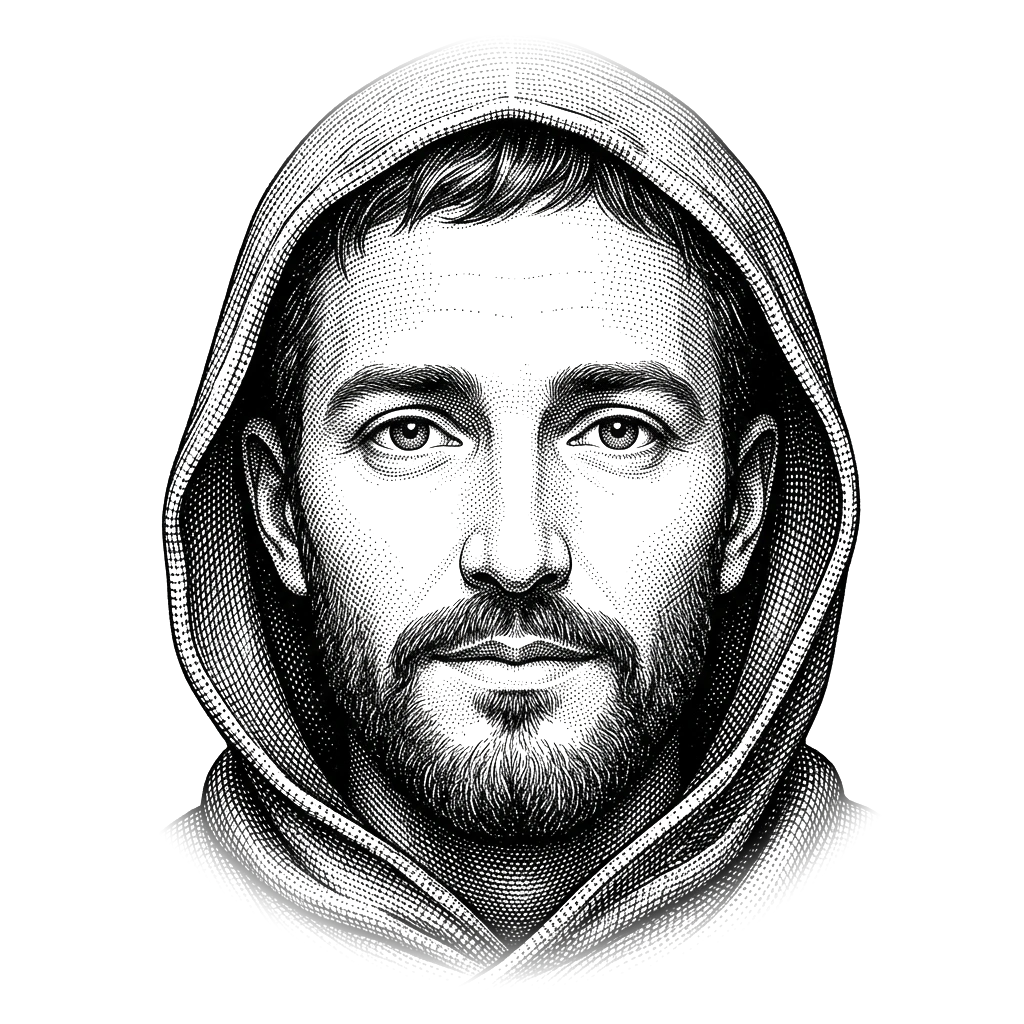
In the winter of 1206, before the episcopal tribunal of Assisi, a twenty-four-year-old merchant's son performed an act of radical renunciation that shattered the emerging bourgeois sensibilities of medieval Italy. Pietro di Bernardone, a prosperous cloth merchant, had dragged his erratic son Francesco before Bishop Guido to recover the proceeds of bolts of fine scarlet cloth that Francis had sold to rebuild the crumbling wayside chapel of San Damiano. Stripping himself bare before the stunned crowd of townsfolk, Francis returned not only the money, but every stitch of fine French clothing he wore, handing them back to his father with the words: "Until now I have called you my father on earth; from now on I can say with complete freedom: Our Father who art in heaven." Bishop Guido, weeping, wrapped the shivering youth in his own episcopal mantle, shielding an absolute, uncompromised poverty that church and state had forgotten how to contain.
Born into the ascendant merchant oligarchy of Assisi in 1181, Francis had spent his youth captivated by French chivalric romances, dreaming of knighthood, martial glory, and aristocratic gallantry. Captured during an inter-communal war with Perugia and imprisoned in a subterranean dungeon for a year, he returned broken in health and hollowed out by melancholia. His interior transformation came not in books, but in an encounter on the dusty road below Assisi: coming upon a leper, whose rotting flesh had always nauseated him to the point of horror, Francis stopped his horse, dismounted, and embraced the outcast, pressing a coin and a kiss into his ulcerated hand. What had previously been bitter turned instantly into sweetness of soul and body; in that single embrace of the socially abandoned, Francis recognized the crucified Christ staring back at him from the margin of the feudal hierarchy.
The theology of Francis was not articulated in scholastic summas or dialectical disputations, but enacted directly through the flesh of living existence. Hearing the Gospel reading from Matthew at the chapel of the Porziuncola—commanding the disciples to go forth with neither gold nor silver, neither traveling bag nor two tunics, neither sandals nor staff—Francis exclaimed with joyful ecstasy: "This is what I want, this is what I seek, this is what I long with all my heart to do!" Where other monastic orders of the era accumulated vast feudal lands, manors, and serfs under the banner of corporate wealth, Francis founded the Order of Friars Minor (Ordo Fratrum Minorum) upon absolute, non-proprietary dispossession (sine proprio). His friars were not to own churches, monasteries, or books; they were to walk barefoot, work manual trades for daily bread, refuse the touch of coin as if it were venom, and beg for whatever daily labor could not provide.
For Francis, poverty was not a grim Stoic endurance or an ascetic self-flagellation; it was "Lady Poverty" (Madonna Povertà), a bride of luminous spiritual beauty and absolute freedom. In stripping away property, human beings strip away the defensive barriers of fear, suspicion, and legal violence that divide neighbor from neighbor. A person who owns nothing has nothing to defend, no reason to wage war, and no status to protect. Poverty restored the primal innocence of Eden, clearing the cluttered slate of the ego so that the soul could look upon the world not as an inventory of commodities to be exploited, but as a theater of gratuitous divine wonder.
This radical dispossession unlocked an unprecedented cosmological fraternity. In his Cantico delle Creature (Canticle of the Creatures), composed in 1225 near the end of his life when he was nearly blind from an agonizing eye disease, Francis pioneered Italian vernacular poetry. He did not look down upon nature from an arrogant heights of human dominance, but addressed the cosmos as an elder sibling: Brother Sun (Messor lo Frate Sole), Sister Moon and the Stars, Brother Wind and Air, Sister Water, Brother Fire, and our Sister Mother Earth (nostra matre Terra), who sustains and governs us. By conferring familial titles upon inanimate elements and wild creatures, Francis dismantled the dualistic alienation between man and nature, anticipating a modern ecological consciousness that views creation as a single, sacred web of kinship.
His peacemaking instinct crossed the deadliest civilizational divides of his century. In 1219, during the bloodshed of the Fifth Crusade at Damietta on the Nile Delta, Francis walked unarmed across the trench lines into the camp of the Saracens, demanding an audience with Sultan al-Malik al-Kamil. Expecting martyrdom, Francis met instead an enlightened Muslim ruler who received the barefoot Italian friar with chivalric hospitality and deep spiritual curiosity. Francis did not curse Muhammad or brandish a crusader's sword; he spoke simply of the love of God and the beauty of peace. When they parted, the Sultan invited Francis to pray with him and offered him rich gifts, which Francis gently declined, leaving behind a lasting model of peaceful interreligious encounter in an age drowned in holy war.
In September 1224, during a forty-day fast on the isolated, rocky heights of Mount La Verna in the Tuscan Apennines, Francis underwent his final transformation. Praying in solitude before dawn on the feast of the Exaltation of the Holy Cross, he beheld a vision of a Seraph—a six-winged fiery angel—bearing the image of a crucified man. As the vision faded, Francis discovered in his own hands, feet, and right side the physical marks of the crucifixion: dark fleshy nails protruding through his palms and insteps, and a bleeding lance wound in his ribcage. The stigmata—the first widely recorded in Christian history—were the somatic inscription of an absolute empathy, marking the friar's complete interior identification with the suffering of the poor and the brokenness of the world.
During his final two years, Francis endured excruciating physical suffering: nearly blind, racked by stomach and liver disease, and subjected to primitive cauterization where surgeons burned his temples with white-hot irons. Yet his joy remained unquenched. As his friars carried him on a stretcher back toward Assisi in October 1226, he paused at the brow of the hill to bless his native city. At the Porziuncola, knowing death was near, he asked to be laid naked upon the bare dirt floor, that he might meet his final breath stripped of everything earthly.
On the evening of October 3, 1226, surrounded by his weeping companions and welcoming "Sister Death" (Sora nostra Morte corporale), Francis died singing the hundred and forty-first Psalm. As the sun set, a vast flock of larks—birds that fly only in the brilliant light of day—alighted on the roof of the infirmary, singing into the falling darkness.
Francis was canonized just two years later, in 1228, by Pope Gregory IX. His life ignited a spiritual revolution that transformed the visual arts, literature, theology, and political consciousness of Europe. In the frescoes of Giotto in the Basilica of Assisi, the stiff, gold-ground Byzantine icons yielded to human tenderness, expressive faces, and real earth, inspired by Francis's love of concrete reality. By restoring radical simplicity, ecological tenderness, and voluntary poverty to the center of spiritual life, Francis proved that the most revolutionary act in history is not the conquest of empires, but the courageous surrender of possession in pursuit of love.
“Start by doing what's necessary; then do what's possible; and suddenly you are doing the impossible.”
“Lord, make me an instrument of your peace: where there is hatred, let me sow love.”
“All the darkness in the world cannot extinguish the light of a single candle.”
“He who works with his hands is a laborer. He who works with his hands and his head is a craftsman. He who works with his hands, his head and his heart is an artist.”
“What a person is before God, that he is and nothing more.”
- Canticle of the Creatures (Cantico delle Creature) 1225
- The Earlier Rule (Regula Non-Bullata) 1221
- The Approved Rule (Regula Bullata) 1223
- The Testament (Testamentum) 1226
- The Admonitions (Admonitiones) c. 1220