Jean Piaget
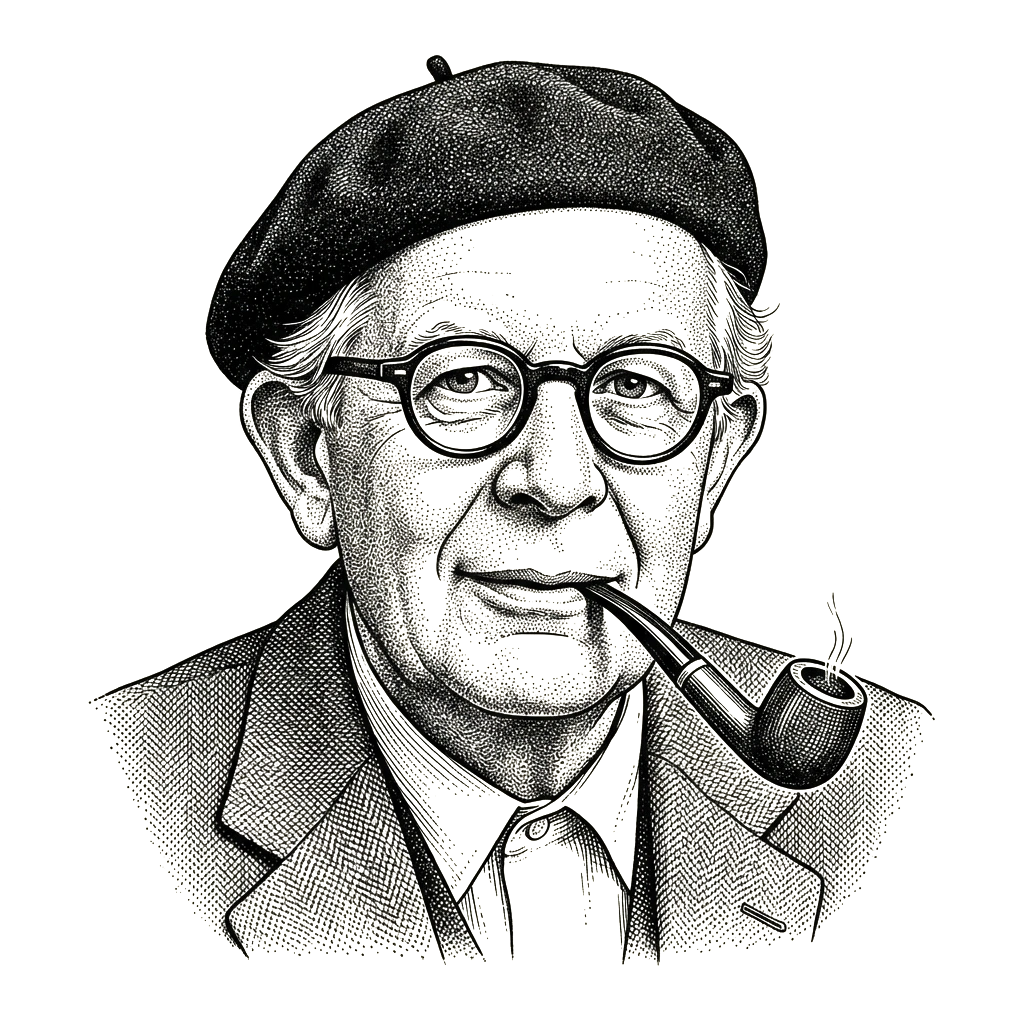
In the autumn of 1919, in a drafty laboratory at the Alfred Binet school on Paris's Rue de la Grange-aux-Belles, a twenty-three-year-old Swiss malacologist sat across from schoolchildren, assigned to standardize an English intelligence test.
His task was straightforward: administer Cyril Burt's reasoning problems, tally the correct answers, and establish statistical norms of mental age. But Jean Piaget could not keep his eyes on the correct answers.
What transfixed him were the mistakes.
When children answered questions about causality, quantity, or space incorrectly, they did not stumble at random. Children of the same age made identical errors, offered identical justifications, and defended them with the same internal logic. A five-year-old insisted that pouring water into a taller cylinder created more water. A six-year-old insisted that spreading out buttons multiplied their number. A seven-year-old looked at twenty brown wooden beads and two white wooden beads, agreed all were wooden, yet answered: "More brown ones, because there are only two white ones."
To Sorbonne psychometricians, these answers were noise—marks of ignorance to be rectified by instruction. For centuries, Western thought had operated on an unexamined, adultocentric dogma: the child was merely a miniature adult, an empty vessel whose reasoning was quantitatively defective.
Piaget saw something entirely different. The child was not an incompetent adult; the child inhabited a distinct, coherent, and rigorously organized cognitive universe. The human mind was neither a blank slate receiving impressions from without, nor a Cartesian program unfolding automatically from the genome.
The mind was an organ. And like every organ in the living kingdom, it had to grow its own architecture through the friction of life.
Piaget’s scientific vision had been forged in the mountain streams of Neuchâtel. By age fifteen, he was an acknowledged authority on freshwater mollusks. In his doctoral studies, he immersed himself in the morphology of Limnaea stagnalis—a pond snail that altered the geometry of its shell depending on whether it lived in calm lagoons or the wave-beaten shallows of Lake Neuchâtel. Moved to turbulent waters, the snail contracted its foot, stunted its spire, and broadened its aperture to grip stones against the surf.
Piaget recognized this as structural morphogenesis: biological adaptation is neither a passive environmental stamp nor a rigid innate blueprint impervious to the world. It is an active, self-regulating equilibrium between internal structure and external constraints.
When Piaget turned from snails to human intelligence, he brought this biological law with him. He named his enterprise genetic epistemology—not genetic in the sense of DNA, but in the classical sense of genesis: the empirical investigation of how the foundational categories of thought—space, time, causality, number, and substance—are actively constructed through time.
To uncover this genesis, Piaget abandoned standardized testing and invented the méthode clinique—the clinical interview. Combining semi-structured Socratic dialogue with the physical manipulation of real objects, he asked children to act upon the world: rolling clay into sausages, dividing fragments, and pouring liquids across vessels of disparate geometry.
Knowledge, Piaget proved, begins with action. To know an object is to operate upon it—to grasp, displace, combine, separate, and mentally transform it. Adaptation proceeds through two engines: assimilation, the incorporation of external reality into existing cognitive structures (schemas); and accommodation, the modification of those schemas when the world resists. When incoming reality contradicts existing structure, the mind enters cognitive disequilibrium—a tension resolved only through equilibration, a higher-order reorganization that restructures cognition at a higher phase of stability.
                           THE DYNAMICS OF EQUILIBRATION
                                         │
        ┌────────────────────────────────┼────────────────────────────────┐
        ▼                                ▼                                ▼
  [ ASSIMILATION ]             [ DISEQUILIBRIUM ]               [ ACCOMMODATION ]
Incorporate reality          Encounter anomaly or              Reorganize internal
into existing schemes        perceptual contradiction;         schemes to resolve
without structural change.   structural strain.                representational conflict.
        │                                                                 ▲
        └──────────────────────► [ EQUILIBRATION ] ───────────────────────┘
                                Higher-Order Structural
                                    Phase Transition
Through thousands of clinical hours, Piaget mapped the structural milestones of this morphogenesis:
In the sensorimotor stage (0–2 years), the infant constructs physical reality out of raw reflexes. The world begins as a fleeting kaleidoscope of sensations. An object hidden behind a screen ceases to exist; it is erased from reality. Only through countless cycles of grasping and retrieval does the infant construct the invariant anchor of the physical world: object permanence.
In the preoperational stage (2–7 years), symbolic representation awakens: language, deferred imitation, and pretend play emerge. Yet thought remains chained to perceptual appearance and egocentrism. In the classic three-mountain experiment, a child cannot imagine what an observer across the table sees, projecting their own viewpoint onto the other. Centered (centration) on a single perceptual feature, the child declares that rolling clay into a cylinder makes "more clay," unable to mentally reverse the transformation.
Between ages seven and eleven, a structural revolution occurs: the emergence of concrete operations. The child discovers reversibility.
When water is poured from a broad tumbler into a tall cylinder, the seven-year-old no longer believes quantity has changed. They declare quantity invariant, invoking logical necessity: "You didn't add any, and you didn't take any away" (identity); "If you pour it back, it will be the same" (inversion); "It's taller, but it's narrower, so it compensates" (reciprocity).
Mental actions have consolidated into operations: reversible, internalized systems of transformation. The child successively masters the conservation of number, substance, weight, and volume—each insight following an invariant developmental sequence.
Finally, in adolescence, the mind attains formal operations. Reason untethers itself from the concrete here-and-now. The adolescent can operate upon operations—formulating hypotheses contrary to fact, manipulating propositions, and systematically isolating variables, as in the famous pendulum problem. Human thought becomes capable of hypothetico-deductive science.
Piaget's architecture shattered two millennia of epistemological dogma.
Against empiricism and behaviorism, Piaget proved that the mind is never an empty slate passively stamped by sensory input. If knowledge were an environmental imprint, a four-year-old surrounded by adults would simply absorb conservation. Yet no amount of verbal drill can instill conservation until the child's internal operational architecture has equilibrated to support it.
Against nativism, Piaget proved that logical categories are not hardwired innate modules pre-programmed into the brain. Logical necessity is not an innate gift; it is a hard-won constructive achievement—the culminating equilibrium of an open biological system resolving its internal contradictions through action.
Jean Piaget demonstrated that reason itself is a living structure. It is not an archive of facts, but a self-correcting dynamic architecture that builds within the human mind the invariants of reality.
“Intelligence is what you use when you don't know what to do.”
“The principal goal of education in the schools should be creating men and women who are capable of doing new things, not simply repeating what other generations have done.”
“Knowledge is not a copy of reality. To know an object, to know an event, is not simply to look at it and make a mental copy or image of it. To know an object is to act upon it.”
“Children have real understanding only of that which they invent themselves, and each time that we try to teach them something too quickly, we keep them from reinventing it themselves.”
- The Language and Thought of the Child 1923
- The Child's Conception of the World 1926
- The Origins of Intelligence in Children 1936
- The Construction of Reality in the Child 1937
- The Psychology of Intelligence 1947
- Biology and Knowledge (Biologie et connaissance) 1967