B.F. Skinner
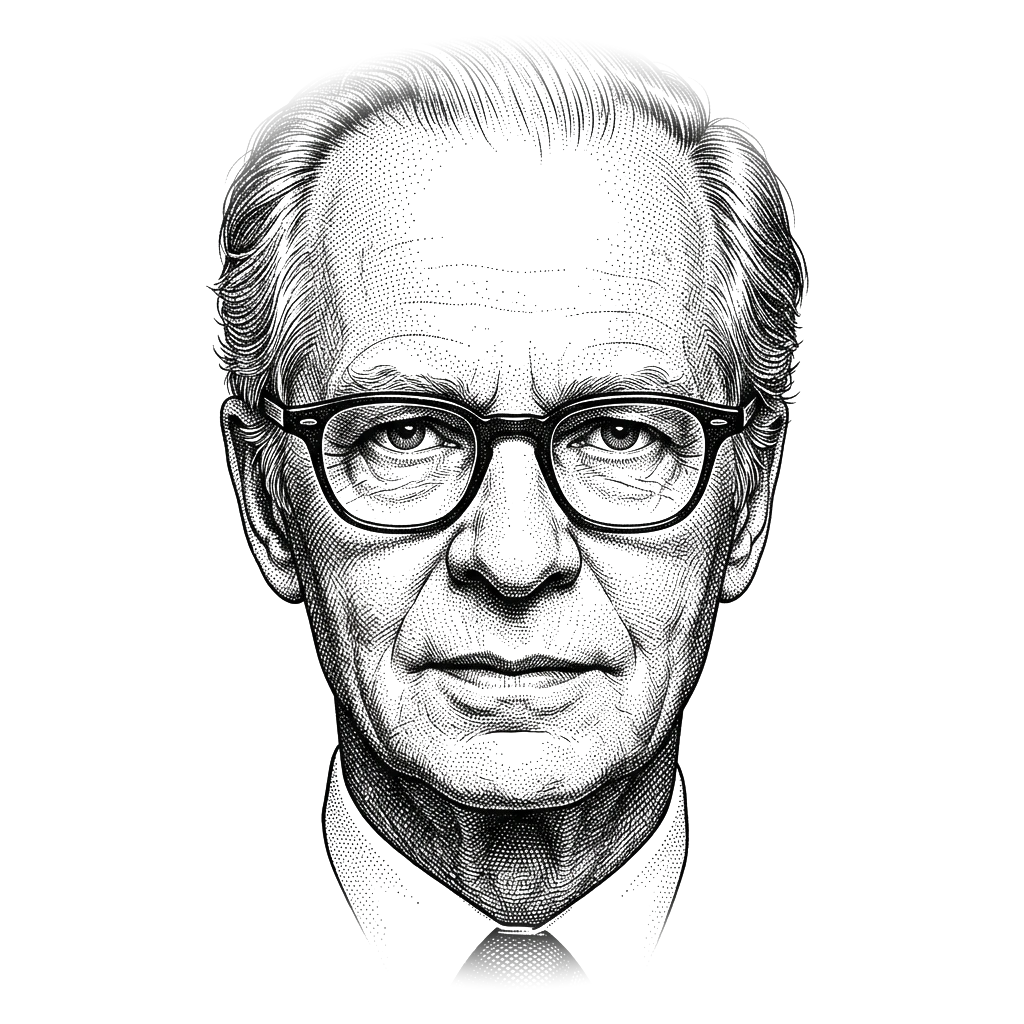
For three centuries following René Descartes, Western thought comforted itself with an uninspected myth: that inside every human skull resides an autonomous governor—a mind, a will, an uncaused cause—directing the body through internal drives and intentions. When a man reached for food, psychology explained that he was propelled by "hunger." When a student labored over Greek, she was driven by "ambition."
To Burrhus Frederic Skinner, working in a Harvard basement in the early 1930s, these explanations were explanatory fictions—verbal placebos that arrested inquiry at its threshold. To say an organism eats because it is hungry, or creates because it is inspired, invents an unobservable homunculus inside the skin and endows it with the very behavior requiring explanation. It was the psychological equivalent of medieval phlogiston—an imaginary fire-essence invented to explain combustion. Skinner looked at the living organism and saw something far more radical: behavior is not pushed from behind by an inner ghost, nor pulled forward by conscious teleology. It is sculpted from ahead by its environmental consequences.
Psychology had attempted an escape from mentalism through Ivan Pavlov and John B. Watson, but their classical conditioning was an impoverished model. Pavlovian reflexology dealt exclusively with respondent behavior: involuntary reflexes elicited by antecedent stimuli, like a dog salivating to a bell or an eye blinking at a puff of air. Watson had declared all human action reducible to chains of these stimulus-response ($S \to R$) reflexes—a wooden caricature of an organism twitching only when poked by its surroundings.
Skinner recognized that vital behavior rarely has an eliciting trigger. An animal does not forage, build nests, or stalk prey because an external spark plug ignited an autonomic reflex. The organism is active; it moves into the world; it emits behavior.
In his 1938 foundation, The Behavior of Organisms, Skinner separated respondent reflexes from what he termed operant behavior. Operants operate upon the environment to generate consequences, which in turn alter the future probability of that action. Skinner replaced the linear reflex arc with the three-term contingency: $$\text{Discriminative Stimulus } (S^D) \;\longrightarrow\; \text{Response } (R) \;\longrightarrow\; \text{Reinforcing Consequence } (S^R)$$
The antecedent stimulus ($S^D$) does not compel action like a puppet string. It sets the occasion, signaling that under this environmental state, a specific action previously yielded reinforcement. The organism's present repertoire is simply the accumulated residue of past consequences operating in the present.
To measure this dynamic, Skinner liberated experimental psychology from the artificial mazes and puzzle boxes of Edward Thorndike. Discrete-trial mazes strangled the phenomenon: the experimenter decided when each trial began and ended, forbidding the animal from behaving freely across time.
Skinner built an automated, sound-damped chamber—the operant chamber—paired with a mechanical invention of his own: the cumulative recorder. Inside the chamber, an organism (a rat pressing a lever or a pigeon pecking an illuminated disk) could respond continuously. Each response tripped a microswitch that stepped a pen upward across a revolving drum of paper. Rapid responding generated a steep vertical slope; pausing produced a flat horizontal line; reinforcements appeared as downward tick marks.
Behavior was suddenly visible as a continuous, dynamic rate of response across unbroken time ($dy/dt$). Rate of response was not an arbitrary index; it was the direct physical metric of behavioral probability.
With this instrument, Skinner and Charles Ferster mapped twelve million responses in their 1957 empirical atlas, Schedules of Reinforcement. They proved that identical behavior could be sustained, suppressed, accelerated, or paused simply by manipulating the rules linking action to reward: * Fixed Ratio (FR): Rapid bursts separated by predictable post-reinforcement pauses. * Variable Ratio (VR): Unpredictable ratios—the engine of the gambling slot machine—generating fierce, unbroken response rates virtually immune to fatigue or extinction. * Fixed Interval (FI): Clock-governed reinforcement producing the celebrated behavioral "scallop"—a post-reinforcement pause accelerating smoothly toward the deadline. * Variable Interval (VI): Steady, uniform rates of continuous vigilance.
These steady-state kinetics proved invariant across species. Pigeons, rats, dogs, and humans traced identical cumulative slopes. Behavioral order was not imposed by an inner executive deciding when to strive; it was an intrinsic mathematical property of the environmental contingency.
The culmination of Skinner’s thought was his 1981 formulation, "Selection by Consequences." Operant conditioning was not an isolated mechanical curiosity, but the ontogenetic branch of a universal biological triad operating under Darwinian logic: variation, selection, and retention.
Nature generates order across three nested tiers: 1. Phylogeny: Natural selection across millennia selects anatomical structures and innate reflexes through differential survival. 2. Ontogeny: Operant conditioning across a single lifetime selects behavioral repertoires through differential reinforcement. An infant babbles thousands of phonetic variants; the surrounding linguistic community selectively reinforces those matching its grammar, sculpting noise into speech. 3. Culture: Social practices across generations are selected by their group survival value.
At no level is an intelligent designer or an inner ghost required. Just as Darwin freed biology from a supernatural Creator who hand-sculpted the eagle’s wing, Skinner freed psychology from the internal homunculus who hand-crafted decisions. Purpose is not an antecedent push from an immaterial mind; it is consequence operating in retrospect.
For this rigor, Skinner was caricatured as a totalitarian engineer seeking to reduce humans to mindless automatons. The accusation inverted his central ethical insight. Skinner did not invent behavioral control; he discovered that human beings are already controlled—brutally and haphazardly—by punitive social systems, exploitative economies, and aversive threats.
Punishment, Skinner demonstrated, never extinguishes behavior; it merely suppresses it while generating anxiety, rage, and counter-aggression. In Beyond Freedom and Dignity (1971), he argued that clinging to the myth of the uncaused, autonomous man prevents society from redesigning the toxic environments that generate crime, addiction, and despair.
True human liberation does not consist in defending an imaginary inner ghost, but in systematically abolishing aversive coercion in favor of deliberate, positive reinforcement. We are neither divine phantoms inhabiting clay nor passive machines reacting to mechanical shocks. We are living organisms locked in continuous, creative reciprocity with the world—transforming our environment through our actions, and being transformed in turn by the reality we touch.
“The consequences of an act affect the probability of its occurring again.”
“A person does not act upon the world, the world acts upon him.”
“We shouldn't teach great books; we should teach a love of reading.”
“The real problem is not whether machines think but whether men do.”
“Operant conditioning shapes behavior as a sculptor shapes a lump of clay.”
- The Behavior of Organisms: An Experimental Analysis 1938
- Science and Human Behavior 1953
- Schedules of Reinforcement (with C.B. Ferster) 1957
- Verbal Behavior 1957
- Beyond Freedom and Dignity 1971
- Selection by Consequences (Science) 1981