Johannes Kepler
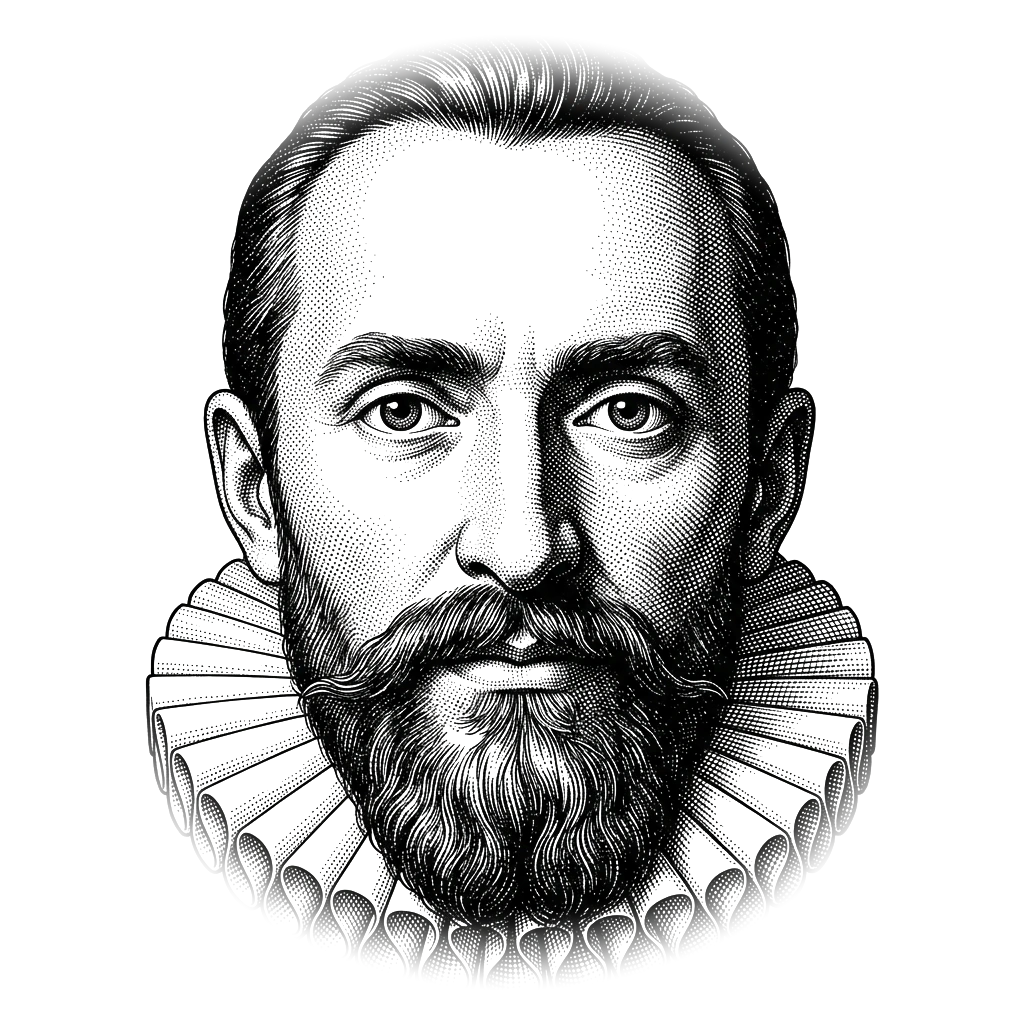
In the summer of 1595, while drawing a figure on a blackboard for schoolboys in Graz, a twenty-three-year-old mathematics teacher froze in the middle of a lecture. He was demonstrating how an equilateral triangle inscribed within a circle generated an inner circle half the size of the outer, and in that sudden geometric collision, he believed he had overheard the private architectural blueprint of God. The ancient world had identified five regular convex polyhedra—the Platonic solids—and astronomy knew precisely six planets: Mercury, Venus, Earth, Mars, Jupiter, and Saturn. Five gaps, six spheres. Kepler immediately imagined nesting the octahedron, icosahedron, dodecahedron, tetrahedron, and cube between the crystalline planetary spheres like nested Russian dolls. In his youthful manifesto, Mysterium Cosmographicum, he declared that geometry was not an invention of the human mind, but the eternal archetype through which the Creator had tuned the cosmos. It was an exquisite, symmetrical, and completely mistaken fantasy. Yet it possessed the decisive virtue of an authentic scientific obsession: it insisted that the arrangement of the heavens was governed by a rigorous, quantitative necessity rather than arbitrary divine whim.
Kepler’s youth had been spent in the shadow of poverty, illness, and religious warfare in Swabia. His father was a mercenary soldier who abandoned the family; his mother was an herbalist whose fiery temperament would later see her chained to a dungeon floor accused of witchcraft. Kepler himself was nearsighted, plagued by skin ailments, and suffered from double vision that made looking through a telescope nearly impossible. He was never an observer of the night sky in the manner of Galileo or Tycho Brahe. He was a geometer of paper, an analyst of numerical shadows who perceived the heavens not through the physical lens of the eye, but through the inner eye of proportion.
The turning point of modern astronomy occurred in February 1600, when Kepler arrived at the castle of Benátky outside Prague to serve as assistant to Tycho Brahe. No two men could have been more violently mismatched. Tycho was a Danish nobleman with a silver-and-gold prosthetic nose, imperious, extravagantly wealthy, and possessor of the most accurate naked-eye observational records in human history—vast logbooks spanning thirty years of night-sky telemetry measured with gargantuan brass sextants. Kepler was an impoverished Lutheran mystic who possessed neither instruments nor social status, but who held the mathematical genius necessary to unlock Tycho’s data. Tycho guarded his observations with fierce jealousy, tossing Kepler scraps like meat to a dog, assigning him the orbital data of Mars—the most erratic and stubborn planet in the sky, whose movements had defeated every astronomer since Ptolemy.
When Tycho died suddenly in October 1601, whispering on his deathbed the desperate plea, Ne frustra vixisse videar—"Let me not seem to have lived in vain"—Kepler inherited both the title of Imperial Mathematician to Holy Roman Emperor Rudolf II and the absolute custody of Tycho’s observational treasure. What followed was what Kepler himself called his "war on Mars." For five years, across nearly a thousand folio pages of relentless manual calculations, he attempted to fit the orbit of Mars into the circular orbits and epicycles demanded by two thousand years of Aristotelian dogma. Every combination of circles failed. At last, he devised a circular hypothesis that matched Tycho’s observations across the entire sky except at two intermediate points, where the theoretical prediction diverged from Tycho’s measurements by a mere eight arcminutes—roughly one-fourth the diameter of the full Moon.
An ordinary astronomer would have adjusted the figures, blamed the instruments, or smoothed the discrepancy away. Kepler could not. He knew that Tycho’s instruments were accurate to within two arcminutes. In a passage of breathtaking intellectual courage in his 1609 masterpiece, Astronomia Nova, he wrote: "If I had believed that we could ignore these eight minutes, I would have patched up my hypothesis accordingly. But since it was not permissible to ignore them, those eight minutes alone pointed the way to a complete reformation of astronomy."
To reconcile those eight arcminutes, Kepler had to shatter the most sacred aesthetic dogma of Western thought: the perfection of the circle. Since antiquity, philosophers had decreed that because celestial bodies were divine, their natural motion must be uniform and circular. Kepler abandoned both. Seeking a physical cause—a vis motrix, a physical force emanating from the rotating Sun like magnetism that swept the planets through the ether—he realized that a planet accelerates as it nears the Sun and slows as it recedes. In place of uniform speed, he discovered that a line joining a planet and the Sun sweeps out equal areas during equal intervals of time. This was his second law, discovered even before the first.
Yet the shape of the path remained an agonizing enigma. For months he wrestled with an oval egg-shaped curve, computing and recomputing until his mind was nearly broken by exhaustion. Only when he discarded the egg and tested the geometry of the ellipse did the numbers snap into absolute, breathless congruence. The Sun sat not at the geometric center, but at one of the two foci of an ellipse; the planet traveled along its perimeter, continually falling toward and curving away from the solar furnace. With two mathematical strokes, Kepler dismantled Ptolemy, overturned Copernicus’s cumbersome system of epicycles, and established the first dynamical laws of the universe. The heavens were no longer an enchanted cathedral of musical crystal spheres, but a physical engine governed by universal geometric force.
A decade later, amidst the horrors of the Thirty Years' War, Kepler published Harmonices Mundi—The Harmony of the World. He had never truly abandoned his youthful dream of cosmic music; he now transcribed the variable angular velocities of each planet at perihelion and aphelion into musical intervals, demonstrating that Mercury sang a rapid, wide soprano while Saturn droned a slow, deep bass. Yet embedded in the fifth book of this mystical work lay his third and crowning discovery: the square of the orbital period of any planet is directly proportional to the cube of the semi-major axis of its orbit.
The third law was the bridge across the solar system. It revealed that the planets were not an assortment of independent travelers, but members of an integrated mechanical family whose speeds and distances were locked into a single mathematical ratio. Sixty-eight years later, it would be this very proportion that allowed Isaac Newton to deduce the inverse-square law of universal gravitation. Kepler had discovered the kinematics of the solar system; he had provided the kinematic answers before Newton could formulate the dynamic questions.
The final decade of Kepler’s life was an odyssey through war, famine, and terror. Catholic armies swept through Upper Austria; Kepler was expelled from Linz for refusing to convert. In the midst of this devastation, he spent nearly two years orchestrating the legal defense of his mother, Katharina Kepler, who was imprisoned in Leonberg accused of practicing witchcraft. By subjecting the wild, superstitious testimonies of her accusers to the same relentless, evidentiary scrutiny he applied to Tycho’s Mars data, he secured her acquittal and saved her from the pyre.
In 1627, working in Ulm on presses guarded by armed soldiers, he completed the Rudolphine Tables—a massive compilation of logarithmic and planetary tables that reduced astronomical calculation from days to hours and proved fifty times more accurate than any preceding navigational chart. Three years later, while riding an old horse to Regensburg in a desperate attempt to collect back-pay owed to him by the Imperial Treasury, he fell ill with a violent fever and died in a modest room at the age of fifty-eight. The Thirty Years' War soon trampled his grave into mud, destroying his headstone. But his self-composed epitaph survived, written in his own hand: Mensus eram coelos, nunc terrae metior umbras. Mens coelestis erat, corporis umbra iacet—I measured the skies, now the shadows I measure. Sky-bound was the mind, earth-bound the body rests.
“I was merely thinking God's thoughts after him.”
“If I had believed that we could ignore these eight minutes, I would have patched up my hypothesis accordingly. But since it was not permissible to ignore them, those eight minutes alone pointed the way to a complete reformation of astronomy.”
“The diversity of the phenomena of nature is so great, and the treasures hidden in the heavens so rich, precisely in order that the human mind shall never be lacking in fresh nourishment.”
“I measured the skies, now the shadows I measure. Sky-bound was the mind, earth-bound the body rests.”
“Nature loves simplicity and unity.”
- Mysterium Cosmographicum 1596
- Ad Vitellionem Paralipomena (Optics) 1604
- Astronomia Nova 1609
- Dioptrice 1611
- Harmonices Mundi 1619
- Epitome Astronomiae Copernicanae 1621
- Tabulae Rudolphinae 1627