John Maynard Keynes
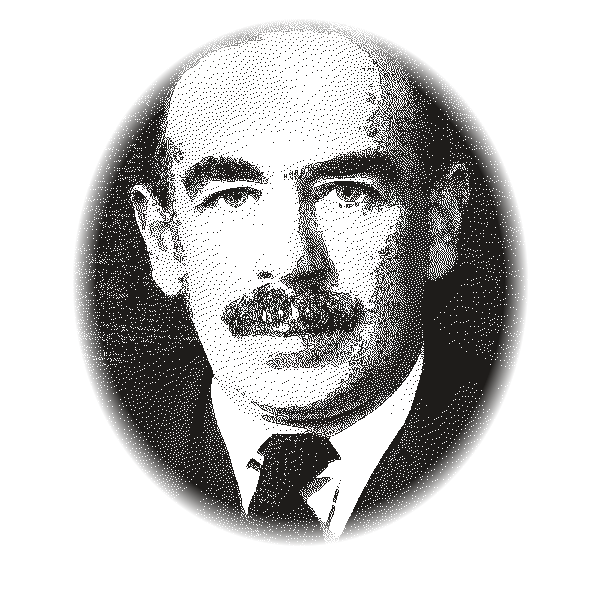
In the spring of 1919, in the gilded mirrors of the Hall of Mirrors at Versailles, a thirty-five-year-old representative of the British Treasury looked upon the victorious Allied statesmen and saw an assembly of blind, vengeful sleepwalkers. Georges Clemenceau was bent on reducing Germany to an agrarian ruin; David Lloyd George was imprisoned by British electoral promises to "squeeze the German lemon until the pips squeak"; and Woodrow Wilson was lost in vague Presbyterian platitudes. Unable to stomach the deliberate economic strangulation of Central Europe, John Maynard Keynes resigned his official post in disgust, retreated to a cottage in Sussex, and in two white-hot months composed the most prophetic political tract of the twentieth century: The Economic Consequences of the Peace.
Keynes demonstrated with cold mathematical fury that modern Europe was not an assemblage of sovereign nations separated by borders, but an interconnected metabolic organism. To demand astronomical financial reparations while simultaneously confiscating Germany’s merchant marine, coal basins, and overseas colonies was to demand that an amputee run a marathon while paying for the privilege. He warned that if the Allies persisted in impoverishing eighty million Germans, the European economy would collapse into hyperinflation, and within twenty years a catastrophic, vengeful reaction would summon the horrors of another world war. The British establishment denounced him as an unpatriotic defeatist. Twenty years later, almost to the exact day, German panzers rolled across the Polish frontier.
Keynes was never a dry, narrow technician of charts and equations. Born in Cambridge in 1883—the year Karl Marx died—he was an intellectual aristocrat of Renaissance breadth: an Apostle at King’s College, a lifelong member of the bohemian Bloomsbury Group alongside Virginia Woolf and Lytton Strachey, an avid collector of modern art and Newton’s alchemical manuscripts, and a peerless currency speculator who built a million-pound fortune for himself and his college from his bed before breakfast. He moved through the world with an effortless, dazzling intellectual arrogance, famously observing that "practical men who believe themselves to be quite exempt from any intellectual influence, are usually the slaves of some defunct economist."
In the 1920s, he turned his analytical weapons against the orthodox high priests of finance. When Chancellor of the Exchequer Winston Churchill recklessly dragged Great Britain back onto the Gold Standard in 1925 at the pre-war parity of four dollars and eighty-six cents to the pound, Keynes published The Economic Consequences of Mr. Churchill. He warned that artificially overvaluing the pound would cripple British coal, steel, and textile exports, forcing industrialists to slash wages and driving the working class into the cataclysm of the 1926 General Strike. He saw that the classical reverence for the golden calf was not prudence, but a barbaric relic that sacrificed human welfare to the idol of an arbitrary metal standard.
When the Wall Street crash of 1929 plunged the industrialized world into the Great Depression, the classical economics of Adam Smith, David Ricardo, and Alfred Marshall suffered an intellectual heart attack. Millions of skilled, desperate men stood idle on street corners while state-of-the-art factories sat empty and silent. Yet orthodox economists, clinging to Say’s Law—the dogma that "supply creates its own demand"—insisted that widespread, involuntary unemployment was impossible in a free market. If workers were unemployed, the professors declared, it was merely because they were demanding wages higher than the market value of their labor. The prescribed remedy was cruel, passive austerity: slash wages, balance the government budget, cut public relief, and wait for the natural equilibrium of the market to restore full employment.
To this complacent theology, Keynes delivered his immortal, devastating rebuke: "In the long run we are all dead. Economists set themselves too easy, too useless a task if in tempestuous seasons they can only tell us that when the storm is long past the ocean is flat again."
In 1936, Keynes published his masterwork: The General Theory of Employment, Interest and Money. It was an intellectual earthquake that permanently restructured the foundation of macroeconomics. Keynes shattered Say’s Law by introducing the revolutionary concept of the monetary economy. In the real world, human beings do not trade apples directly for shoes; they trade through money, and money is not merely a neutral medium of exchange, but an asset that can be hoarded.
When the future is clouded by radical uncertainty—an uncertainty fundamentally different from mathematical risk, because its probability distribution cannot be computed—businessmen and households freeze. Paralyzed by what Keynes called fluctuating "animal spirits," individuals retreat into liquidity preference, hoarding cash rather than investing in machinery or spending on consumer goods.
Here lay Keynes’s most counterintuitive discovery: the Paradox of Thrift. What appears prudent for an individual family—cutting expenditure during a crisis to accumulate savings—is ruinous when practiced by society as a whole. Because one person’s expenditure is another person’s income, when everyone attempts to save simultaneously, aggregate expenditure collapses, national income plummets, and total savings fall.
A market economy, Keynes proved, possesses no automatic steering wheel that guides it toward full employment. It can become locked in a chronic, low-level equilibrium of stagnation and mass poverty. The private market, paralyzed by fear, cannot rescue itself. The state must step forward as the spender of last resort. Through counter-cyclical deficit financing, public works programs, and deliberate infrastructure investment, the government must inject purchasing power into the economic bloodstream. The initial public outlay ripples through the economy via the multiplier effect, reviving consumer demand, restoring business confidence, and putting the idle machines and idle hands back to work.
In the final, grueling years of his life, his body broken by repeated heart attacks, Keynes took upon his shoulders the financial survival of Great Britain during the Second World War. In 1944, at the Mount Washington Hotel in Bretton Woods, New Hampshire, he led the British delegation in drafting the post-war global financial order.
Keynes envisioned a radical, balanced international monetary system. He proposed an international clearing union with an abstract global reserve currency—the Bancor—and designed a mechanism that imposed financial penalties not only on debtor nations that ran trade deficits, but also on creditor nations that ran chronic trade surpluses, forcing wealthy countries like the United States to reinvest their excess capital rather than draining global liquidity. The American delegation, led by Harry Dexter White, wielded its overwhelming financial hegemony to veto Keynes’s egalitarian design, anchoring the post-war world to the US dollar instead. Yet the institutions that emerged from the conference—the International Monetary Fund and the World Bank—bore the indelible imprint of his structural vision.
Keynes died of heart failure at his farmhouse in Tilton in April 1946 at the age of sixty-two. He had accomplished the supreme intellectual reconciliation of the twentieth century: he had saved capitalism from its own self-destructive depressions without surrendering human liberty to the totalitarian tyranny of the Soviet planned state. John Maynard Keynes proved that the economy is not a sacred, unalterable natural machine to be worshiped in fatalistic passivity, but a human instrument designed for human happiness—an instrument that can be steered, stabilized, and governed by reason in the service of civilization.
“In the long run we are all dead.”
“The difficulty lies, not in the new ideas, but in escaping from the old ones.”
“Practical men who believe themselves to be quite exempt from any intellectual influence, are usually the slaves of some defunct economist.”
“When the facts change, I change my mind. What do you do, sir?”
“The ideas of economists and political philosophers, both when they are right and when they are wrong, are more powerful than is commonly understood.”
- The Economic Consequences of the Peace 1919
- A Treatise on Probability 1921
- A Tract on Monetary Reform 1923
- The Economic Consequences of Mr. Churchill 1925
- A Treatise on Money (2 vols.) 1930
- The General Theory of Employment, Interest and Money 1936
- How to Pay for the War 1940