Julian of Norwich
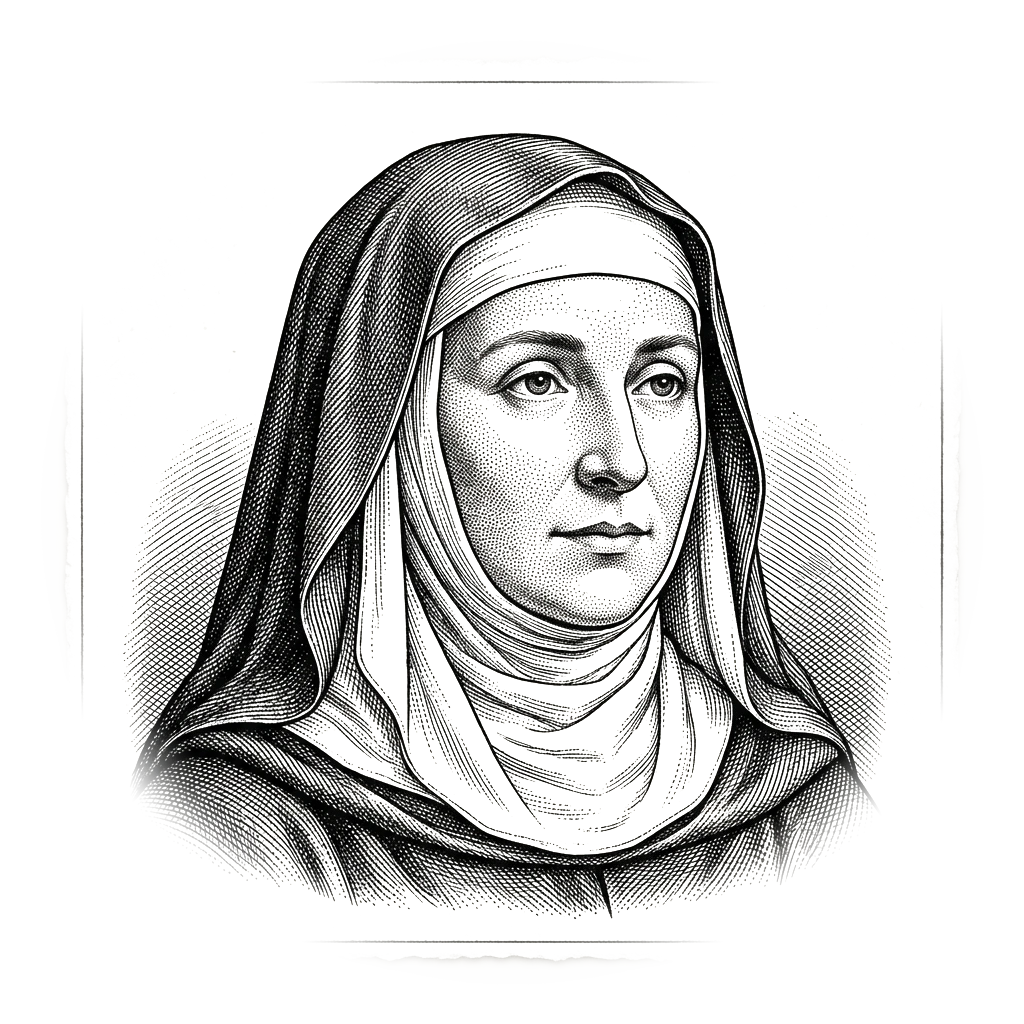
In May 1373, in Norfolk, a thirty-year-old woman lay dying. Her priest administered the last rites, placed a crucifix before her failing eyes, and told her to fix her gaze upon it. Her lower body grew cold; her sight narrowed until the room vanished and only the cross remained lit.
England was enduring generational catastrophe. The Black Death of 1348–1349 had eradicated nearly half of East Anglia, followed by outbreaks in 1361 and 1369. Fourteenth-century theology was mercilessly coherent: plague, famine, and agony were divine retribution for human sin.
As her breath slowed, the dying woman did not see an avenging judge. The crucifix before her seemed to stream with warm blood, initiating sixteen daylight visions—what she called "showings."
Amidst this dissolution, her attention was drawn to something minuscule:
"In this he showed a little thing, the quantity of an hazelnut, lying in the palm of my hand, and it was as round as a ball. I looked upon it with eye of my understanding, and thought: What may this be? And it was answered generally thus: It is all that is made. I marveled how it might last, for methought it might suddenly have fallen to naught for littlehead. And I was answered in my understanding: It lasts, and ever shall, for God loveth it; and so hath all thing being by the love of God. In this little thing I saw three properties: the first is that God made it, the second is that God loveth it, the third is that God keepeth it."
This was an ontological deduction of extraordinary clarity. Creation has no autonomous stability; left to its intrinsic weight, it ought to collapse into nothingness (fall to naught for littlehead). It persists solely because it is regarded with love. Being is not a mechanical baseline, but an uninterrupted act of benevolent preservation.
Julian survived and entered an anchorhold—a stone cell built against St. Julian’s Church in Norwich.
Her enclosure was a living burial. The bishop conducted the officium mortuorum—the Office of the Dead. Extreme unction was administered, Julian crossed the threshold, and the entrance was mortared shut. She would never walk outside again.
Her universe was reduced to three apertures: an interior squint (hagioscope) angled toward the altar; a curtained street window through which she counseled pilgrims; and a domestic hatch where a maidservant brought food.
Beyond her walls, society fractured. In 1381, the Peasants’ Revolt swept Norfolk; rebel bands were routed by Bishop Henry Despenser’s lances and gallows. By 1401, under De Haeretico Comburendo, heretics were burned alive across the river at Lollards Pit.
Between a graveyard and a busy port city, Julian wrote a rapid account of her visions, the Short Text. Yet one showing resisted comprehension: the Parable of the Lord and the Servant.
For nearly twenty years, Julian probed that vision in solitary contemplation. When she completed the expanded Long Text—titled A Revelation of Love, the earliest surviving book in English written by a woman—she had forged visionary experience into a systematic theology.
In the parable, a Servant stands eager before a tranquil Lord. Sent on an errand, he leaps forward, but instantly falls into a deep, jagged ravine. Bruised, paralyzed, and isolated, the Servant groans in agony, unable even to turn his head toward his master.
Medieval theology dictated that the master should burn with rage: sin was high treason against infinite majesty, deserving vengeance.
Julian looked upon the Lord and was startled by what was missing:
"I beheld with revrence and heed, and thought in this that I saw the Lord sit as a man, and I saw neither wrath nor scorn... And then the Lord looked upon his servant with great pity and compassion, and not with blame."
She examined the showing relentlessly: "For I saw no manner of wrath in God, neither by short time nor by long... If God might be wroth for a while, we should neither have life nor being nor bliss."
Then came her breakthrough: the Servant possessed a double identity. He was Adam—stumbling humanity fallen into the ditch of mortality through frailty and blindness rather than malice. But he was also Christ—who plunged into that same ravine, donned the Servant's ragged tunic in the Incarnation, and died there to lift Adam out.
Sin, Julian concluded, has no ontological substance: "I saw not sin, for I believe it hath no manner of substance nor no part of being." It is an absence, a blindness, a wound. God does not view fallen humanity as criminals to be punished, but as injured children to be healed.
Julian grounded this insight in the Motherhood of God. God is not merely Sovereign and Father, but Mother in nature, Mother in mercy, and Mother in grace.
Christ conceives humanity in His body, endures the labor pains of the Passion, feeds the soul with His flesh in the Eucharist, and cradles the child through clumsy developmental errors:
"The mother may give her child suck of her milk, but our precious Mother Jesus, he may feed us with himself... The mother may suffer the child to fall sometimes, and be diseased in divers manners for its own profit, but she will never suffer any manner of peril to come unto the child."
From this maternal ground came her most celebrated phrase: "Sin is behooveful, but all shall be well, and all shall be well, and all manner of thing shall be well."
Modern readers hear "All shall be well" as greeting-card cheer. In Julian's Middle English ("Synne is behovabil"), the claim is austere. Behooveful means necessary, functional, fitting. Pain and error are not meaningless anomalies, but the developmental conditions through which finite creatures learn humility and mature into love.
Julian did not deny horror. She lived beside a plague cemetery, breathing the dust of open graves and hearing the cries of an unmoored society. Yet she maintained that terror is a distortion of finite perspective. Reality rests in a benevolent ground that reserves a "Great Deed" at time’s end—a secret eschatological act that mends all brokenness without vengeance.
Julian looked through the dark, placed the hazelnut of creation in her dying palm, and saw that the universe cannot fall into the abyss, because it has never once slipped from the hands of love.
“All shall be well, and all shall be well, and all manner of thing shall be well.”
“He showed me a little thing, the quantity of an hazelnut, in the palm of my hand; and it was as round as a ball. I looked thereupon with eye of my understanding, and thought: What may this be? And it was answered generally thus: It is all that is made.”
“I saw no manner of wrath in God, neither for short time nor for long; for truly, as I see it, God is never angry.”
“As truly as God is our Father, so truly is God our Mother.”
“Prayer is not overcoming God's reluctance; it is laying hold of His willingness.”
- A Vision Showed to a Devout Woman (The Short Text) c. 1373
- Revelations of Divine Love (The Long Text) c. 1393