John of the Cross
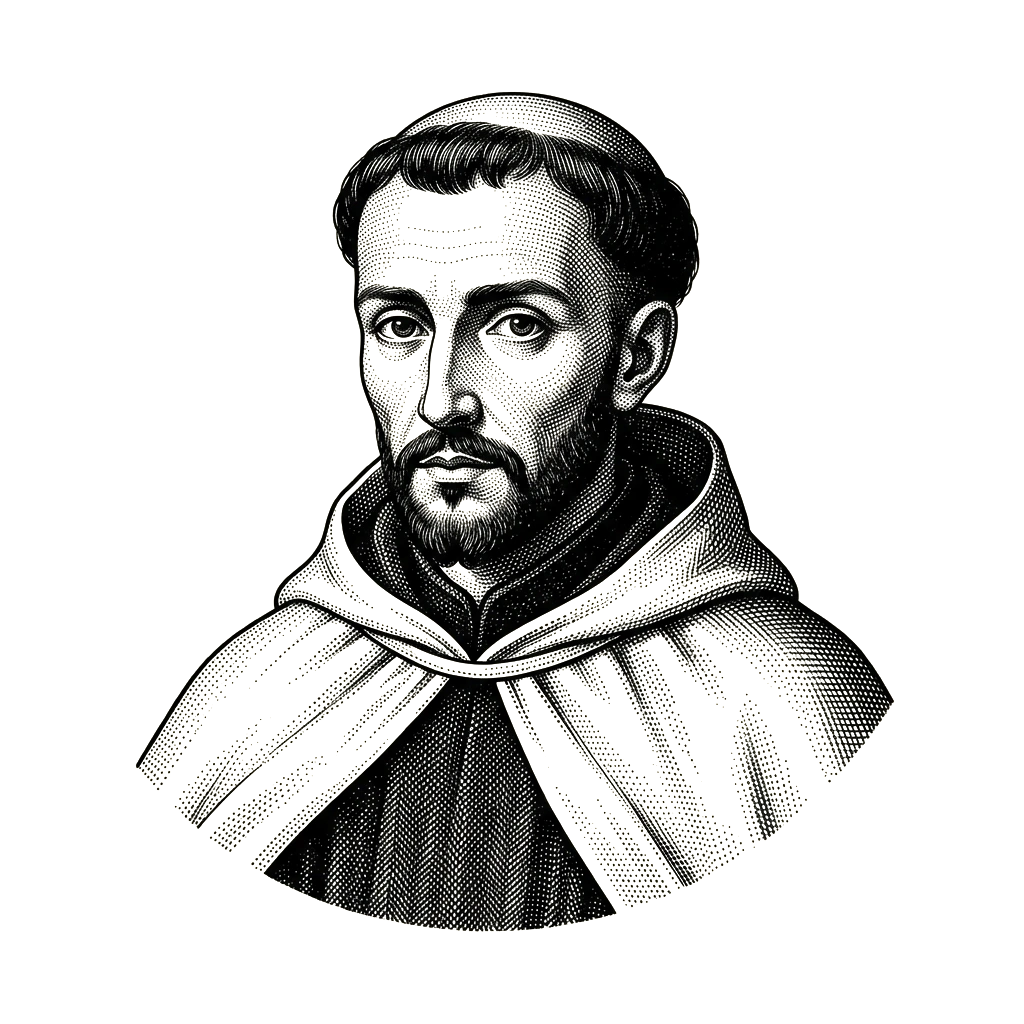
In December 1577, in the Spanish city of Toledo, a thirty-five-year-old Carmelite friar named Juan de Yepes y Álvarez was seized by his religious brothers, blindfolded, and locked inside a converted latrine. The cell was six feet wide and ten feet long. It had no windows—only a three-inch vertical slit cut high into the masonry wall that admitted indirect daylight for a few minutes each noon. He was given a wooden board for a bed, a tunic that rotted against his skin, a daily ration of water, bread, and half a salted sardine, and a bucket for his waste. Every Friday, he was brought down to the refectory where the community stripped him to the waist and scourged his bare back with rods until the scars were permanent.
He remained in that vault for nine months.
Under sensory deprivation, starvation, and physical terror, the human nervous system typically fractures. The mind hallucinates, turns manic, or descends into catatonia. But Juan de Yepes—known to history as John of the Cross—did something that overturned the prevailing psychology of his era. Sitting in the dark, unable to read or write, he composed in his memory the foundational stanzas of The Dark Night:
En una noche oscura,
con ansias en amores inflamada,
¡oh dichosa ventura!
salí sin ser notada,
estando ya mi casa sosegada.(In a dark night, / with anxious love inflamed, / O fortunate venture! / I went out unnoticed, / my house being now at rest.)
In August 1578, he loosened the hinges of his door, twisted strips of torn blankets into a rope, dropped over the monastery wall into the darkness above the Tagus river, and escaped. Over the next thirteen years, John did not write memoirs of persecution or hagiographies of endurance. Instead, he treated his verses as empirical field notes, producing two comprehensive analytical treatises: The Ascent of Mount Carmel and The Dark Night.
In these texts, John diagnosed an experience that had bewildered thinkers for centuries: the sudden, catastrophic collapse of interior meaning.
In sixteenth-century Europe, when an earnest thinker or practitioner suddenly lost the ability to feel purpose, find comfort in thought, or derive joy from their vocation, society offered two explanations. It was either moral corruption and divine curse, or melancolía—a diseased excess of black bile.
John rejected both. He proposed that interior desolation is neither moral failure nor medical pathology. It is an involuntary, necessary restructuring of consciousness.
The human mind begins its development through sensory scaffolding. When someone begins an intellectual discipline, an artistic vocation, or a contemplative practice, they run on sensory fuel. They meditate by constructing mental images, discursive arguments, emotional consolations, and structured models. This beginner’s stage is necessary, but it contains an inherent trap: the mind mistakes its internal representations for reality itself. It falls in love with its concepts, feelings, and progress, turning possessive and complacent.
Eventually, if development continues, the machinery stalls. The imagination runs dry. Thoughts that once produced illumination now produce only fatigue. Concepts that once felt alive become tasteless, like ashes in the mouth.
Most people panic. Assuming they have failed or been abandoned, they frantically try to force the old machinery to work, grinding their imagination into exhaustion.
John inverted the sign of the crisis. Dryness is not the death of the mind; it is its weaning.
He termed this initial threshold the Night of Sense. The cognitive faculties—imagination, sensory appetite, and discursive reasoning—are starved of their accustomed gratification. Just as an infant must be weaned from milk before it can digest solid food, consciousness must be stripped of its dependence on sensory feedback if it is to perceive anything deeper. The practitioner must stop trying to force thoughts. The task is to yield to the dryness: to remain in silent, receptive, loving attentiveness, allowing the mind to transition from the active manipulation of concepts to imageless contemplation.
Because this dryness resembled clinical depression, John formulated three diagnostic criteria to distinguish the dark night from ordinary melancholia.
First was universal aridity: the individual finds no taste or consolation in spiritual matters, nor in any worldly distraction or physical pleasure. (If consolation is readily found in worldly diversion, the cause is mere negligence; if mood fluctuates wildly with circumstances, the cause is bodily.) Second was painful solicitude: the memory continually returns to truth with anxious longing, fearing that one is falling backward rather than advancing. Melancholia turns inward into self-obsessed dread; the dark night remains an outward, aching hunger. Third was the inability to meditate discursively alongside a profound interior peace when the mind ceases straining to produce mental images.
Yet the Night of Sense remained only the outer gate. John identified an infinitely deeper crisis: the Night of Spirit.
In the Night of Spirit, it is not merely sensory consolation that is silenced; the ego’s core faculties—Intellect, Memory, and Will—are dismantled. Here John introduced his celebrated metaphor: the green log thrown into a fire.
When green wood is cast into a furnace, the fire does not immediately cause it to shine. First, the heat attacks the moisture trapped within the fibers. The log hisses, turns black, smokes bitterly, sweats foul sap, and appears far uglier and more ruined than before. Only when every drop of hidden pitch and water has been purged does the log ignite, taking on the heat, brilliance, and nature of the fire itself.
When unmediated reality strikes a conditioned mind, it does not feel like illumination. It feels like blinding darkness, crushing pressure, and ruin. The incoming clarity exposes all the latent falsehoods, defenses, and spiritual vanity within the self. The suffering is not inflicted by the light; it is the friction of the light dissolving the structures that resist it.
To chart this ascent, John drew a diagram: the Mount of Perfection. Up the mountain ran three paths. The path on the left pursued earthly possessions; it ended in exhaustion. The path on the right pursued spiritual consolations, visions, and special status; it ended in vanity. Only the narrow central path reached the summit. Up the middle of the ridge, John lettered a single word seven times:
Nada, nada, nada, nada, nada, nada, y en el monte nada.
(Nothing, nothing, nothing, nothing, nothing, nothing, and on the mount nothing.)
Nada was not nihilism. John’s discovery was epistemological: any concept you hold of the ultimate is not the ultimate. To reach the All (el Todo), the mind must unclasp the proprietary reflex of the ego—the habit of seizing every experience, insight, and virtue and labeling it "mine." When the mind ceases to clutch its models, it discovers that in possessing nothing, it is open to everything.
John of the Cross was not a herald of suffering, but an engineer of interior transition. He demonstrated that human understanding does not expand solely by steady accumulation, but through catastrophic reorganizations, where the conceptual scaffolding that brought us to the threshold must be dismantled before the real can enter.
“In the evening of life, we will be judged on love alone.”
“To reach satisfaction in all, desire satisfaction in nothing. To come to possess all, desire the possession of nothing.”
“In an obscure night, with anxieties, by love inflamed, O happy lot! I went forth unobserved, my house being now at rest.”
“What we need most in order to make progress is to be silent before this great God with our appetite and our tongue.”
“Live in the world as if only God and your soul were in it; so shall your heart be no prisoner of any creature.”
- The Ascent of Mount Carmel (Subida del Monte Carmelo) c. 1581–1585
- The Dark Night of the Soul (Noche Oscura del Alma) c. 1584–1586
- The Spiritual Canticle (Cántico Espiritual) 1584
- The Living Flame of Love (Llama de Amor Viva) 1585–1586