Santiago Ramón y Cajal
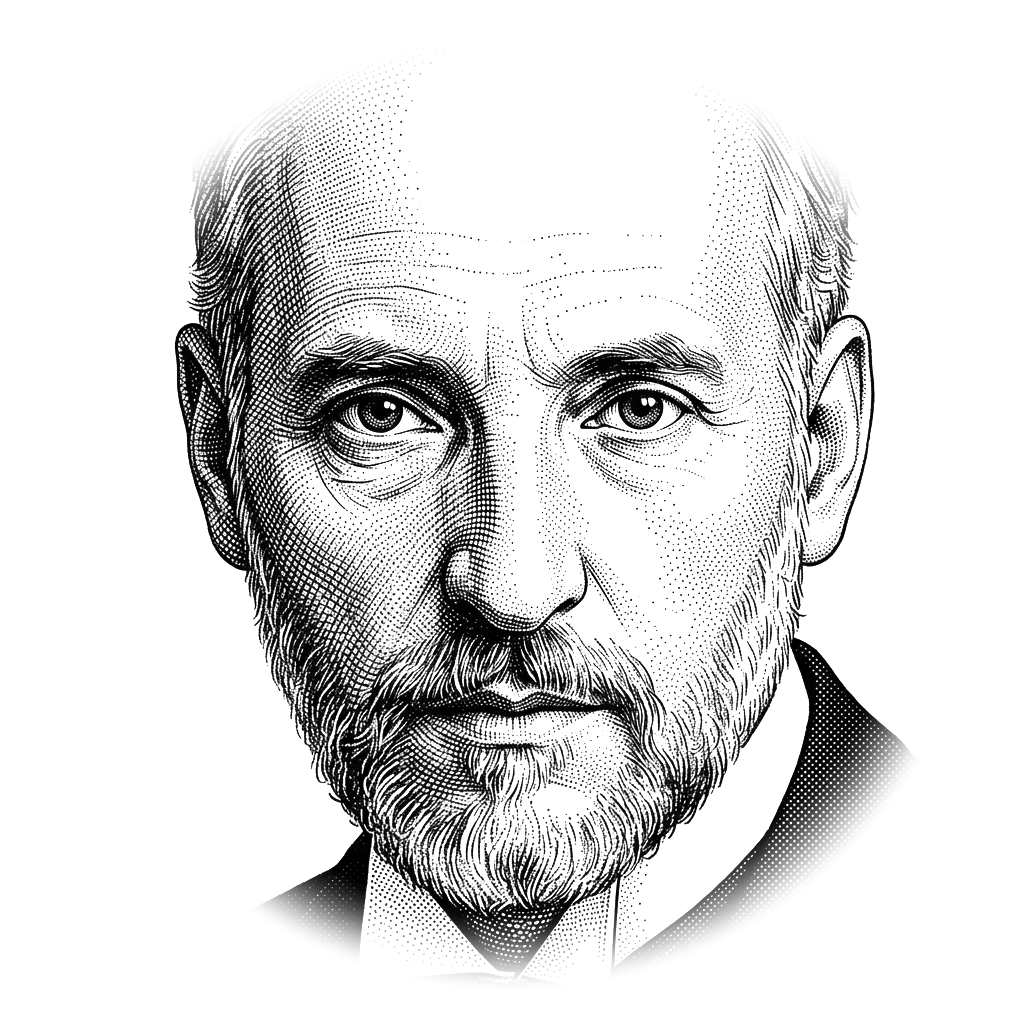
In the late nineteenth century, the cellular theory of life stopped abruptly at the base of the skull.
Across every other tissue, the microscope revealed modularity. In 1839, Matthias Schleiden and Theodor Schwann established that living bodies were assemblies of discrete cells. Rudolf Virchow demonstrated that all pathology was cellular pathology. The liver was an orderly brickwork of hepatocytes; muscle was a bundle of individual fibers; blood was a suspension of distinct corpuscles.
The brain remained the grand exception.
Under the optical microscopes of the 1870s and 1880s, the cerebral cortex resembled an impenetrable swamp. Standard dyes like carmine and hematoxylin colored cell bodies indiscriminately, leaving the vast surrounding territory—the neuropil—a murky violet fog. Through this blur, billions of microscopic filaments seemed to dissolve into an infinite, tangled feltwork.
Histologists concluded that nervous tissue obeyed different laws. In 1871, Joseph von Gerlach formulated the reticular theory: the brain was not made of discrete cells, but was a single, uninterrupted protoplasmic syncytium. Nerve impulses did not pass between distinct units; they circulated through a continuous net, washing through gray matter like tides in a closed lagoon.
Even Camillo Golgi, who in 1873 invented the chemical reaction that would unlock the nervous system, remained captive to the dogma. Soaking tissue in potassium dichromate and silver nitrate precipitated dark silver chromate inside neural tissue. Yet Golgi’s mind supplied the continuity his eyes could not verify. He insisted that dendrites were merely nutritive roots, while the true nervous network (rete nervosa diffusa) was an unbroken web of fused axons—an undifferentiated ocean.
In 1887, in a modest laboratory in Madrid, a thirty-five-year-old professor of anatomy named Santiago Ramón y Cajal saw Golgi's stain for the first time.
His friend Luis Simarro Lacabra, an alienist newly returned from Paris, placed a slide prepared with the Italian’s reazione nera—the "black reaction"—beneath Cajal's lens. Cajal was transfixed. Standard dyes colored everything weakly and simultaneously, burying structure under noise. But the silver chromate reaction performed an uncanny physical trick: the silver salt precipitated inside only one or two out of every hundred neurons in a section.
The unselected ninety-nine percent remained completely transparent, bathed in pale amber. But the chosen one percent were stained opaque jet-black from the soma to the finest tips of their branches. For the first time, an individual nerve cell could be seen in its entirety, sharp as an ink drawing against a field of light.
Cajal grasped what the great laboratories had missed: Golgi held the master key to neural architecture, but had turned it in the wrong lock.
Golgi and his contemporaries worked on adult mammalian brains. In mature cortex, billions of axons are wrapped in thick coats of fatty myelin that block reagents and scatter light. Decades of growth create a canopy so dense that even a one percent stain yields an impenetrable thicket.
Cajal countered with the ontogenetic method. To understand an ancient forest, one does not hack into the primeval jungle where canopies are hopelessly knotted. One visits the nursery garden when the saplings are young.
He turned to bird embryos and newborn mammals—chick embryos at three to ten days of incubation, neonatal rodents, and newborn rabbits. In embryonic tissue, myelin had not yet formed. The dendritic trees were short, sparse, and clean. Entire functional circuits could be observed within a single histological slice.
Working through the nights, focusing the fine adjustment with one hand while drawing on cardboard with the other, Cajal searched for the central requirement of reticular theory: an anastomosis—a physical bridge where the protoplasm of one nerve cell fused into that of another.
He never found one.
In the cerebellar cortex, Cajal traced the fan-like dendritic trees of the Purkinje cells. He observed the axons of nearby basket cells travel horizontally, drop vertical branches, and wrap tightly around the swelling bodies of the Purkinje cells like woven wicker baskets. The basket fibers embraced the Purkinje soma intimately, touching its membrane at dozens of points, yet remained strictly separate. The fibers terminated in distinct, rounded endings that never melted into the host cell.
Everywhere he looked, the evidence was identical. Nerve fibers did not form a continuous web; they ended in freedom (terminaciones libres). Axons terminated in club-like swellings, delicate footplates, and claw-like clasps that pressed against neighboring cells without fusing with them. Along the dendrites of cerebral pyramidal cells, he discovered thousands of tiny lateral thorns—dendritic spines—acting as dedicated docking sites for axonal terminals.
The nervous system was not an unbroken continuum. It was an architecture of contiguity, not continuity: an archipelago of sovereign, individual cells.
Yet proving that neurons were physically discrete units created a new puzzle. If the brain was composed of isolated islands separated by microscopic gaps, how did nervous impulses traverse the network without dissolving into chaos?
In 1891, Cajal formulated the Law of Dynamic Polarization.
Tracing sensory pathways in the retina, the olfactory bulb, and the spinal cord—circuits where the direction of information was known from physiology—Cajal identified an unvarying functional rule. Transmission was strictly vector-driven. Excitation was gathered by the receptive antennae of the cell: the dendrites and the cell body. The soma integrated these incoming influences and discharged a single output down the axon. The axon carried the signal away from the cell body (axifugal), terminating in an arborization that delivered the message to the dendrites or soma of the next neuron (axipetal).
The brain was not an undirected bath. It was a directed computational graph. Information flowed through irreversible pathways, gated and routed across microscopic gaps that Charles Sherrington would later name the synapse.
At the tip of every growing embryonic axon, Cajal discovered the cono de crecimiento, or growth cone—an amoeboid swelling sending out delicate micro-spikes that palpated the extracellular terrain. Axons did not grow blindly; they navigated the developing embryo by sensing chemical lures, guided by chemotaxis toward distant targets.
In his 1894 Croonian Lecture to the Royal Society of London, Cajal extended this structural insight to the living mind. Learning and memory, he argued, do not require the birth of new neurons in the adult brain. Instead, mental exercise sprouts new dendritic spines and strengthens existing connections, transforming the cerebral arborization into an adaptive garden.
When Cajal and Golgi shared the 1906 Nobel Prize in Stockholm, Golgi used his lecture to mount a bitter defense of his obsolete reticular net. Cajal followed the next day. Without rancor, he laid out two decades of meticulous optical evidence: circuit by circuit, synapse by synapse.
Golgi had defended a philosophical system. Cajal had simply seen what was there.
Before Cajal, the organ of thought was an impenetrable fog. When he laid down his pencil, the brain had revealed its true structure: an expanse of individual cellular trees, touching one another across empty space, communicating across the fertile chasm of the synapse.
“The garden of the neurologist offers the spectator spectacles other than those of the common flora: there, delicate and elegant cells, the mysterious butterflies of the soul, beat their wings.”
“As long as our brain is a mystery, the universe, the reflection of the structure of the brain, will also be a mystery.”
“Every man can, if he so desires, become the sculptor of his own brain.”
“Observation produces the idea; the idea directs the experiment; the experiment decides the truth.”
- Estructura de los centros nerviosos de las aves 1888
- Leyes de la polarización dinámica de las neuronas 1891
- La fina textura del centro nervioso (Croonian Lecture) 1894
- Textura del sistema nervioso del hombre y de los vertebrados 1899–1904
- Recuerdos de mi vida (Memories of My Life) 1917