Jalal al-Din Muhammad Rumi
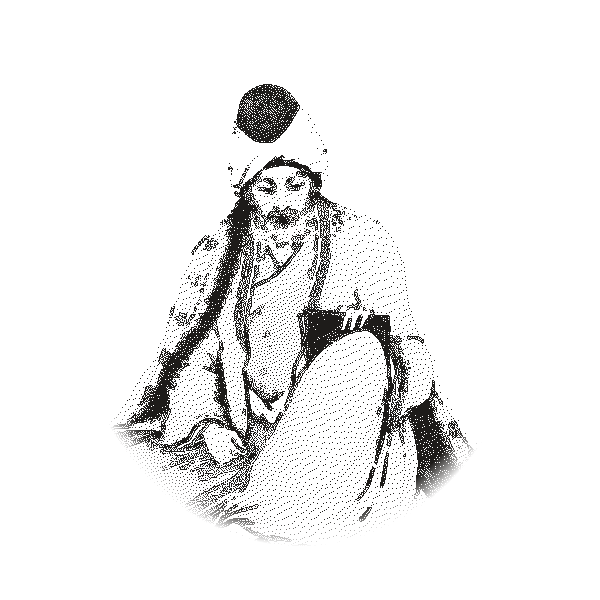
In the crowded bazaar of Konya in central Anatolia, on a crisp autumn day in late November 1244, a respected thirty-seven-year-old Islamic jurist, theologian, and madrasa professor was riding through the street on a mule, surrounded by respectful students and admirers. Jalal al-Din Muhammad Rumi was the ultimate embodiment of religious orthodoxy: the son of a celebrated Islamic scholar who had fled the Mongol invasions of Central Asia, trained in Islamic jurisprudence in Aleppo and Damascus, delivering Friday sermons in the great mosques of the Seljuk Sultanate of Rum. Then, out of the crowd stepped a sixty-year-old wandering dervish in a coarse black felt cloak, his beard wild, his eyes burning with unsettling intensity. It was Shams of Tabriz.
Shams seized the bridle of Rumi's mule and asked a riddle that struck Rumi like a bolt of lightning: 'Who was greater: the Prophet Muhammad, or the mystic Bayazid Bastami? For Bayazid said, 'Glory be to me, how great is my majesty!' while the Prophet said, 'We have not known You as You ought to be known.'' Rumi looked at the beggar and understood: Bayazid's vessel was small, so a single sip of divine wine overflowed his cup in ecstatic arrogance; but Muhammad's vessel was infinite, an ocean that drank the universe and still cried out for more. In that instant of spiritual recognition, Rumi fell from his mule into the arms of the wanderer.
The encounter with Shams shattered Rumi's orthodox identity. The sober jurist who had spent decades parsing grammar, legal rulings, and religious dogmas was consumed by a volcanic fire of ecstatic love (Ishq). For months, Rumi and Shams locked themselves in a private chamber, engaged in sohbat—mystical communion—ignoring students, family, and religious duties. When Rumi's jealous disciples drove Shams out of Konya, Rumi plunged into inconsolable grief; and when Shams was murdered in the shadows of the city in 1248, Rumi's agony transformed into pure, spontaneous poetry. He began to whirl around a wooden pillar in his garden, weeping, chanting, while scribes scrambled to write down the torrent of Persian verses that poured from his lips.
Rumi had discovered that grief and longing are not pathological afflictions to be numbed or medicated; they are the catalytic alchemy of the soul. The ego-self (nafs) is a calcified wall of vanity, fear, and intellectual certainty. It cannot be dismantled by logical arguments alone; it must be shattered by love. In one of his most celebrated verses, he wrote: 'The wound is the place where the Light enters you.' The pain of separation from the divine source is itself the evidence of the connection: the longing is the return.
Out of this ecstatic fire came the Masnavi-ye Ma'navi—the Spiritual Couplets: twenty-five thousand rhyming couplets spanning six books, widely revered across the Persian-speaking world as the 'Koran in Persian.' The work opens not with a theological decree, but with the haunting voice of an instrument carved from marsh grass: the reed flute (ney): 'Listen to the reed flute, how it tells its tale, complaining of its separation: Ever since they cut me from the reed-bed, my lament has caused men and women to weep... Everyone who is left far from his source longs for the time when he was united with it.'
The reed flute is the human soul. Plucked from the eternal divine wetland, hollowed out by suffering, pierced with finger-holes by the cosmic artisan, it cannot help but sing a song of longing whenever the divine breath blows through its hollow interior. In the Masnavi, Rumi wove together folk tales, street jokes, Qur'anic parables, legal anecdotes, and sublime mystical metaphysics into a seamless psychological tapestry. He mapped the transformation of the soul through five evolutionary stages: mineral, plant, animal, human, and divine: 'I died as a mineral and became a plant, I died as plant and rose to animal, I died as animal and I was Man. Why should I fear? When was I less by dying?'
To embody this cosmic ecstasy in physical space, Rumi founded the Mevlevi Order and ritualized the Sema—the sacred whirling dance. Dressed in white robes representing the shroud of the ego, wearing tall camel-hair felt hats representing the tombstone of the self, and shedding black cloaks representing worldly attachments, the dervishes spin upon their left foot like planets orbiting the sun. With the right hand turned upward toward heaven to receive divine grace, and the left hand turned downward toward the earth to distribute that grace to all living beings, the dancer becomes a hollow axis connecting the cosmos.
On December 17, 1273, as Rumi lay dying in Konya, he forbade his followers to mourn him with tears or funerary laments. He named the night of his death Sheb-i Arus—the Wedding Night: the long-awaited moment when the drop of water dissolves into the ocean, when the solitary soul is embraced in the eternal beloved. When his funeral procession moved through the streets of Konya, Muslims, Christians, Jews, and Greeks walked together weeping, each singing their own sacred scriptures, because Rumi had spoken a language that transcended the walls of dogma: 'Come, come, whoever you are. Wanderer, worshiper, lover of leaving. It doesn't matter. Ours is not a caravan of despair.'
Today, Jalal al-Din Muhammad Rumi is celebrated as the best-selling poet in the English-speaking world, as well as the spiritual compass of the Islamic east. While pop-culture translations often strip his poetry of its deep Islamic roots to sell greeting-card romance, the true Rumi remains a fierce, demanding spiritual titan.
He proved that religion without love is a dead skeleton of rules, and that the ultimate purpose of human existence is not the preservation of the fragile ego, but its ecstatic dissolution into the ocean of divine compassion. Rumi gave humanity a voice for the deepest ache of the soul, proving that within our deepest wound lies the doorway to the infinite.
“The wound is the place where the Light enters you.”
“You are not a drop in the ocean. You are the entire ocean in a drop.”
“Stop acting so small. You are the universe in ecstatic motion.”
“Silence is the language of God, all else is poor translation.”
“Listen to the reed flute, how it tells its tale, complaining of its separation.”
- Masnavi-ye Ma'navi (Spiritual Couplets, 6 Books) 1258-1273
- Divan-e Shams-e Tabrizi (The Great Divan) 1247-1273
- Fihi Ma Fihi (It Is What It Is / Discourses) c. 1260
- Majales-e Sab'a (Seven Sessions) c. 1250
- Makatib (The Letters) c. 1260