Thomas Edison
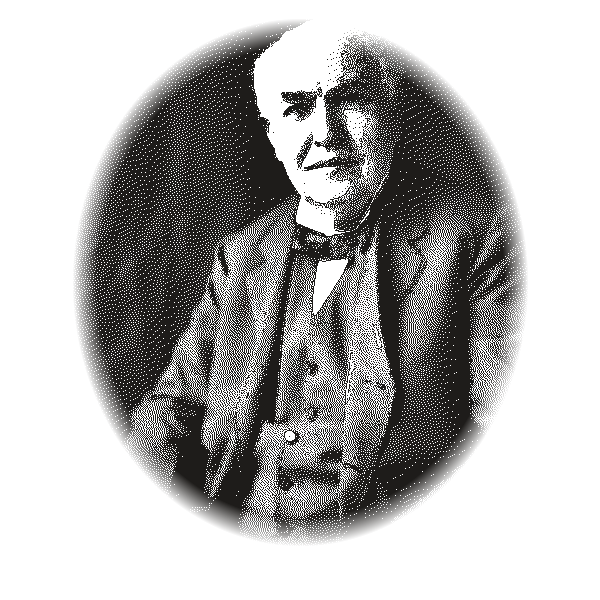
In the bitter, snowbound winter of 1876, in the rural hamlet of Menlo Park, New Jersey, twenty-five miles south of New York City, a twenty-nine-year-old telegraph operator built a long, two-story clapboard wooden building surrounded by quiet apple orchards. Thomas Alva Edison did not call it an academy, an institute, or a university. He called it an invention factory. He promised the financial world that his team of machinists, glassblowers, chemists, and mathematicians would deliver 'a minor invention every ten days and a big thing every six months or so.' Up to that moment, invention in the West had been a solitary, haphazard romantic myth: the eccentric genius starving in an attic, struck by an unpredictable lightning bolt of divine inspiration.
Edison industrialized the lightning bolt. At Menlo Park, he created the world's first modern industrial research and development laboratory. He understood that invention was not a solitary art, but a coordinated engineering discipline. He gathered precision lathes, chemical reagents, galvanometers, vacuum pumps, and a library of scientific journals under a single roof, surrounding himself with brilliant technical specialists—including the English mathematician Francis Upton and the Swiss machinist John Kruesi. Edison functioned as the grand orchestrator: deaf since childhood, sleeping barely four hours a night on laboratory tables, driven by an insatiable, ferocious energy that treated failure as a routine statistical byproduct of exhaustive search.
In late 1877, this organized machine produced the invention that shocked the nineteenth century: the phonograph. While trying to record telephone messages on embossed paper tape, Edison realized that sound was nothing more than mechanical vibrations of air. He attached a steel stylus to a vibrating mica diaphragm and pressed it against a grooved cylinder wrapped in tin foil, while hand-cranking the axle and shouting the nursery rhyme 'Mary had a little lamb.' When he rewound the cylinder and turned the crank again, the tin foil pushed the stylus, vibrating the diaphragm to reproduce his voice back into the room. For the first time in human history, the ephemeral human voice was decoupled from the living throat and frozen into a physical groove.
Yet his true magnum opus was not a single device; it was an entire technological infrastructure. When Edison turned his attention to electric illumination in 1878, dozens of inventors had already produced glowing incandescent wires in laboratories; but their filaments burned out in minutes, or drew so much current that an electrical distribution network would require copper cables as thick as tree trunks. Edison did not merely seek to invent a light bulb; he set out to replace the entire municipal gas lighting industry. He recognized that to make incandescent lighting commercially viable, the lamp had to possess high electrical resistance: by Ohm's and Joule's laws, high resistance meant low current ($I = V/R$), which allowed power to be transmitted over miles of thin, economical copper wires ($P_{\text{loss}} = I^2 R$).
To find a filament that could endure high temperatures in a high vacuum without disintegrating, Edison launched the most legendary empirical brute-force campaign in the history of science. His laboratory tested over six thousand organic materials: platinum, spider webs, boxwood, coconut hair, fish line, and beard hair. Finally, in October 1879, a carbonized cotton sewing thread burned continuously for forty-five hours in an evacuated glass bulb. Edison sent researchers to Japan, the Amazon, and India to collect exotic vegetable fibers, ultimately settling on carbonized Japanese bamboo, which could burn for over twelve hundred hours.
Simultaneously, Edison engineered the rest of the ecosystem from scratch: the jumbo bipolar dynamo generators, the underground conduit pipes, the safety fuses, the screw-base lamp socket (still universal today as the E26/E27 Edison screw), and the parallel circuit distribution architecture that allowed individual lamps to be turned on and off independently without blacking out the entire neighborhood. On September 4, 1882, Edison threw the master switch at the Pearl Street Station in lower Manhattan, illuminating four hundred electric lamps across Wall Street. Modern electrification was born.
Yet his ferocious, pragmatic stubbornness had a dark side. In the late 1880s, when George Westinghouse and Nikola Tesla demonstrated that High-Voltage Alternating Current (AC) could transmit electricity over hundreds of miles via transformers, rendering Edison's Low-Voltage Direct Current (DC) obsolete for long-distance power grids, Edison refused to yield. Trapped by his heavy capital investments in DC infrastructure, he waged the brutal 'War of the Currents.' In a desperate public relations campaign, Edison attempted to brand AC as lethal, staging gruesome public electrocutions of stray dogs, horses, and eventually an elephant named Topsy, and covertly helping finance the world's first electric chair using a Westinghouse AC generator.
It was a battle he could not win against the laws of physics: DC lines suffered massive resistive losses over distances greater than a mile, requiring central stations every few blocks. By 1892, his financial backers, led by J.P. Morgan, merged Edison General Electric with the Thomson-Houston Company to form General Electric, quietly dropping Edison's name from the corporate masthead and adopting alternating current.
Undeterred by the defeat, Edison moved his industrial laboratory to West Orange, New Jersey, scaling his R&D empire to thirty buildings and thousands of employees. He invented the Kinetograph and Kinetoscope, establishing the global motion picture industry, commercialized alkaline storage batteries for electric vehicles, and invested millions in automated magnetic iron ore milling. Holding a record 1,093 U.S. patents at his death, he remained working at his desk into his eighties.
When Thomas Alva Edison died in West Orange in October 1931 at the age of eighty-four, President Herbert Hoover asked the nation to dim their electric lights for one minute in his honor. From the Golden Gate Bridge to Broadway, America went dark, paying silent tribute to the man who had banished the night.
Today, Thomas Edison is remembered not merely for the light bulb, the phonograph, or the movie camera, but as the supreme architect of modern corporate R&D. He proved that technological breakthrough is not an accidental miracle, but an organized industrial process: a disciplined, relentless mobilization of human labor, physical science, and capital designed to transform human civilization.
“Genius is one percent inspiration, ninety-nine percent perspiration.”
“I have not failed. I've just found 10,000 ways that won't work.”
“Our greatest weakness lies in giving up. The most certain way to succeed is always to try just one more time.”
“To invent, you need a good imagination and a pile of junk.”
“I find out what the world needs. Then I go ahead and try to invent it.”
- Automatic Telegraphy Patents 1870-1875
- Quadruplex Telegraph (US Patent 474,230) 1874
- Phonograph (US Patent 200,521) 1878
- Electric Lamp and Lighting System (US Patent 223,898) 1880
- Pearl Street Central Power Station (New York City) 1882
- Kinetograph and Kinetoscope (Motion Pictures) 1891