Michael Faraday
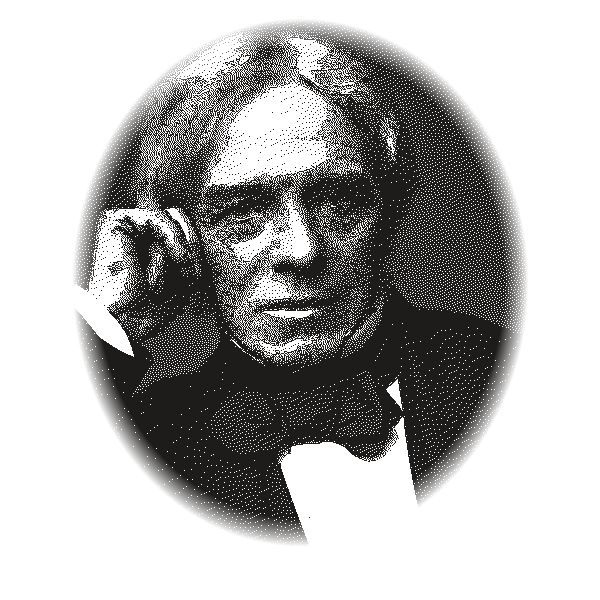
In the basement laboratory of the Royal Institution on Albemarle Street in London, an apprentice bookbinder with virtually no formal education in differential calculus stood before a wooden ring wrapped in coiled copper wire and saw what the finest continental mathematicians were blind to. It was August 1831. For decades, natural philosophers had treated electricity and magnetism as Newtonian forces: instantaneous actions-at-a-distance acting across inert, empty space between localized points of matter, obeying neat inverse-square laws. Michael Faraday looked at a battery, a magnet, and a coil of wire and saw no empty space at all. He saw space as a plenum, curved, tensed, and pulsing with physical vitality. When he closed the electrical circuit in his primary coil, the galvanometer attached to the secondary coil twitched—not while the current flowed steadily, but only at the instant of connection and the instant of rupture.
In that fleeting twitch of an iron needle, electromagnetic induction was discovered. Faraday did not grasp nature through algebraic symbols; he grasped it through spatial, kinetic, and physical intuition. He asked a question that no Newtonian had thought to pose: where does the magnetic force reside during the interval between emission and reception? His answer was radical: the force resides in the space itself. Space was traversed by continuous, physical 'lines of force'—tensed, elastic threads that resisted lateral crowding and sought to contract along their length. A magnet was not an isolated object radiating hypothetical mathematical vectors; it was the nexus of a dynamic, looped field of energy that filled the surrounding air, water, and vacuum.
This visual and mechanical conception of lines of force transformed the understanding of nature from an ontology of isolated particles to an ontology of continuous fields. When Faraday sprinkled fine iron filings onto a sheet of paper held above a bar magnet and tapped the paper gently, the filings did not arrange themselves in chaotic heaps. They aligned along sweeping, parabolic arcs, mapping the invisible skeletal architecture of the magnetic field with breathtaking clarity. For Faraday, these curves were not mathematical fictions or explanatory metaphors; they were real, physical entities, capable of tension, vibration, and propagation.
To prove that the medium itself participates directly in electromagnetic phenomena, Faraday conducted a legendary sequence of experiments. He constructed an enormous twelve-foot cube covered in copper foil—the Faraday cage—entered it with sensitive electroscopes, and charged the exterior with thousands of volts of static electricity until sparks leaped from the corners into the surrounding room. Inside the cage, the air remained completely neutral; the electroscope showed zero deflection. The electric force did not penetrate the interior because the mobile electrons in the conductive copper reordered themselves along lines of induction, shielding the internal cavity. Space, matter, and electrical charge were an interconnected continuum.
In the laboratory, his manual dexterity was matched by an uncompromising experimental discipline. Faraday isolated benzene from illuminating gas, liquified chlorine and carbon dioxide under immense pressure, and formulated the fundamental quantitative laws of electrochemistry. He showed that the mass of a substance altered at an electrode during electrolysis is directly proportional to the quantity of electricity transferred, and that the masses of different elements liberated by the same current are proportional to their chemical equivalent weights. Without ever seeing an electron or an ion, Faraday had discovered that electricity, like matter, possesses a discrete, particulate atomicity.
Yet his most daring metaphysical intuition occurred in September 1845. Convinced of the unity of all natural forces, he set out to prove that light itself is linked to electromagnetism. For decades, physicists had treated optics as a separate domain governed by the luminiferous aether. Faraday placed a piece of heavy borosilicate glass between the poles of an immense electromagnet and passed a beam of plane-polarized light through it. When the magnet was energized, the plane of polarization of the light beam rotated. It was the Faraday Effect—the first definitive experimental proof that light and electromagnetism are intimately coupled, and that magnetism can act upon the photons of the electromagnetic spectrum.
Continental theorists, accustomed to the elegant mathematical formalisms of Laplace, Poisson, and Ampère, initially dismissed Faraday's lines of force as the primitive, qualitative visualizations of an untrained tradesman who could not write a proper partial differential equation. They could not understand how a man who had never mastered trigonometry could presume to rewrite fundamental mechanics. Faraday felt his mathematical inadequacy keenly, confessing in private letters his longing for someone who could translate his spatial visions into the rigorous language of analysis.
In 1855, that translator arrived in the person of a brilliant young Scotsman named James Clerk Maxwell. Reading Faraday's Experimental Researches in Electricity, Maxwell realized that Faraday's lines of force were not crude metaphors, but a profound, mathematically precise geometry of continuous vector fields. Maxwell took Faraday's physical lines, converted them into equations of curl, divergence, and displacement current, and discovered that electromagnetic waves propagate across space at precisely the speed of light. Faraday had supplied the physical architecture; Maxwell provided the mathematical proof.
In his final years, Faraday's memory deteriorated, and he declined the presidency of the Royal Society, refusing knighthood and state honors, choosing to remain 'plain Michael Faraday' in accordance with his quiet, devout Sandemanian Christian faith. When asked upon his deathbed what his speculations on the afterlife were, he replied with characteristic empirical austerity: 'Speculations? I have none. I am resting on certainties.'
Today, the entire energetic fabric of modern civilization—every electric generator spinning inside a hydroelectric dam, every electric motor driving an electric vehicle, every transformer stepping down voltage along transmission grids, and every radio wave traversing the cosmos—traces its lineage directly to the wooden ring and copper coils Faraday wound by hand in 1831. He banished action-at-a-distance from physics, replaced empty space with the dynamic concept of the field, and proved that the humble eye, when guided by patient, severe experimental integrity, can see the invisible architecture that holds the material universe in its embrace.
“Nothing is too wonderful to be true if it be consistent with the laws of nature.”
“Work. Finish. Publish.”
“I cannot conceive curved lines of force without the conditions of a physical existence in that intermediate space.”
“Speculations? I have none. I am resting on certainties.”
“The world little knows how many of the thoughts and theories which have passed through the mind of a scientific investigator have been crushed in silence and secrecy by his own severe criticism and adverse examination.”
- Experimental Researches in Electricity (Series 1-29) 1831-1855
- On the Physical Character of the Lines of Magnetic Force 1852
- Chemical Manipulation 1827
- Experimental Researches in Chemistry and Physics 1859
- The Chemical History of a Candle 1861